


Promotion of healthy eating through public policy: a controlled experiment
- PMID: 23790988
- PMCID: PMC3696184
- DOI: 10.1016/j.amepre.2013.02.023
Promotion of healthy eating through public policy: a controlled experiment
Abstract
Background: To induce consumers to purchase healthier foods and beverages, some policymakers have suggested special taxes or labels on unhealthy products. The potential of such policies is unknown.
Purpose: In a controlled field experiment, researchers tested whether consumers were more likely to purchase healthy products under such policies.
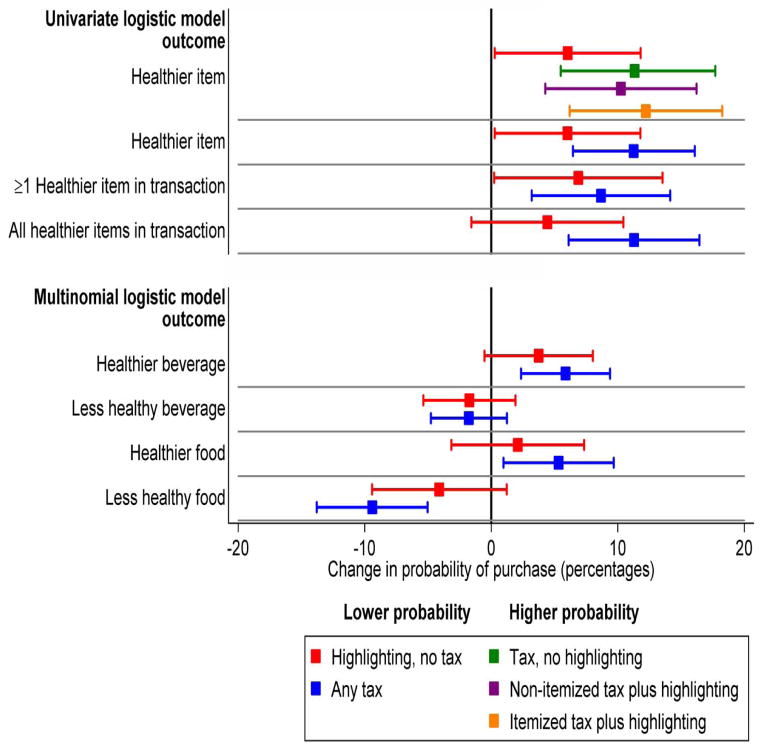
Methods: From October to December 2011, researchers opened a store at a large hospital that sold a variety of healthier and less-healthy foods and beverages. Purchases (N=3680) were analyzed under five conditions: a baseline with no special labeling or taxation, a 30% tax, highlighting the phrase "less healthy" on the price tag, and combinations of taxation and labeling. Purchases were analyzed in January-July 2012, at the single-item and transaction levels.
Results: There was no significant difference between the various taxation conditions. Consumers were 11 percentage points more likely to purchase a healthier item under a 30% tax (95% CI=7%, 16%, p<0.001) and 6 percentage points more likely under labeling (95% CI=0%, 12%, p=0.04). By product type, consumers switched away from the purchase of less-healthy food under taxation (9 percentage point decrease, p<0.001) and into healthier beverages (6 percentage point increase, p=0.001); there were no effects for labeling. Conditions were associated with the purchase of 11-14 fewer calories (9%-11% in relative terms) and 2 fewer grams of sugar. Results remained significant controlling for all items purchased in a single transaction.
Conclusions: Taxation may induce consumers to purchase healthier foods and beverages. However, it is unclear whether the 15%-20% tax rates proposed in public policy discussions would be more effective than labeling products as less healthy.
Copyright © 2013 American Journal of Preventive Medicine.
Figures
References
-
- Glickman D, Parker L, Sim L, Cook H, Miller E. Accelerating progress in obesity prevention: solving the weight of the nation. Washington, D.C: The National Academies Press; 2012. - PubMed
-
- Elbel B, Kersh R, Brescoll V, Dixon L. Calorie labeling and food choices: a first look at the effects on low-income people in New York City. Health Aff. 2009;28(6):w1110–21. - PubMed
Publication types
MeSH terms
Grants and funding
LinkOut - more resources
Full Text Sources
Other Literature Sources
