


Neuropsychological functioning predicts community outcomes in affective and non-affective psychoses: a 6-month follow-up
- PMID: 23791391
- PMCID: PMC3751391
- DOI: 10.1016/j.schres.2013.05.012
Neuropsychological functioning predicts community outcomes in affective and non-affective psychoses: a 6-month follow-up
Abstract
Introduction: Neurocognitive dysfunction is a major symptom feature of schizophrenia and bipolar disorder. A prognostic relationship between cognition and community outcomes is well-documented in schizophrenia and increasingly recognized in bipolar disorder. However, specific associations among neurocognition, diagnosis, state symptomatology, and community functioning are unclear, and few studies have compared these relationships among patients with affective and non-affective psychoses in the same study. We examined neurocognitive, clinical, and community functioning in a cross-diagnostic sample of patients with psychotic disorders over a 6-month follow-up interval.
Method: Neurocognitive, clinical and community functioning were assessed in participants with schizophrenia (n=13), schizoaffective disorder (n=17), or bipolar disorder with psychosis (n=18), and healthy controls (n=18) at baseline and 6months later.
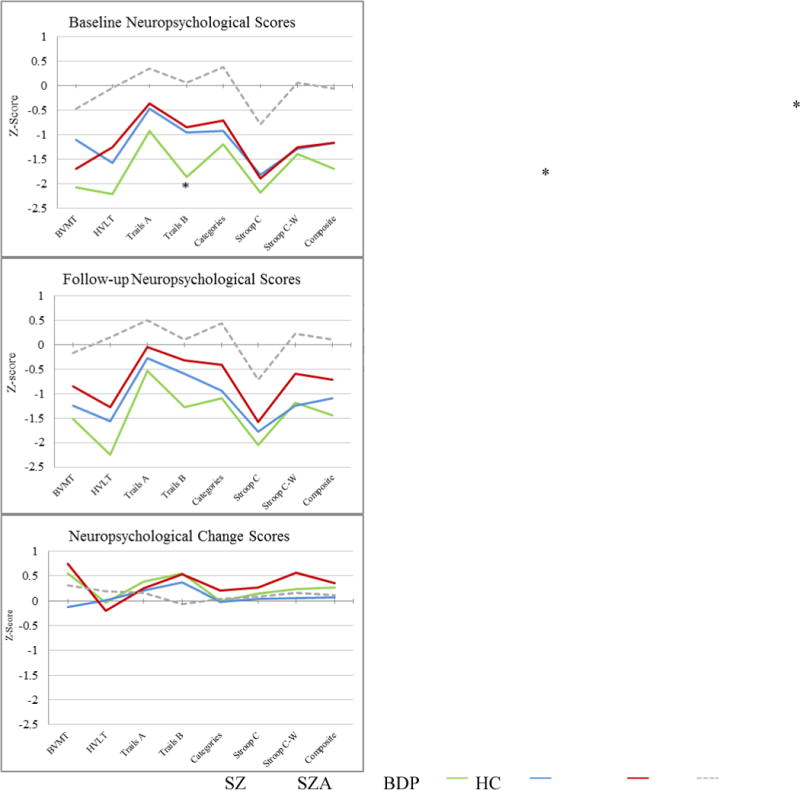
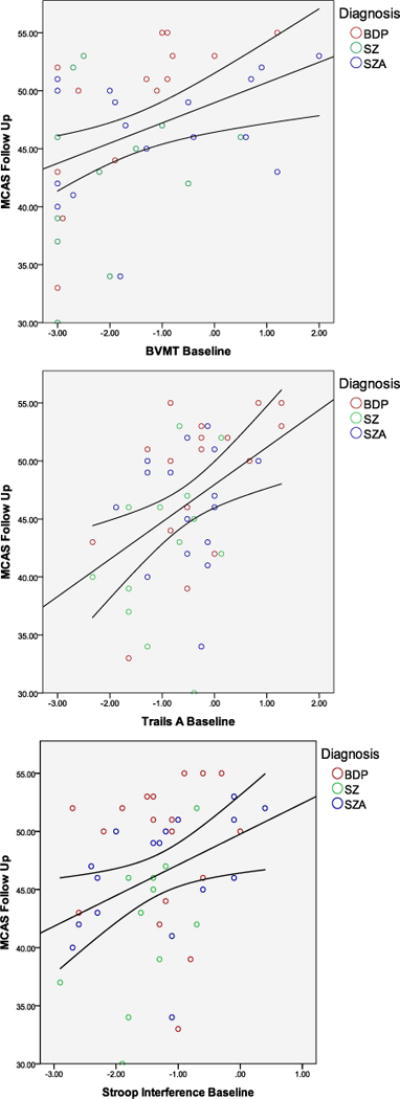
Results: Neurocognitive functioning was impaired in all diagnostic groups and, despite reductions in primary symptoms, did not recover on most measures over the follow-up period. Neurocognitive impairment was not associated with diagnosis or clinical improvement. Several neurocognitive scores at baseline (but not diagnosis or clinical baseline or follow-up scores) predicted community functioning at follow-up.
Discussion: In one of the few studies to longitudinally examine neurocognition in association with clinical and outcomes variables in a cross diagnostic sample of psychotic disorders patients, neurocognitive deficits were pronounced across diagnoses and did not recover on most measures despite significant reductions in clinical symptoms. Baseline neurocognitive functioning was the only significant predictor of patients' community functioning six months later. Efforts to recognize and address cognitive deficits, an approach that has shown promise in schizophrenia, should be extended to all patients with psychosis.
Keywords: Bipolar; Comparative; Longitudinal; Neurocognitive; Schizoaffective; Schizophrenia.
Copyright © 2013 Elsevier B.V. All rights reserved.
Conflict of interest statement
Kathryn Lewandowski is a paid consultant with Clintara; Matcheri Keshavan has received a grant from GlaxoSmithKline and Sunovion; Dost Ongur is currently on a research contract with Rules Based Medicine, Inc. The authors declare that they have no other disclosures of conflicts of interest in connection with the present work.
Figures
References
-
- Altshuler LL, Ventura J, van Gorp WG, Green MF, Theberge DC, Mintz J. Neurocognitive function in clinically stable men with bipolar I disorder or schizophrenia and normal control subjects. Biol Psychiatry. 2004;56:560–569. - PubMed
-
- Balanza-Martinez V, Tabares-Seisdedos R, Selva-Vera G, Martinez-Aran A, Torrent C, Salazar-Fraile J, Leal-Cercos C, Vieta E, Gomez-Beneyto M. Persistent cognitive dysfunctions in bipolar I disorder and schizophrenic patients: a 3-year follow-up study. Psychother Psychosom. 2005;74:113–119. - PubMed
-
- Baldessarini RJ. Chemotherapy in Psychiatry. Springer Verlag; New York: 2012.
-
- Denicoff KD, Ali SO, Mirsky AF, Smith-Jackson EE, Leverich GS, Duncan CC, Connell EG, Post RM. Relationship between prior course of illness and neuropsychological functioning in patients with bipolar disorder. J Affect Disord. 1999;56:67–73. - PubMed
Publication types
MeSH terms
Grants and funding
LinkOut - more resources
Full Text Sources
Other Literature Sources
Medical
