Review
. 2013 Oct;86(3):121-5.
doi: 10.1016/j.diff.2013.02.005. Epub 2013 Jun 21.

Collective migration and cell jamming

Affiliations
Review

Collective migration and cell jamming

Monirosadat Sadati et al. Differentiation. 2013 Oct.

Abstract

Our traditional physical picture holds with the intuitive notion that each individual cell comprising the cellular collective senses signals or gradients and then mobilizes physical forces in response. Those forces, in turn, drive local cellular motions from which collective cellular migrations emerge. Although it does not account for spontaneous noisy fluctuations that can be quite large, the tacit assumption has been one of linear causality in which systematic local motions, on average, are the shadow of local forces, and these local forces are the shadow of the local signals. New lines of evidence now suggest a rather different physical picture in which dominant mechanical events may not be local, the cascade of mechanical causality may be not so linear, and, surprisingly, the fluctuations may not be noise as much as they are an essential feature of mechanism. Here we argue for a novel synthesis in which fluctuations and non-local cooperative events that typify the cellular collective might be illuminated by the unifying concept of cell jamming. Jamming has the potential to pull together diverse factors that are already known to contribute but previously had been considered for the most part as acting separately and independently. These include cellular crowding, intercellular force transmission, cadherin-dependent cell-cell adhesion, integrin-dependent cell-substrate adhesion, myosin-dependent motile force and contractility, actin-dependent deformability, proliferation, compression and stretch.

Keywords: Cooperativity; Glass transition; Heterogeneity; Kinetic arrest.


Figures

Fig. 1
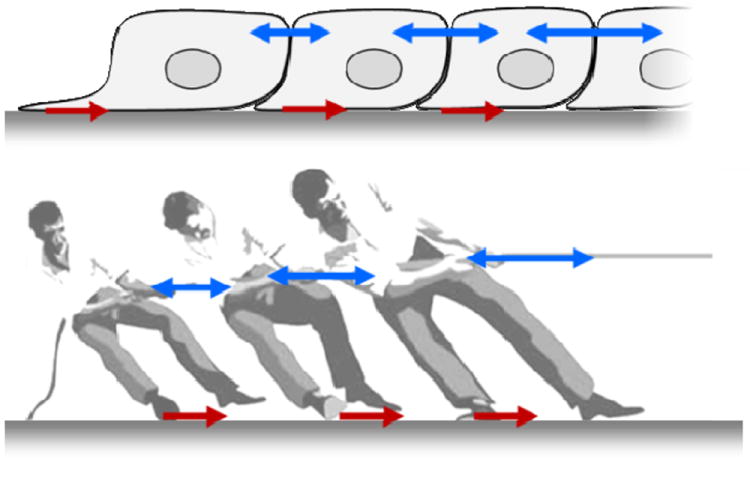
Fig. 1. Cells use a tug–of–war mechanism to integrate local tractions (red) into long-range gradients of intra- and inter-cellular tension (blue)
Tension in the monolayer reflects the spatial accumulation, or pile-up of traction forces. Equivalently, the local traction force is the spatial derivative of the intercellular stress. Reprinted with permission from
Fig 2
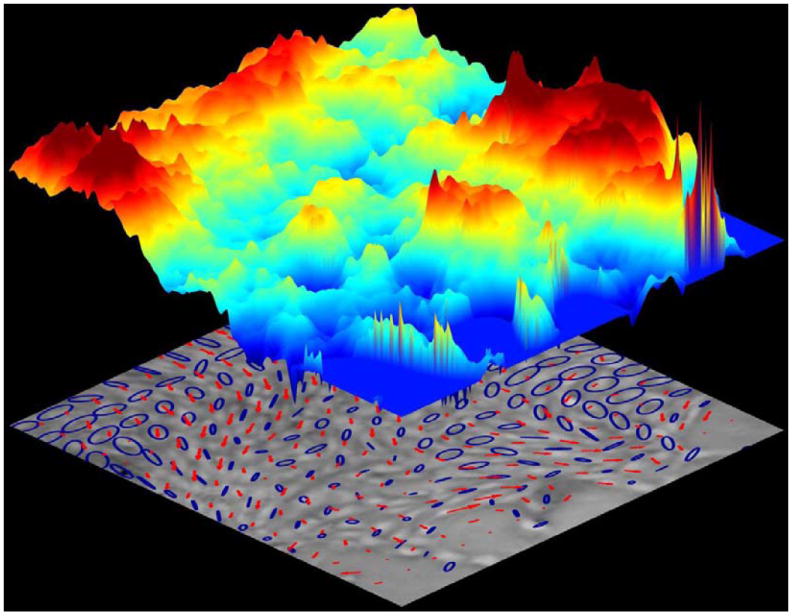
Fig 2. Malleable cells trek a rugged stress landscape and make for a resilient monolayer
Cellular migrations (red arrows) follow stress orientations (blue ellipses) over a rugged stress landscape (colored topography denotes local tensile stress; scale bar units: Pa). Cell navigation on this scale– plithotaxis– is innately collective, strongly cooperative, and dynamically glassy. Reprinted with permission from
Fig. 3
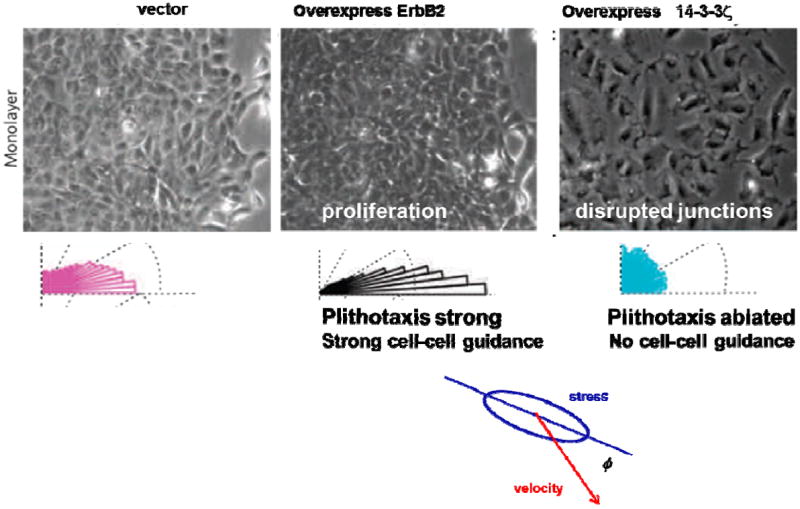
Fig. 3. Stress maps and migration in monolayers of breast-cancer model systems
Phase contrast image of nontransformed human mammary epithelial cell line, MCF10A, control or vector, cells overexpressing ErbB2, and 14-3-3ζ. The angle ϕ defines the orientation between the maximal principle stress and the migration velocity. In each case, the histogram of ϕ is plotted as a rose of directions. Adapted with permission from .
Fig. 4
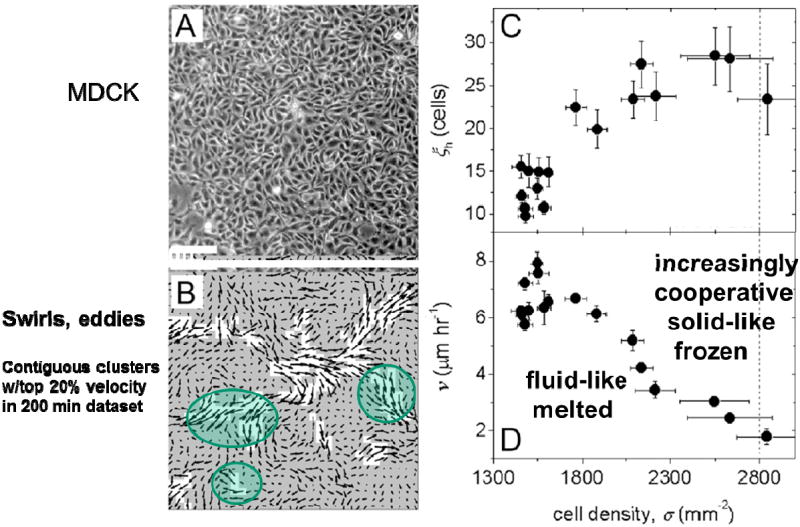
Fig. 4. MDCK cells within a confluent monolayer migrate in a spatially heterogeneous manner (A, B)
The average area of contiguous regions of the fastest velocity vectors defines ξh, the area of dynamic heterogeneities (B, white regions). As cell density rises, ξh grows from an area of about 10 cell bodies to 30 cell bodies (C, inset: ξh in μm2). The average migration speed of cells within the entire field of view, ν, decreases with increasing cell density (D). (Scale bar, 100μm.). Reprinted with permission from
Fig. 5
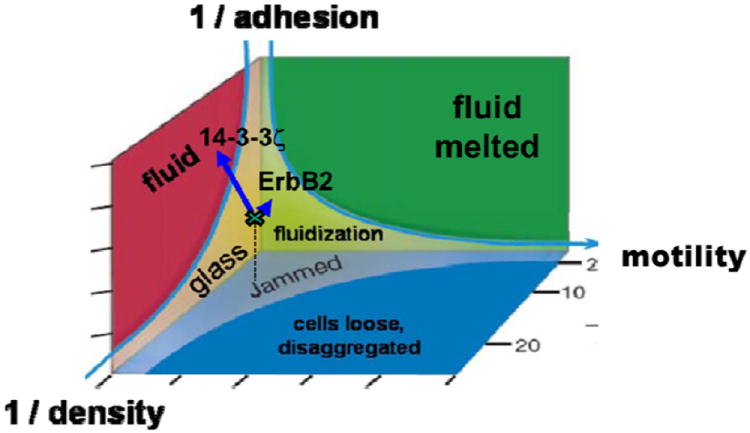
Fig. 5. Hypothetical jamming phase diagram for the cellular monolayer
As cells express more mutual crowding, more mutual adhesion, or less myosin-dependent motile force, associated coordinates in phase space move progressively closer to the origin and the monolayer state becomes increasingly jammed. Transition toward a jammed state and resulting glassy dynamics is depicted by the hypothetical shaded surface. Arrow-heads depict the migration speed and migration direction of individual cells. Colors depict cell clusters (packs) that move collectively. Vector: Cells in the control state (MCF10A-vector) exist close to but just outside the jamming transition, where cells move in packs that become progressively larger and slower as the jamming transition is approached. ,, Local orientation of cell migration correspond closely to the local orientation of maximal principal stress (not shown); this mechanism of cell collective guidance is called plithotaxis., Overexpression of oncogene ErbB2: As cells proliferate and crowd more densely, cell packs become progressively larger and slower, and plithotaxis becomes amplified. Overexpression of oncogene 14-3-3ζ: As cell-cell junctions lose cadherin-dependent adhesion, the monolayer becomes fluidized and unjammed. Collectivity is lost and plithotaxis is ablated. Adapted from ,

References

    1. Friedl P, Alexander S. Cancer invasion and the microenvironment: plasticity and reciprocity. Cell. 2011;147:992–1009. - PubMed
    1. Friedl P, Gilmour D. Collective cell migration in morphogenesis, regeneration and cancer. Nat Rev Mol Cell Biol. 2009;10:445–57. - PubMed
    1. Weber G, Bjerke M, DeSimone D. A Mechanoresponsive Cadherin-Keratin Complex Directs Polarized Protrusive Behavior and Collective Cell Migration. Developmental Cell. 2012 - PMC - PubMed
    1. Editors. News Focus: Mysteries of the Cell. Science. 2011;334:1046–51. - PubMed
    1. Discher D, Dong C, Fredberg JJ, Guilak F, Ingber D, Janmey P, Kamm RD, Schmid-Schonbein GW, Weinbaum S. Biomechanics: cell research and applications for the next decade. Ann Biomed Eng. 2009;37:847–59. - PMC - PubMed

Publication types

LinkOut - more resources