. 2013 Jul 8;23(13):1181-94.
doi: 10.1016/j.cub.2013.05.014. Epub 2013 Jun 20.

Polarity-dependent distribution of angiomotin localizes Hippo signaling in preimplantation embryos

Affiliations

Polarity-dependent distribution of angiomotin localizes Hippo signaling in preimplantation embryos

Yoshikazu Hirate et al. Curr Biol. .

Abstract

Background: In preimplantation mouse embryos, the first cell fate specification to the trophectoderm or inner cell mass occurs by the early blastocyst stage. The cell fate is controlled by cell position-dependent Hippo signaling, although the mechanisms underlying position-dependent Hippo signaling are unknown.

Results: We show that a combination of cell polarity and cell-cell adhesion establishes position-dependent Hippo signaling, where the outer and inner cells are polar and nonpolar, respectively. The junction-associated proteins angiomotin (Amot) and angiomotin-like 2 (Amotl2) are essential for Hippo pathway activation and appropriate cell fate specification. In the nonpolar inner cells, Amot localizes to adherens junctions (AJs), and cell-cell adhesion activates the Hippo pathway. In the outer cells, the cell polarity sequesters Amot from basolateral AJs to apical domains, thereby suppressing Hippo signaling. The N-terminal domain of Amot is required for actin binding, Nf2/Merlin-mediated association with the E-cadherin complex, and interaction with Lats protein kinase. In AJs, S176 in the N-terminal domain of Amot is phosphorylated by Lats, which inhibits the actin-binding activity, thereby stabilizing the Amot-Lats interaction to activate the Hippo pathway.

Conclusions: We propose that the phosphorylation of S176 in Amot is a critical step for activation of the Hippo pathway in AJs and that cell polarity disconnects the Hippo pathway from cell-cell adhesion by sequestering Amot from AJs. This mechanism converts positional information into differential Hippo signaling, thereby leading to differential cell fates.


Figures

Figure 1
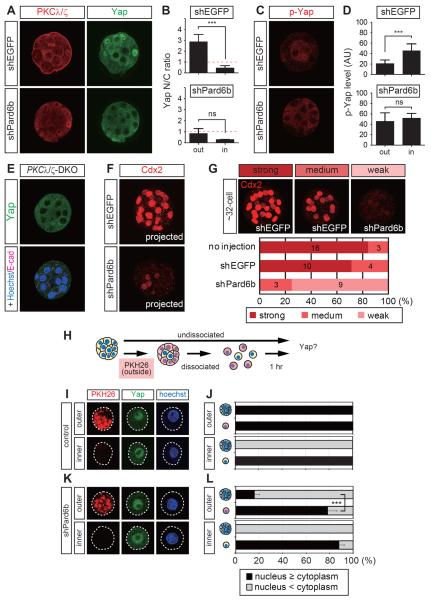
Figure 1. Combination of cell polarity and cell–cell-cell adhesion established position-dependent Hippo signaling in 32-cell stage preimplantation embryos
(A) Effects of Pard6b knockdown (KD) on the apical domain marker PKCλ/ζ and Yap. Nuclear Yap was reduced in the outer cells of Pard6b KD embryos. (B) Quantification of the ratio of nuclear (N) to cytoplasmic (C) Yap shown in A. ns, not significant. ***, P < 0.001. (C) Increase in p-Yap in the outer cells of Pard6b KD embryos. (D) Quantification of the signal intensity of p-Yap shown in C. ns, not significant. ***, P < 0.001. (E) PKCλ−/−:PKCζ−/− embryos with reduced nuclear Yap in the outer cells. (F, G) Expression of Cdx2 in 32-cell stage Pard6b KD embryos. (F) Representative Pard6b KD embryo with reduced Cdx2 expression. (G) Embryos were classified into three categories, depending on the Cdx2 expression level. A representative embryo for each category is shown in the upper panels. The numbers in the graphs indicate the numbers of embryos in each category. (H–L) Effects of cell dissociation on the Yap distribution in normal and Pard6b KD embryos. (H) Schematic representation of the cell dissociation experiments. (I, J) Distribution of Yap in dissociated control (uninjected) embryos. (K, L) Distribution of Yap in dissociated Pard6b KD embryos. (J, L) Quantification of Yap distribution. ***, P < 0.001 See Figure S1 for related data.
Figure 2
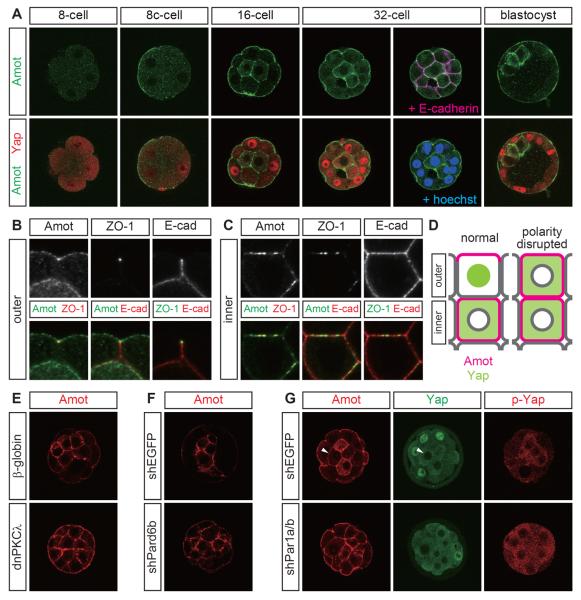
Figure 2. The junction-associated Hippo component angiomotin had different position- and polarity-dependent distributions in preimplantation embryos
(A) Correlation between the position-dependent distributions of Amot and Yap in eight cell stage embryos and blastocysts. 8c-cell: compacted eight cell stage. (B) Amot distribution in the outer cells relative to the distributions of ZO-1 and E-cadherin. Note that the ZO-1 signals in the inner cells were significantly weaker than those in the outer cells (tight junctions). Therefore, the ZO-1 signals in the inner cells are not visible in this panel. (C) Comparison of the Amot distribution in the inner cells with those of ZO-1 and E-cadherin. (D) Schematic representation showing the distributions of Amot and Yap proteins in the inner and outer cells of normal and polarity-disrupted embryos. (E) Amot distribution in PKCλ/ζ-inhibited embryos. (F) Amot distribution in Pard6b KD embryos. (G) Par1a/b DKD disrupted the Amot distribution and Hippo signaling. The arrowhead indicates an inner cell with nuclear exclusion of Yap in the absence of a clear Amot signal in the cytoplasm. Therefore, cytoplasmic Amot is probably not important for the regulation of Yap. See Figure S2 for related data.
Figure 3
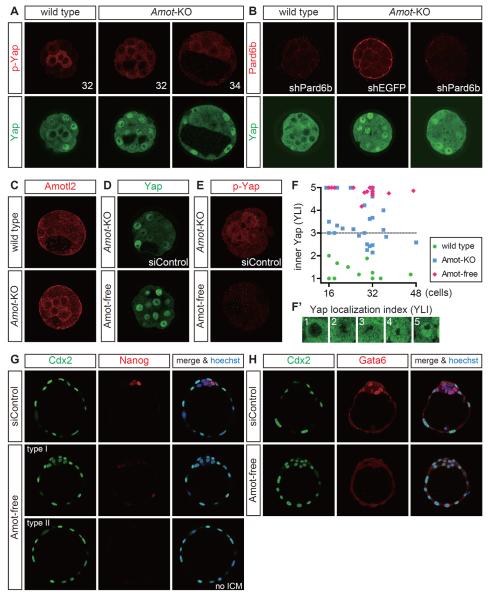
Figure 3. Amot family proteins are required for Hippo pathway activation in preimplantation embryos
(A) Distribution of Yap and p-Yap proteins in Amot mutant (Amot-KO) embryos. The numbers in the upper panels indicate the number of nuclei in the embryos shown. (B) Distribution of Yap in Pard6b KD Amot mutant embryos. (C) Distribution of Amotl2 proteins in wild-type and Amot mutant embryos. (D) Distribution of Yap in Amot mutant and Amot-free embryos. Amot-free indicates Amotl2 KD in Amot mutant embryos. (E) Distribution of p-Yap in Amot mutant and Amot-free embryos. Note that virtually no p-Yap signal was observed in Amot-free embryos. (F) Ontogenic change in the subcellular distribution of Yap in the inner cells. The subcellular distribution of Yap was determined semiquantitatively based on the Yap localization index (YLI) shown in F′. Each dot represents the mean index value of the inner cells in a single embryo. (G) Expression of Cdx2 and Nanog in Amot-free embryos at E4.5. (H) Expression of Cdx2 and Gata6 in Amot-free embryos at E4.5. See Figure S3 for related data.
Figure 4
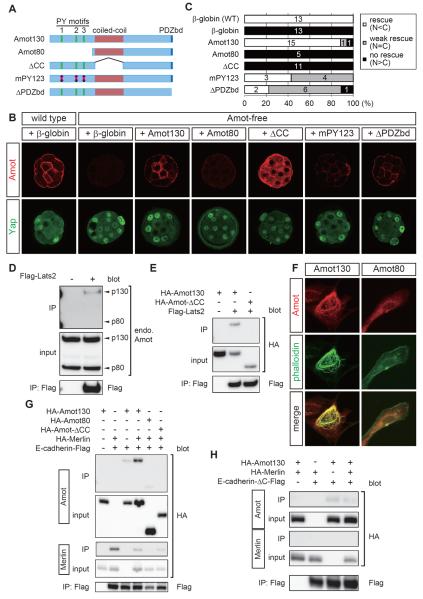
Figure 4. The N-terminal domain of Amot is required for actin polymerization, association with AJs and Lats2, and Hippo pathway activation
(A) Schematic representations of mutant Amot proteins. (B) Representative results from the rescue experiments. mRNAs encoding the proteins indicated were injected into wild-type or Amot-free embryos. The upper panels show the distributions of injected Amot proteins (except the wild-type embryos). The lower panels show the distributions of Yap proteins. (C) Graphs summarizing the rescue activities of each protein. The numbers in the graphs show the number of embryos in each category. (D) Co-immunoprecipitation experiments showing the interaction between endogenous Amot130 and Lats2. (E) Co-immunoprecipitation experiments showing the requirement for the coiled-coil domain of Amot for the interaction with Lats2. (F) F-actin polymerization and actin-binding activities of Amot proteins in NIH3T3 cells. Exogenous Amot proteins were detected using the HA-tag. (G) Co-immunoprecipitation experiments showing the interactions of Amot with E-cadherin and Merlin. Note that interaction between Merlin and E-cadherin was not enhanced by Amot. (H) Co-immunoprecipitation experiments showing the requirement for the β-catenin-binding domain of E-cadherin in the Merlin-dependent interaction with Amot. See Figure S4 for related data.
Figure 5
Figure 5. Phosphorylation of S176 in Amot by Lats activates the Hippo pathway
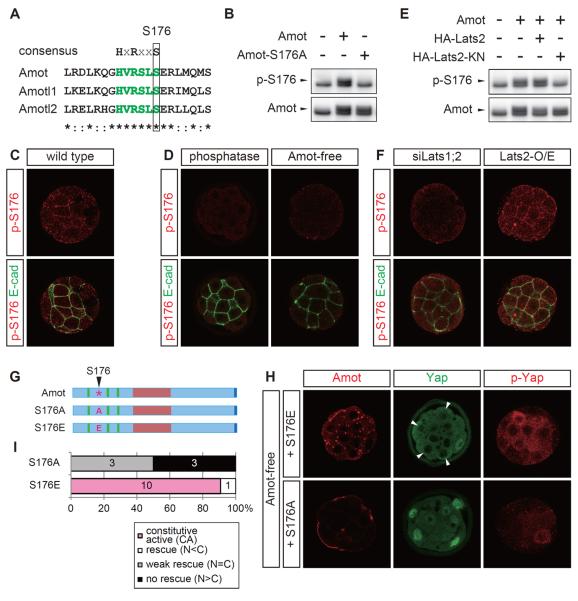
(A) Identification of the Lats phosphorylation consensus sequence in the N-terminal domain of Amot family proteins. The amino acid sequences of the mouse proteins are shown. (B) Western blot analysis showing the specificity of anti-p-S176-Amot antibody. The anti-p-S176-Amot and anti-Amot antibodies detected endogenous (lower bands) and tagged-exogenous (upper bands indicated with arrowheads) Amot proteins. (C) Localization of p-S176-Amot to AJs in the inner cells of 32-cell stage embryos. (D) Anti-p-S176-Amot antibody specifically detected phosphorylated Amot proteins. Amot-free and phosphatase-treated embryos did not exhibit signals. (E) Western blot analysis showing the Lats-dependent phosphorylation of S176-Amot. (F) Distribution of p-S176-Amot in Lats1/2 DKD and Lats2-overexpressing embryos. The efficient knockdown of Lats1/2 in Lats1/2 DKD embryos was confirmed by the nuclear accumulation of Yap in all blastomeres, which was similar to that in Lats1−/−; Lats2−/− embryos (data not shown). (G) Schematic representations of mutant Amot proteins. (H) Distribution of Amot-S176A/E, Yap, and p-Yap proteins in an Amot-free embryo. The arrowheads indicate outer cells that exhibited the clear nuclear exclusion of Yap. (I) Graphs summarizing the rescue activities of each protein. The numbers in the graphs show the number of embryos in each category.
Figure 6
Figure 6. Phosphorylation of S176 in Amot stabilizes the interaction with Lats2
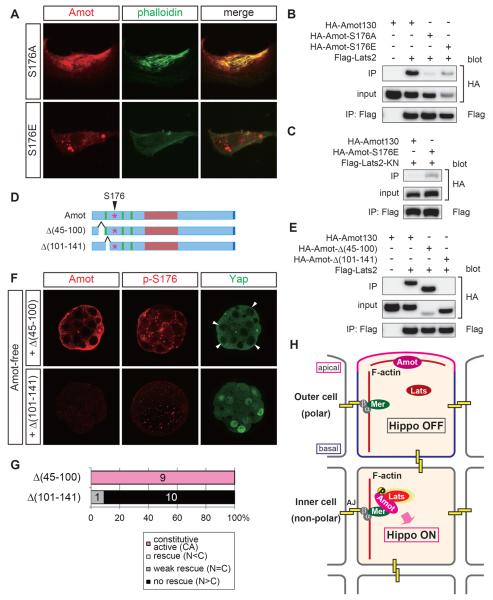
(A) The F-actin polymerization and actin-binding activities of Amot-S176A/E proteins in NIH3T3 cells. Exogenous Amot proteins were detected with the HA-tag. (B) Co-immunoprecipitation experiments showing the interaction of Amot-S176A/E with Last2. (C) Co-immunoprecipitation experiments showing the interaction of Amot-S176A/E with Lats2-KN. (D) Schematic representations of the mutant Amot proteins. (E) Co-immunoprecipitation experiments showing the interaction between Amot-Δ(45-100)/(101-141) and Lats2. (F) Distribution of Amot, p-S176-Amot, and Yap proteins in Amot-Δ(45–100)/Δ(101–141)-expressing Amot-free embryos. The arrowheads indicate outer cells that exhibited clear nuclear exclusion of Yap. (G) Graphs summarizing the rescue activities of each protein. The numbers in the graphs show the number of embryos in each category. (H) Model of Amot-regulated differential Hippo activation in preimplantation embryos. α, α-catenin; β, β-catenin; Mer, Merlin; AJ, adherens junction. See Discussion for details. See Figure S5 for related data.

Comment in

References

    1. Tarkowski AK, Wroblewska J. Development of blastomeres of mouse eggs isolated at the 4- and 8-cell stage. Journal of embryology and experimental morphology. 1967;18:155–180. - PubMed
    1. Johnson MH, Ziomek CA. The foundation of two distinct cell lineages within the mouse morula. Cell. 1981;24:71–80. - PubMed
    1. Yamanaka Y, Ralston A, Stephenson RO, Rossant J. Cell and molecular regulation of the mouse blastocyst. Dev Dyn. 2006;235:2301–2314. - PubMed
    1. Niwa H, Toyooka Y, Shimosato D, Strumpf D, Takahashi K, Yagi R, Rossant J. Interaction between Oct3/4 and Cdx2 determines trophectoderm differentiation. Cell. 2005;123:917–929. - PubMed
    1. Nishioka N, Yamamoto S, Kiyonari H, Sato H, Sawada A, Ota M, Nakao K, Sasaki H. Tead4 is required for specification of trophectoderm in pre-implantation mouse embryos. Mechanisms of development. 2008;125:270–283. - PubMed

Publication types

MeSH terms