


From never to daily smoking in 30 months: the predictive value of tobacco and non-tobacco advertising exposure
- PMID: 23794549
- PMCID: PMC3686248
- DOI: 10.1136/bmjopen-2013-002907
From never to daily smoking in 30 months: the predictive value of tobacco and non-tobacco advertising exposure
Abstract
Objective: To test the specificity of the association between tobacco advertising and youth smoking initiation.
Design: Longitudinal survey with a 30 month interval.
Setting: 21 public schools in three German states.
Participants: A total of 1320 sixth-to-eighth grade students who were never-smokers at baseline (age range at baseline, 10-15 years; mean, 12.3 years).
Exposures: Exposure to tobacco and non-tobacco advertisements was measured at baseline with images of six tobacco and eight non-tobacco advertisements; students indicated the number of times they had seen each ad and the sum score over all advertisements was used to represent inter-individual differences in the amount of advertising exposure.
Primary and secondary outcome measures: Established smoking, defined as smoked >100 cigarettes during the observational period, and daily smoking at follow-up. Secondary outcome measures were any smoking and smoking in the last 30 days.
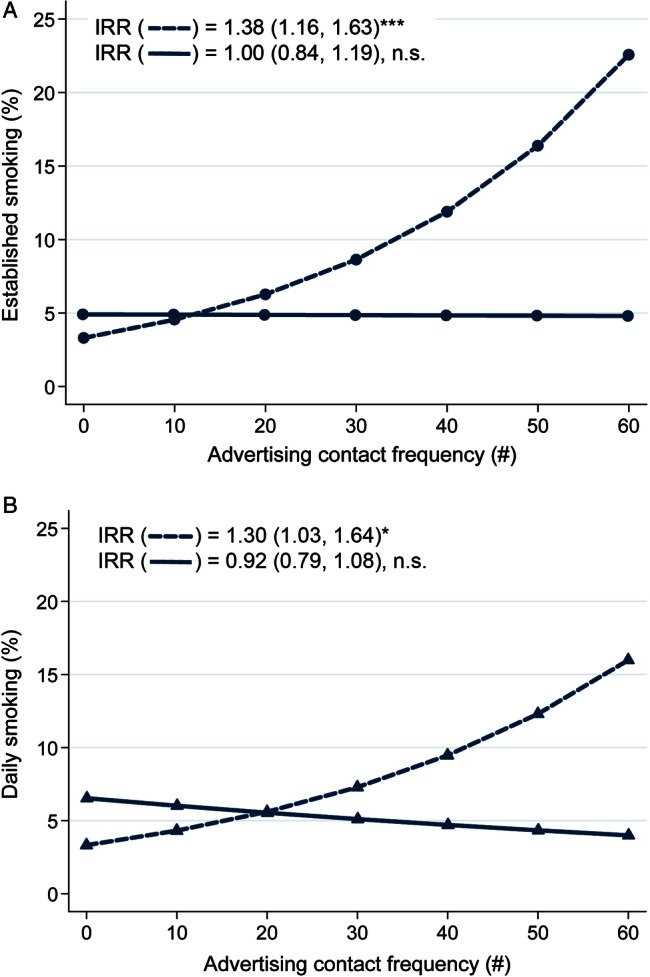
Results: During the observation period, 5% of the never-smokers at baseline smoked more than 100 cigarettes and 4.4% were classified as daily smokers. After controlling for age, gender, socioeconomic status, school performance, television screen time, personality characteristics and smoking status of peers and parents, each additional 10 tobacco advertising contacts increased the adjusted relative risk for established smoking by 38% (95% CI 16% to 63%; p<0.001) and for daily smoking by 30% (95% CI 3% to 64%; p<0.05). No significant association was found for non-tobacco advertising contact.
Conclusions: The study confirms a content-specific association between tobacco advertising and smoking behaviour and underlines that tobacco advertising exposure is not simply a marker for adolescents who are generally more receptive or attentive towards marketing.
Keywords: EPIDEMIOLOGY; PREVENTIVE MEDICINE; PUBLIC HEALTH.
Figures
References
-
- Brandt AM. The cigarette century: the rise, fall and deadly persistence of the product that defined America. New York, NY: Basic Books, 2007
-
- U.S. Department of Health and Human Services Preventing tobacco use among youth and young adults: a report of the Surgeon General. Atlanta, GA: U.S. Department of Health and Human Services, Centers for Disease Control and Prevention, National Center for Chronic Disease Prevention and Health Promotion, Office on Smoking and Health, 2012
Grants and funding
LinkOut - more resources
Full Text Sources
Other Literature Sources
