. 2013 Jul;57 Suppl 1(Suppl 1):S23-7.
doi: 10.1093/cid/cit298.

Multiple contributory factors to the age distribution of disease cases: a modeling study in the context of influenza A(H3N2v)

Affiliations

Multiple contributory factors to the age distribution of disease cases: a modeling study in the context of influenza A(H3N2v)

Manoj Gambhir et al. Clin Infect Dis. 2013 Jul.

Abstract

Background: In late 2011 and early 2012, 13 cases of human influenza resulted from infection with a novel triple reassortant swine-origin influenza virus, influenza A (H3N2) variant. This variant was notable for its inclusion of the matrix gene from the 2009 influenza A(H1N1) pandemic virus. While most of these confirmed cases were among children, the transmission potential and likely age-dependent susceptibility to the virus was unknown. Preliminary serologic studies indicated that very young children have less protection than older children and adults.

Methods: We construct a mathematical transmission model of influenza transmission that allows for external zoonotic exposure to infection and show how exposure and susceptibility-related factors contribute to the observed case distribution.

Results and conclusions: Age-dependent susceptibility to infection strongly influences epidemic dynamics. The result is that the risk of an outbreak in a highly susceptible age group may be substantially higher than in an older age group with less susceptibility, but exposure-related factors must also be accounted for when interpreting case data.

Keywords: emerging infection; modeling; novel influenza; zoonosis.


Figures
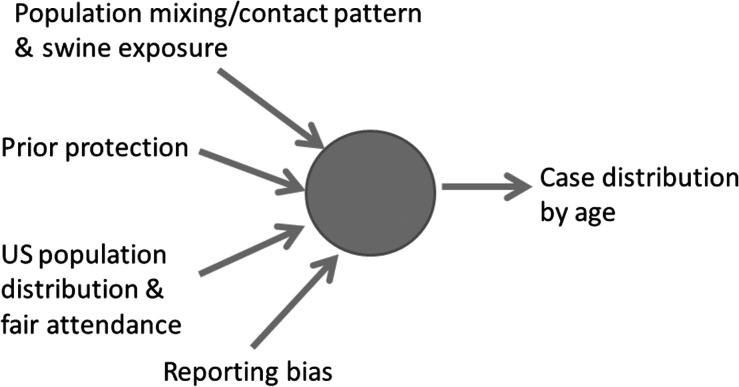
Figure 1.
Figure 1.
Illustration of the factors that influence the distribution of influenza cases by age .
Figure 2.
Figure 2.
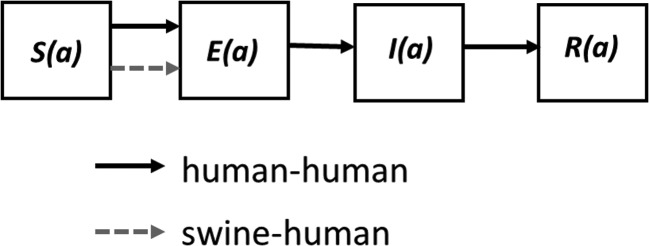
Model compartmental flow diagram illustrating the 4 infection states into which each age group, denoted a, is partitioned. Abbreviations: S, susceptible; E, exposed (incubating); I, infected and infectious; R, recovered.
Figure 3.
Figure 3.
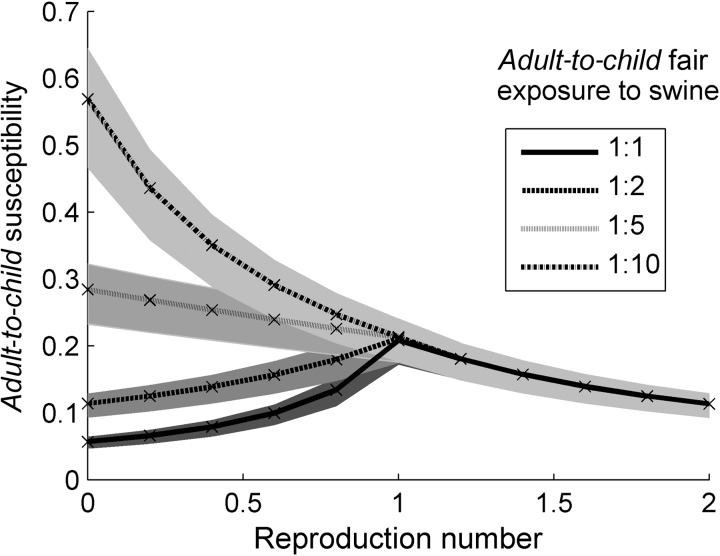
Variation in the calculated susceptibility ratio between adults and children. We set the model-generated adult-to-child case ratio to the observed case ratio of 1:6.5; the reproduction number is increased from zero for each of the 4 swine exposure scenarios (see legend inset). At R = 0, the case distribution is generated purely by swine exposure and the 4 curves corresponding to the different degrees of swine exposure are clearly demarcated. As R increases, swine exposure becomes less relevant until it is entirely irrelevant as R > 1, when cases are overwhelmingly generated through human-to-human transmission. Shaded regions indicate 95% confidence intervals.
Figure 4.
Figure 4.
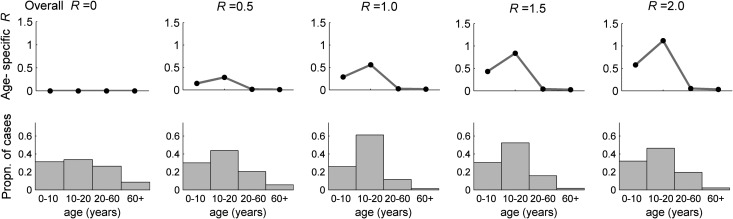
The age-specific reproduction number Ra and the case distribution by age. In each subfigure we set the overall population R to the value shown, the ratio of susceptibility between adults (aged >20 years) and children (aged <20 years) to 1:5 and equal exposure of all age groups to swine. As the overall population R is raised from zero, in steps of 0.5 (from left to right), the figure shows the changing age distribution of cases and the age-specific reproduction number.

References

    1. Update: Influenza A (H3N2)v transmission and guidelines—five states, 2011. MMWR Morb Morta Wkly Rep. 2012;60:1741–4. - PubMed
    1. Lindstrom S, Garten R, Balish A, et al. Human infections with novel reassortant influenza A(H3N2)v viruses, United States, 2011. Emerg Infect Dis. 2012;18:834–7. - PMC - PubMed
    1. Liu Q, Ma J, Liu H, et al. Emergence of novel reassortant H3N2 swine influenza viruses with the 2009 pandemic H1N1 genes in the United States. Arch Virol. 2012;157:555–62. - PubMed
    1. Lakdawala SS, Lamirande EW, Suguitan AL, Jr., et al. Eurasian-origin gene segments contribute to the transmissibility, aerosol release, and morphology of the 2009 pandemic H1N1 influenza virus. PLoS Pathog. 2011;7:e1002443. - PMC - PubMed
    1. Pearce MB, Jayaraman A, Pappas C, et al. Pathogenesis and transmission of swine origin A(H3N2)v influenza viruses in ferrets. Proc Natl Acad Sci U S A. 2012;109:3944–9. - PMC - PubMed

Publication types

MeSH terms