. 2013 Jan 1;1(1):32-39.
doi: 10.1016/j.redox.2012.11.006.

Redox Biology of Hydrogen Sulfide: Implications for Physiology, Pathophysiology, and Pharmacology

Affiliations

Redox Biology of Hydrogen Sulfide: Implications for Physiology, Pathophysiology, and Pharmacology

Asaf Stein et al. Redox Biol. .

Abstract

Hydrogen sulfide (H2S) has emerged as a critical mediator of multiple physiological processes in mammalian systems. The pathways involved in the production, consumption, and mechanism of action of H2S appear to be sensitive to alterations in the cellular redox state and O2 tension. Indeed, the catabolism of H2S through a putative oxidation pathway, the sulfide quinone oxido-reductase system, is highly dependent on O2 tension. Dysregulation of H2S homeostasis has also been implicated in numerous pathological conditions and diseases. In this review, the chemistry and the main physiological actions of H2S are presented. Some examples highlighting the cytoprotective actions of H2S within the context of cardiovascular disease are also reported. Elucidation of the redox biology of H2S will enable the development of new pharmacological agents based on this intriguing new redox cellular signal.

Keywords: hydrogen sulfide; mitochondria; oxidative stress; oxygen; redox biology.


Figures
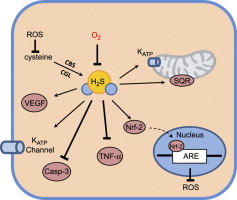
None
Graphical abstract
Fig. 1
Fig. 1
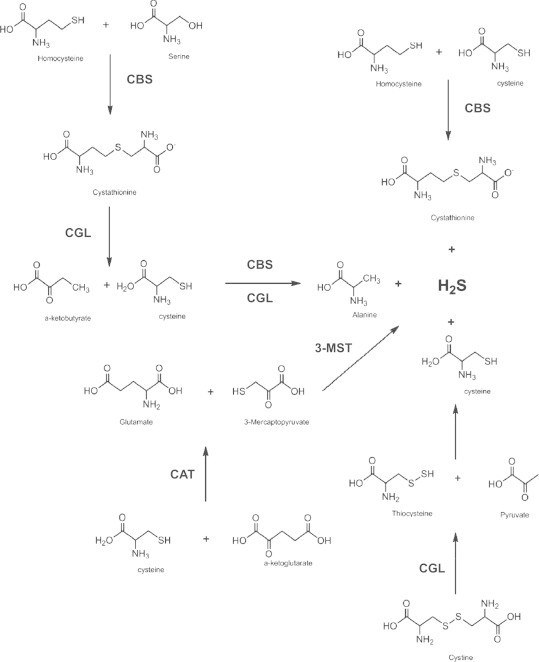
The enzymatic production of H2S. The two primary enzymes responsible for H2S production, cystathionine-γ-lyase (CGL) and cystathionine-β-synthase (CBS), are found in the cytosol. CBS catalyzes the first step in H2S production through the transsulfuration of homocysteine to cystathionine. CGL in an elimination reaction catalyzes the formation of cysteine and α-ketobutyrate. Cysteine is the substrate from which H2S is directly produced either through elimination (CGL) or β-replacement (CBS). Cysteine amino transferase (CAT) catalyzes the formation of 3-mercaptopyruvate, a substrate for the mitochondrial enzyme 3-mercaptopyruvate-S-transferase (3-MST). 3-MST can directly produce H2S, albeit at lower levels than CBS and CGL, in mitochondria.
Fig. 2
Fig. 2
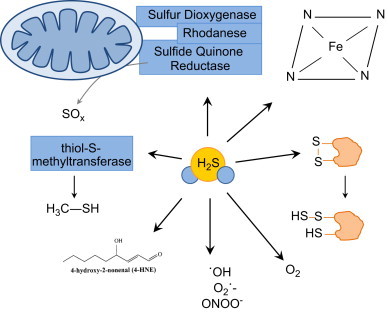
Proposed pathways of H2S removal in mammalian cells. The physiological steady-state concentration of H2S in vivo is believed to be maintained in the sub-micromolar range. This steady state concentration is established by the production pathways shown in Fig. 1 and the proposed consumption pathways shown within this figure. H2S will react non-enzymatically with many biomolecules such as reactive oxygen and nitrogen species, electrophilic lipids like 4-hydroxy-2-nonenal, free heme, and disulfide bonds to form a thiol and perthiol. The catabolism of H2S can also be catalyzed enzymatically by the sulfide quinone oxido-reductase system (SQR) comprised by sulfur dioxygenase, rhodanese, and sulfur quinone reductase.
Fig. 3
Fig. 3
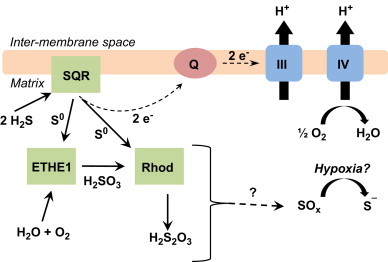
The oxidation of H2S by the sulfide quinone oxido-reductase system in mitochondria. H2S reduces the disulfide composed of the vicinal thiols on the sulfide quinone reductase (SQR) forming a thiol and a perthiol. The second sulfur atom on the perthiol, the sulfane sulfur (S0), is the substrate for both the sulfur transferase enzyme, rhodanese, and the sulfur dioxygenase enzyme encoded by the gene ETHE1. Rhodanese catalyzes the formation of thiosulfate (S2O3−2) from sulfite (SO3−2) and S0. ETHE1 catalyzes the formation of SO3−2. The reduced SQR can then transfer electrons into the ubiquinone (Q) pool, thus coupling the oxidation of H2S to electron transfer, H+ pumping, and ultimately ATP synthesis.
Fig. 4
Fig. 4
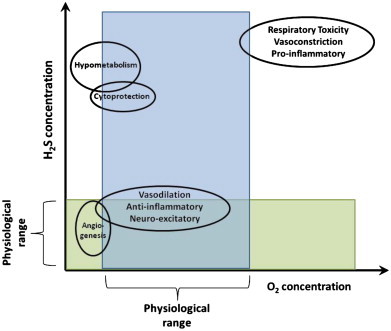
Interaction of O2 and H2S on physiological outcomes. H2S plays a role in many physiological processes. Additionally, it is capable of acting as a therapeutic agent. The concentration of H2S, whether endogenously produced or exogenously administered, will dictate the outcome. This can be beneficial at low and intermediate concentrations or harmful at high concentrations. High O2 can reverse many of the beneficial roles of H2S seen at lower O2 concentrations, resulting in, for example, vasoconstriction rather than vasodilation. Additionally, under hypoxic and normoxic conditions, H2S promotes angiogenesis. However, at higher concentrations of both O2 and H2S, an inhibition of cellular proliferation is seen. H2S has a narrow therapeutic window within which it is cytoprotective. At high concentrations it can be pro-apoptotic and pro-inflammatory. Finally, the larger doses of H2S necessary to induce a hypometabolic effect, can, if pushed further, result in cardiac and respiratory toxicity.

References

    1. Jeney V., Komodi E., Nagy E., Zarjou A., Vercellotti G.M., Eaton J.W., Balla G., Balla J. Supression of hemin-mediated oxidation of low-density lipoprotein and subsequent endothelial reactions by hydrogen sulfide (H(2)S) Free Radical Biology & Medicine. 2009;46:616–623. - PMC - PubMed
    1. Wang Y., Zhao X., Jin H., Wei H., Li W., Bu D., Tang X., Ren Y., Tang C., Du J. Role of hydrogen sulfide in the development of atherosclerotic lesions in apolipoprotein E knockout mice. Arteriosclerosis, Thrombosis, and Vascular Biology. 2008;29:173–179. - PubMed
    1. King A.L., Lefer D.J. Cytoprotective actions of hydrogen sulfide in ischaemia-reperfusion injury. Experimental Physiology. 2011;96:840–846. - PubMed
    1. Blackstone E., Morrison M., Roth M.B. H2S induces a suspended animation-like state in mice. Science. 2005;308:518. - PubMed
    1. Stein A., Mao Z., Morrison J.P., Fanucchi M.V., Postlethwait E.M., Patel R.P., Kraus D.W., Doeller J.E., Bailey S.M. Metabolic and cardiac signaling effects of inhaled hydrogen sulfide and low oxygen in male rats. Journal of Applied Physiology. 2012;112:1659–1669. - PMC - PubMed