


Risk of choroidal neovascularization among the uveitides
- PMID: 23795984
- PMCID: PMC3748230
- DOI: 10.1016/j.ajo.2013.04.040
Risk of choroidal neovascularization among the uveitides
Abstract
Purpose: To evaluate the risk, risk factors, and visual impact of choroidal neovascularization (CNV) in uveitis cases.
Design: Retrospective cohort study.
Methods: Standardized medical record review at 5 tertiary centers.
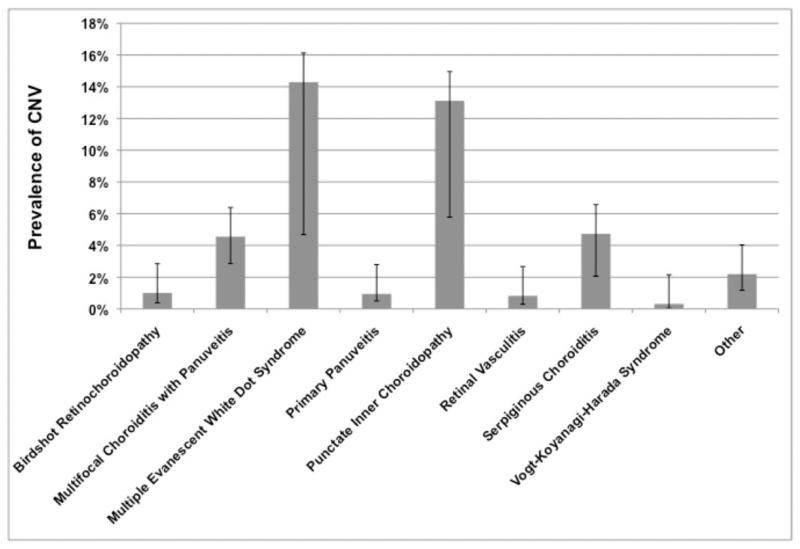
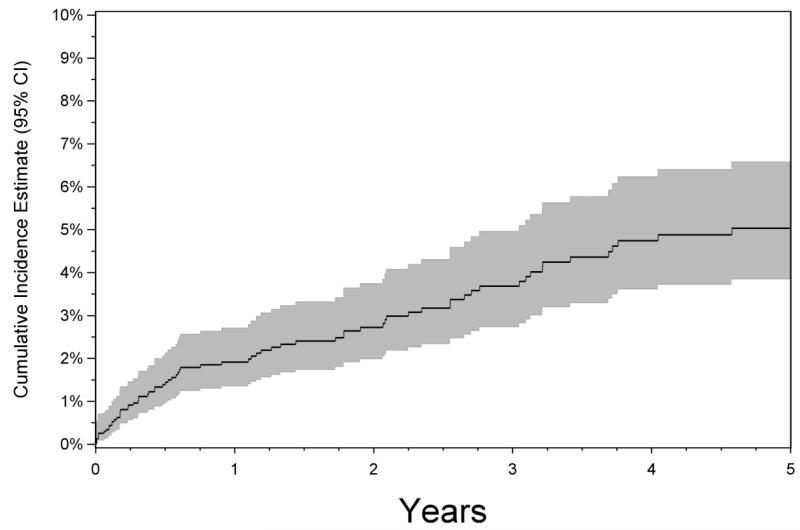
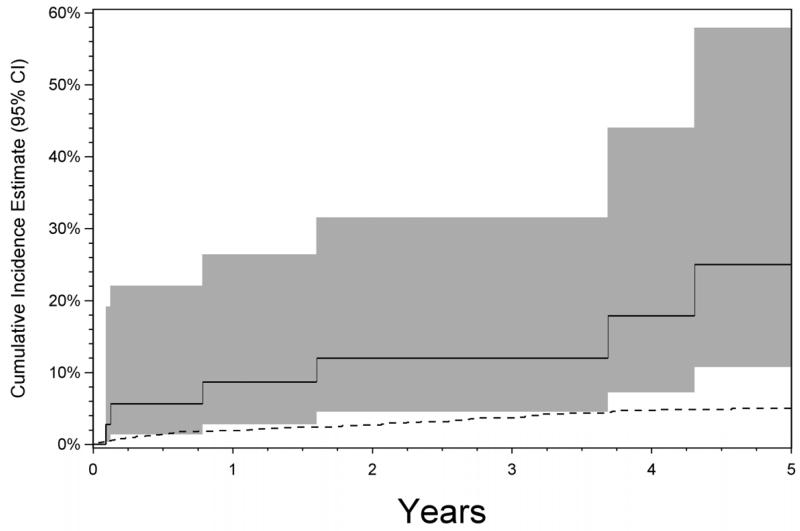
Results: Among 15,137 uveitic eyes (8868 patients), CNV was rare in the cases of anterior or intermediate uveitis. Among the 4041 eyes (2307 patients) with posterior uveitis or panuveitis, 81 (2.0%) had CNV at presentation. Risk factors included posterior uveitis in general and specific uveitis syndromes affecting the outer retina-retinal pigment epithelium-choroid interface. Among the 2364 eyes (1357 patients) with posterior uveitis or panuveitis and free of CNV at the time of cohort entry, the cumulative 2-year incidence of CNV was 2.7% (95% confidence interval [CI], 1.8% to 3.5%). Risk factors for incident CNV included currently active inflammation (adjusted hazard ratio [aHR], 2.13; 95% CI, 1.26 to 3.60), preretinal neovascularization (aHR, 3.19; 95% CI, 1.30 to 7.80), and prior diagnosis of CNV in the contralateral eye (aHR, 5.79; 95% CI, 2.77 to 12.09). Among specific syndromes, the incidence was greater in Vogt-Koyanagi-Harada syndrome (aHR, 3.37; 95% CI, 1.52 to 7.46) and punctate inner choroiditis (aHR, 8.67; 95% CI, 2.83 to 26.54). Incident CNV was associated with a 2-line loss of visual acuity (+0.19 logarithm of the minimal angle of resolution units; 95% CI, 0.079 to 0.29) from the preceding visit.
Conclusions: CNV is an uncommon complication of uveitis associated with visual impairment that occurs more commonly in forms affecting the outer retina-retinal pigment epithelium-choroid interface, during periods of inflammatory activity, in association with preretinal neovascularization, and in second eyes of patients with unilateral CNV. Because CNV is treatable, a systematic approach to early detection in high-risk patients may be appropriate.
Copyright © 2013 Elsevier Inc. All rights reserved.
Figures
References
-
- Penn J, editor. Retinal and Choroidal Angiogenesis. Springer; Dordrecht, The Netherlands: 2008.
-
- Miller DG, Singerman LJ. Vision loss in younger patients: a review of choroidal neovascularization. Optom Vis Sci. 2006;83(5):316–325. - PubMed
-
- Julian K, Terrada C, Fardeau C, et al. Intravitreal bevacizumab as first local treatment for uveitis-related choroidal neovascularization: long-term results. Acta Ophthalmol. 2011;89(2):179–184. - PubMed
Publication types
MeSH terms
Grants and funding
LinkOut - more resources
Full Text Sources
Other Literature Sources
Medical
