


Antibiotic Resistance in Salmonella enterica Serovar Typhimurium Associates with CRISPR Sequence Type
- PMID: 23796925
- PMCID: PMC3754329
- DOI: 10.1128/AAC.00913-13
Antibiotic Resistance in Salmonella enterica Serovar Typhimurium Associates with CRISPR Sequence Type
Abstract
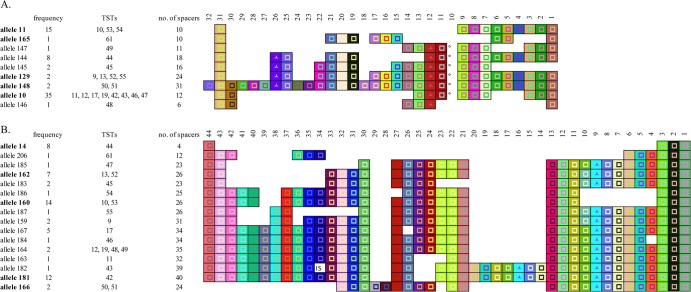
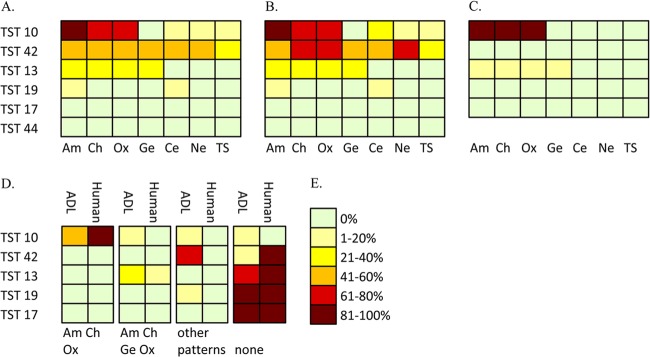
Salmonella enterica subsp. enterica serovar Typhimurium is a leading cause of food-borne salmonellosis in the United States. The number of antibiotic-resistant isolates identified in humans is steadily increasing, suggesting that the spread of antibiotic-resistant strains is a major threat to public health. S Typhimurium is commonly identified in a wide range of animal hosts, food sources, and environments, but little is known about the factors mediating the spread of antibiotic resistance in this ecologically complex serovar. Previously, we developed a subtyping method, CRISPR-multi-virulence-locus sequence typing (MVLST), which discriminates among strains of several common S. enterica serovars. Here, CRISPR-MVLST identified 22 sequence types within a collection of 76 S Typhimurium isolates from a variety of animal sources throughout central Pennsylvania. Six of the sequence types were identified in more than one isolate, and we observed statistically significant differences in resistance among these sequence types to 7 antibiotics commonly used in veterinary and human medicine, such as ceftiofur and ampicillin (P < 0.05). Importantly, five of these sequence types were subsequently identified in human clinical isolates, and a subset of these isolates had identical antibiotic resistance patterns, suggesting that these subpopulations are being transmitted through the food system. Therefore, CRISPR-MVLST is a promising subtyping method for monitoring the farm-to-fork spread of antibiotic resistance in S Typhimurium.
Copyright © 2013, American Society for Microbiology. All Rights Reserved.
Figures
References
-
- Scharff RL. 2012. Economic burden from health losses due to foodborne illness in the United States. J. Food Prot. 75:123–131 - PubMed
-
- Hoffmann S, Batz MB, Morris JG. 2012. Annual cost of illness and quality-adjusted life year losses in the United States due to 14 foodborne pathogens. J. Food Prot. 75:1292–1302 - PubMed
-
- Blake DP, Hillman K, Fenlon DR, Low JC. 2003. Transfer of antibiotic resistance between commensal and pathogenic members of the Enterobacteriaceae under ileal conditions. J. Appl. Microbiol. 95:428–436 - PubMed
LinkOut - more resources
Full Text Sources
Other Literature Sources
