


Gender considerations in ventilatory and metabolic development in rats: special emphasis on the critical period
- PMID: 23797186
- PMCID: PMC3731389
- DOI: 10.1016/j.resp.2013.06.013
Gender considerations in ventilatory and metabolic development in rats: special emphasis on the critical period
Abstract
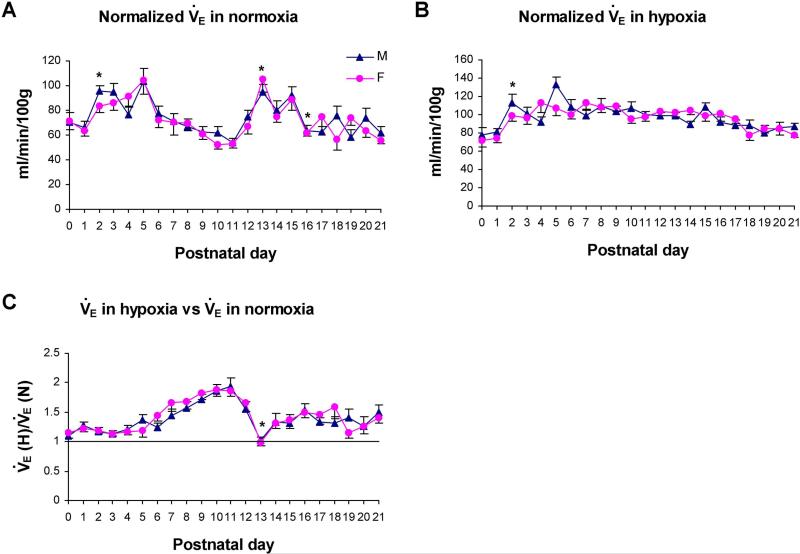
In rats, a critical period exists around postnatal day (P) 12-13, when an imbalance between heightened inhibition and suppressed excitation led to a weakened ventilatory and metabolic response to acute hypoxia. An open question was whether the two genders follow the same or different developmental trends throughout the first 3 postnatal weeks and whether the critical period exists in one or both genders. The present large-scale, in-depth ventilatory and metabolic study was undertaken to address this question. Our data indicated that: (1) the ventilatory and metabolic rates in both normoxia and acute hypoxia were comparable between the two genders from P0 to P21; thus, gender was never significant as a main effect; and (2) the age effect was highly significant in all parameters studies for both genders, and both genders exhibited a significantly weakened response to acute hypoxia during the critical period. Thus, the two genders have comparable developmental trends, and the critical period exists in both genders in rats.
Keywords: Carbon dioxide production; Gender difference; Hypoxia; Oxygen consumption; Respiration.
Copyright © 2013 Elsevier B.V. All rights reserved.
Figures


References
-
- Benjamini Y, Hochberg Y. Controlling the false discovery rate: a practical and powerful approach to multiple testing. J. Roy. Statist. Soc. Ser. B. 1995;57:289–300.
-
- Bertin R, De Marco F, Mouroux I, Portet R. Postnatal development of nonshivering thermogenesis in rats: effects of rearing temperature. J. Dev. Physiol. 1993;19:9–15. - PubMed
-
- Bisgard GE, Olson EB, Jr., Wang ZY, Bavis RW, Fuller DD, Mitchell GS. Adult carotid chemoafferent responses to hypoxia after 1, 2, and 4 wk of postnatal hyperoxia. J. Appl. Physiol. 2003;95:946–952. - PubMed
Publication types
MeSH terms
Substances
Grants and funding
LinkOut - more resources
Full Text Sources
Other Literature Sources
