Review
. 2013 Sep;67(1):111-26.
doi: 10.1007/s12013-013-9637-1.

The WD40-repeat protein-containing deubiquitinase complex: catalysis, regulation, and potential for therapeutic intervention

Affiliations
Review

The WD40-repeat protein-containing deubiquitinase complex: catalysis, regulation, and potential for therapeutic intervention

Mark A Villamil et al. Cell Biochem Biophys. 2013 Sep.

Abstract

Ubiquitination has emerged as an essential signaling mechanism in eukaryotes. Deubiquitinases (DUBs) counteract the activities of the ubiquitination machinery and provide another level of control in cellular ubiquitination. Not surprisingly, DUBs are subjected to stringent regulations. Besides regulation by the noncatalytic domains present in the DUB sequences, DUB-interacting proteins are increasingly realized as essential regulators for DUB activity and function. This review focuses on DUBs that are associated with WD40-repeat proteins. Many human ubiquitin-specific proteases (USPs) were found to interact with WD40-repeat proteins, but little is known as to how this interaction regulates the activity and function of USPs. In recent years, significant progress has been made in understanding a prototypical WD40-repeat protein-containing DUB complex that comprises USP1 and USP1-associated factor 1 (UAF1). It has been shown that UAF1 activates USP1 through a potential active-site modulation, and the complex formation between USP1 and UAF1 is regulated by serine phosphorylation. Recently, human USPs have been recognized as a promising target class for inhibitor discovery. Small molecule inhibitors targeting several human USPs have been reported. USP1 is involved in two major DNA damage response pathways, DNA translesion synthesis and the Fanconi anemia pathway. Inhibiting the USP1/UAF1 deubiquitinase complex represents a new strategy to potentiate cancer cells to DNA-crosslinking agents and to overcome resistance that has plagued clinical cancer chemotherapy. The progress in inhibitor discovery against USPs and the WD40-repeat protein-containing USP complex will be discussed.


Figures

Figure 1
Figure 1
The ubiquitin cycle. Ubiquitin (Ub) is activated by the ubiquitin-activating enzyme (E1) and forms a thioester linkage with the E1 active site cysteine residue in an ATP-dependent manner. The ubiquitin is then transferred to the ubiquitin-conjugating enzyme (E2). E2 with the ubiquitin ligase (E3) targets the substrate and attaches Ub to the substrate's Lys residue forming an isopeptide bond. Additional Ub can be attached to the same ubiquitin on the ubiquitin by the E1-E2-E3 cascade. Deubiquitinating enzymes (DUBs) are involved in the reverse process in editing or removing Ub from target protein.
Figure 2
Figure 2
The structures of ubiquitin and polyubiquitin. A. The ubiquitin structure displays the seven lysine residues (Lys6, Lys11, Lys27, Lys29, Lys33, Lys48, and Lys63) involved in forming polyubiquitin chains. B. Structures (depicted as surface) of monoubiquitin (PDB ID: 1UBQ), diubiquitin (PDB IDs: Lys6-linked diubiquitin, 2XK5; Lys11-linked diubiquitin, 2XEW; Lys48-linked diubiquitin, 3M3J; Lys63-linked diubiquitin, 2JF5), and tetraubiquitin (PDB IDs: Lys48-linked tetraubiquitin, 2O6V; Lys63-linked tetraubiquitin, 3HM3).
Figure 3
Figure 3
Classification of DUBs and the representative DUB structures. DUBs are grouped into six subclasses: Ubiquitin-Specific Proteases (USP), Machado-Joseph Domain (MJD), JAB1/MPN/Mov34 Metalloenzyme (JAMM), Ovarian tumor protease (OTU), Ubiquitin C-Terminal Hydrolase (UCH), and Monocyte Chemotactic Protein-Induced Protein (MCPIP). USPs encompass the majority of DUBs with over 50 members. USP, MJD, OTU, UCH, and MCPIP are cysteine proteases, JAMM is zinc-dependent metalloenzyme. Structures of the representative DUBs from each of the six families are shown. The catalytic triad residues are shown as spheres, and the active site Zn2+ in the JAMM structure is shown as a grey sphere. (PDB IDs: USP7, 1NBF; Ataxin-3, 1YZB; OTU2, 1TFF; UCH-L3, 1XD3; MCPIP1, 3V33; JAMM, 1R5X)
Figure 4
Figure 4
Known interactions between USPs and WD40-repeat proteins in humans. Among the USPs, several are able to interact with multiple WD40-repeats. Several WD40-repeats can interact with more than one USPs.
Figure 5
Figure 5
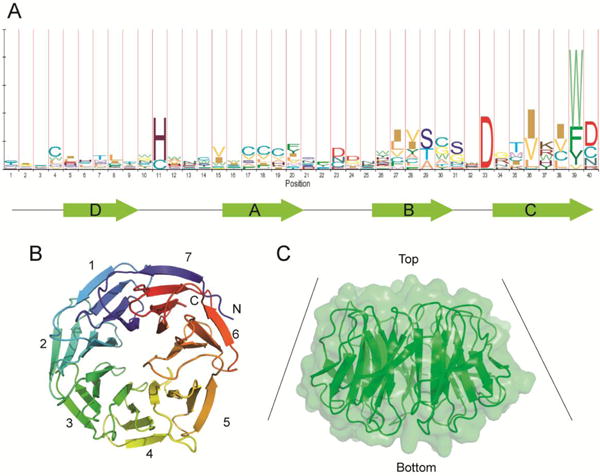
Structure and sequence of WD40-repeat domain. A. Sequence logo of WD40-repeats created using HMMlogo (144). WD40-repeat domains of know structures are used to create a sequence alignment. The letter plot represents conserved amino acid residues at each position, with larger letters representing more conservation. The β-strands within a repeat are depicted below the sequence. B. Structure of a representative WD40-repeat protein (WDR5, PDB ID: 2H14). Each repeat contains four antiparallel β-strands. The seventh blade is constructed by the first β-strand in the N-terminal end and three β-strands at the C-terminal end. C. Surface view of a WD40-repeat domain. WD40 repeats typically have a funnel-like shape with a narrow end defined as the top, and a wider part defined as the bottom.
Figure 6
Figure 6
Plasticity of the USP active sites. A. Overall structure of the catalytic core of USP using USP7 (PBD ID 1NB8) as an example. The catalytic core structure comprises three subdomains, i.e. finger (blue), palm (green), and thumb (pink) domains. The active site cysteine catalytic triad is located between the palm and the thumb domains. B. Comparison of the apo USP7 (left, PBD ID 1NB8) and the USP7 bound with ubiquitin-aldehyde (right, PDB ID: INBF). The catalytic residues are shown as stick. The binding of ubiquitin-aldehyde to USP7 brings the distance between the catalytic cysteine and histidine from 9.7 Å to 3.6 Å. C. Comparison of the apo USP14 (left, PDB ID: 2AYN) and the USP14 bound with ubiquitin-aldehyde (right, PDB ID: 2AYO). In USP14, the ubiquitin-binding cleft leading to the active site is blocked by two surface loops BL1 (yellow) and BL2 (purple) in the apo structure. These two loops undergo conformational changes to allow the C terminus of ubiquitin to bind to the cleft.

References

    1. Komander D. The emerging complexity of protein ubiquitination. Biochemical Society transactions. 2009;37:937–953. - PubMed
    1. Pickart CM, Eddins MJ. Ubiquitin: structures, functions, mechanisms. Biochim Biophys Acta. 2004;1695:55–72. - PubMed
    1. Pickart CM. Mechanisms underlying ubiquitination. Annu Rev Biochem. 2001;70:503–533. - PubMed
    1. Fang S, Weissman AM. A field guide to ubiquitylation. Cellular and molecular life sciences : CMLS. 2004;61:1546–1561. - PMC - PubMed
    1. van der Veen AG, Ploegh HL. Ubiquitin-like proteins. Annu Rev Biochem. 2012;81:323–357. - PubMed

Publication types

MeSH terms