


BRAFV600E immunohistochemistry facilitates universal screening of colorectal cancers for Lynch syndrome
- PMID: 23797718
- PMCID: PMC3773060
- DOI: 10.1097/PAS.0b013e31828f233d
BRAFV600E immunohistochemistry facilitates universal screening of colorectal cancers for Lynch syndrome
Abstract
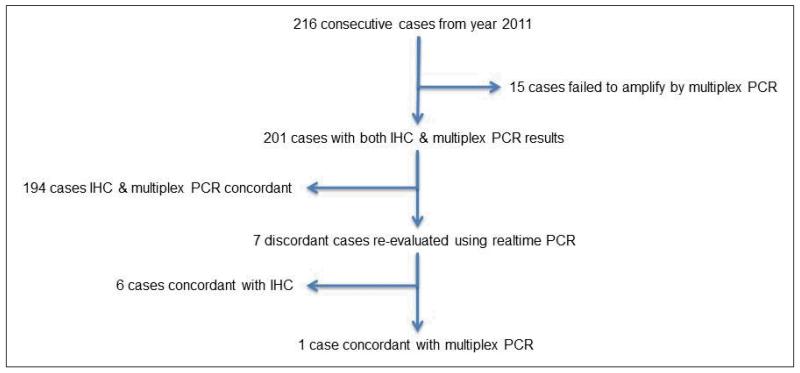
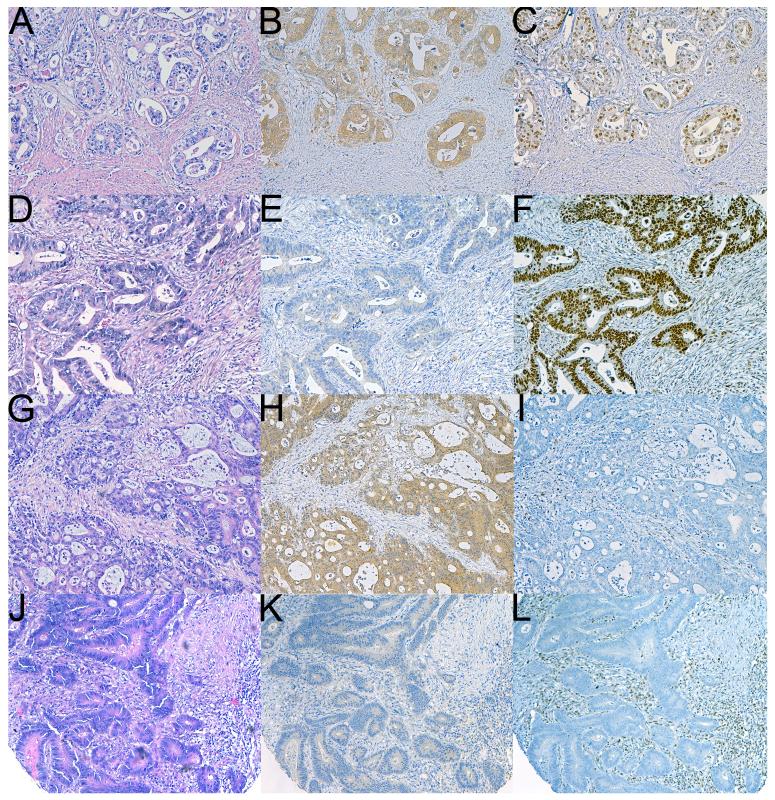
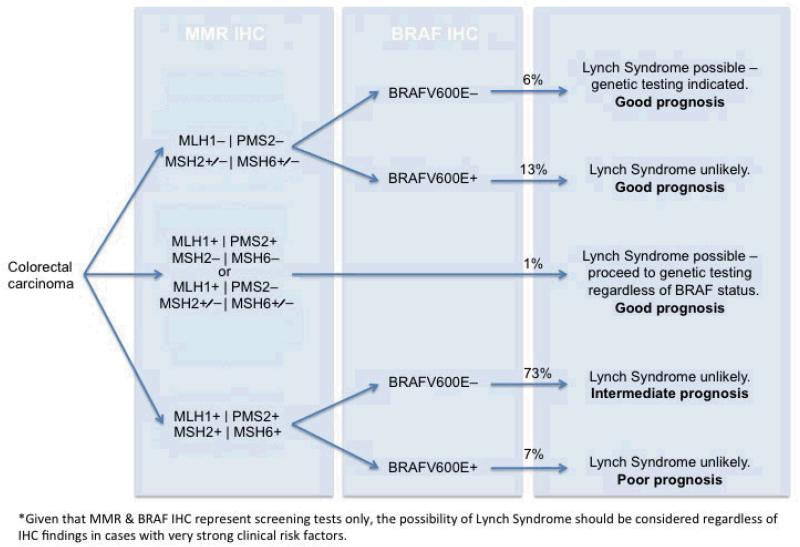
BRAFV600E mutation in microsatellite-unstable (MSI) colorectal carcinomas (CRCs) virtually excludes Lynch syndrome (LS). In microsatellite-stable (MSS) CRCs it predicts poor prognosis. We propose a universal CRC LS screening algorithm using concurrent reflex immunohistochemistry (IHC) for BRAFV600E and mismatch-repair (MMR) proteins. We compared BRAFV600E IHC with multiplex polymerase chain reaction (PCR) and matrix-assisted laser desorption/ionization-time of flight mass spectrometry in 216 consecutive CRCs from 2011. Discordant cases were resolved with real-time PCR. BRAFV600E IHC was performed on 51 CRCs from the Australasian Colorectal Cancer Family Registry (ACCFR), which were fully characterized for BRAF mutation by allele-specific PCR, MMR status (MMR IHC and MSI), MLH1 promoter methylation, and germline MLH1 mutation. We then assessed MMR and BRAFV600E IHC on 1403 consecutive CRCs. By matrix-assisted laser desorption/ionization-time of flight mass spectrometry 15 cases did not yield a BRAF result, whereas 38/201 (19%) were positive. By IHC 45/216 (20%) were positive. Of the 7 discordant cases, real-time PCR confirmed the IHC result in 6. In the 51 CRCs from the ACCFR, IHC was concordant with allele-specific PCR in 50 cases. BRAFV600E and MSI IHC on 1403 CRCs demonstrated the following phenotypes: BRAF/MSS (1029 cases, 73%), BRAF/MSS (98, 7%), BRAF/MSI (183, 13%), and BRAF/MSI (93, 7%). All 11/1403 cancers associated with proven LS were BRAF/MSI. We conclude that BRAF IHC is highly concordant with 2 commonly used PCR-based BRAFV600E assays; it performed well in identifying MLH1 mutation carriers from the ACCFR and identified all cases of proven LS among the 1403 CRCs. Reflex BRAFV600E and MMR IHC are simple cheap tests that facilitate universal LS screening and identify the poor prognosis of the BRAFV600E-mutant MSS CRC phenotype.
Figures
References
-
- Atlanta., A.C.C.F.F.-. American Cancer Society 2011 http://www.cancer.org/research/cancerfactsfigures/colorectalcancerfactsf....
-
- Jarvinen HJ, et al. Controlled 15-year trial on screening for colorectal cancer in families with hereditary nonpolyposis colorectal cancer. Gastroenterology. 2000;118(5):829–34. - PubMed
Publication types
MeSH terms
Substances
Grants and funding
LinkOut - more resources
Full Text Sources
Other Literature Sources
Research Materials
