


Amphetamine actions at the serotonin transporter rely on the availability of phosphatidylinositol-4,5-bisphosphate
- PMID: 23798435
- PMCID: PMC3710838
- DOI: 10.1073/pnas.1220552110
Amphetamine actions at the serotonin transporter rely on the availability of phosphatidylinositol-4,5-bisphosphate
Abstract
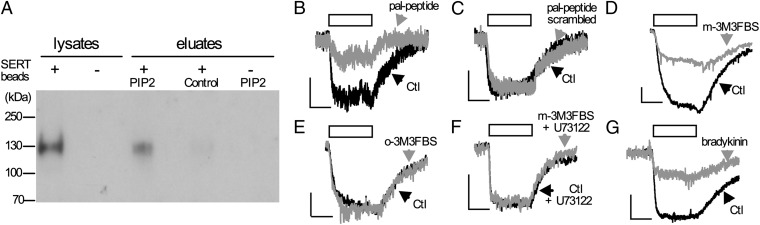
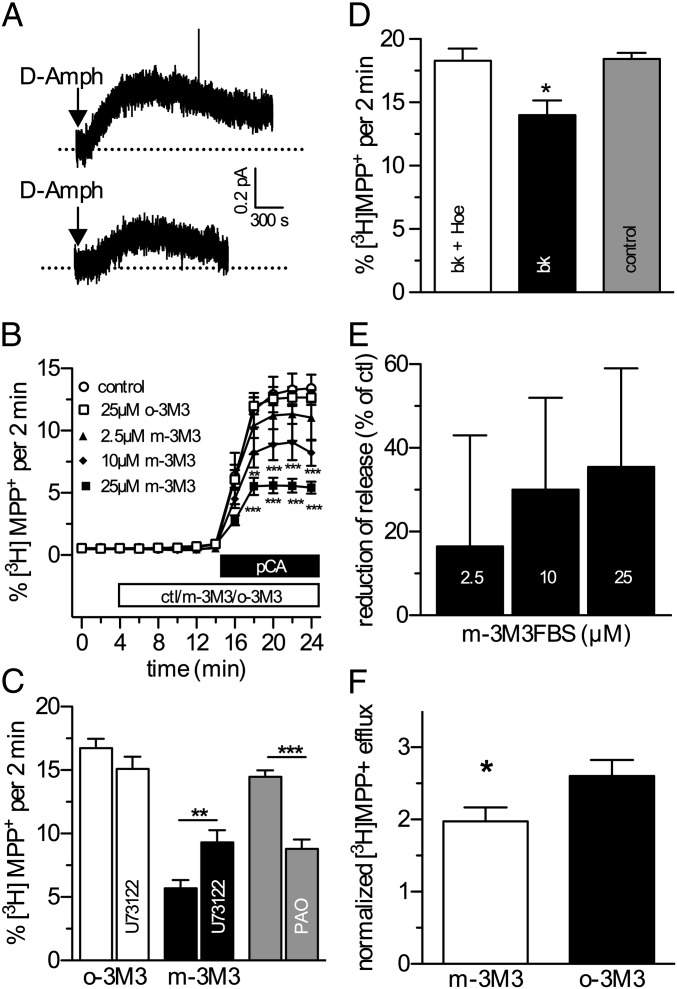
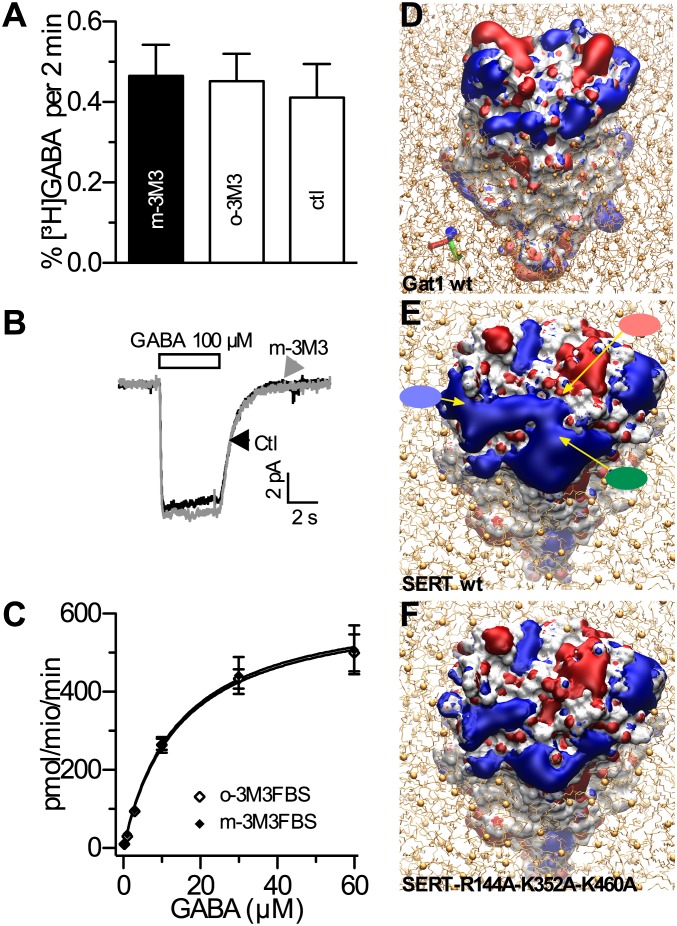
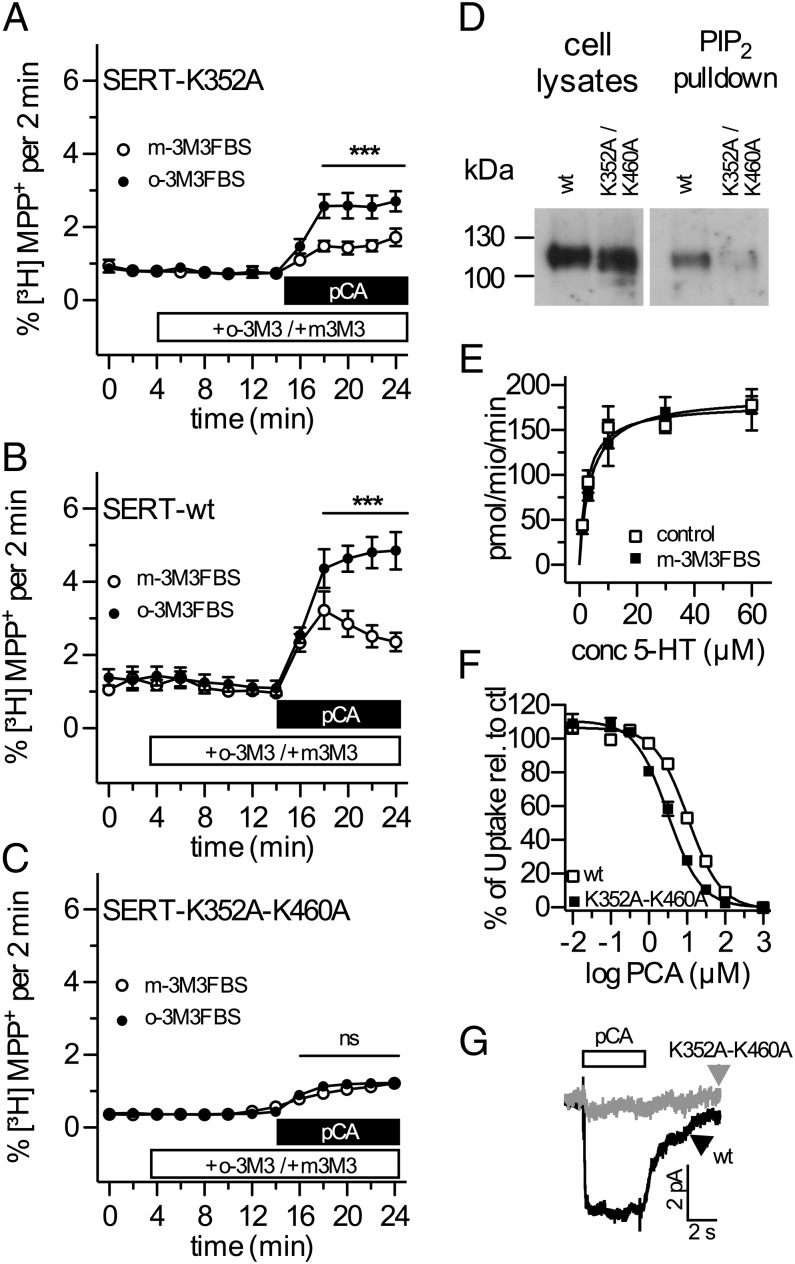
Nerve functions require phosphatidylinositol-4,5-bisphosphate (PIP2) that binds to ion channels, thereby controlling their gating. Channel properties are also attributed to serotonin transporters (SERTs); however, SERT regulation by PIP2 has not been reported. SERTs control neurotransmission by removing serotonin from the extracellular space. An increase in extracellular serotonin results from transporter-mediated efflux triggered by amphetamine-like psychostimulants. Herein, we altered the abundance of PIP2 by activating phospholipase-C (PLC), using a scavenging peptide, and inhibiting PIP2-synthesis. We tested the effects of the verified scarcity of PIP2 on amphetamine-triggered SERT functions in human cells. We observed an interaction between SERT and PIP2 in pull-down assays. On decreased PIP2 availability, amphetamine-evoked currents were markedly reduced compared with controls, as was amphetamine-induced efflux. Signaling downstream of PLC was excluded as a cause for these effects. A reduction of substrate efflux due to PLC activation was also found with recombinant noradrenaline transporters and in rat hippocampal slices. Transmitter uptake was not affected by PIP2 reduction. Moreover, SERT was revealed to have a positively charged binding site for PIP2. Mutation of the latter resulted in a loss of amphetamine-induced SERT-mediated efflux and currents, as well as a lack of PIP2-dependent effects. Substrate uptake and surface expression were comparable between mutant and WT SERTs. These findings demonstrate that PIP2 binding to monoamine transporters is a prerequisite for amphetamine actions without being a requirement for neurotransmitter uptake. These results open the way to target amphetamine-induced SERT-dependent actions independently of normal SERT function and thus to treat psychostimulant addiction.
Keywords: amperometry; mass spectrometry; phosphoinositide; release; reuptake.
Conflict of interest statement
The authors declare no conflict of interest.
Figures
References
-
- Di Paolo G, De Camilli P. Phosphoinositides in cell regulation and membrane dynamics. Nature. 2006;443(7112):651–657. - PubMed
-
- Tolias KF, Cantley LC. Pathways for phosphoinositide synthesis. Chem Phys Lipids. 1999;98(1-2):69–77. - PubMed
-
- Marín-Vicente C, Nicolás FE, Gómez-Fernández JC, Corbalán-García S. The PtdIns(4,5)P2 ligand itself influences the localization of PKCalpha in the plasma membrane of intact living cells. J Mol Biol. 2008;377(4):1038–1052. - PubMed
-
- Pike LJ, Miller JM. Cholesterol depletion delocalizes phosphatidylinositol bisphosphate and inhibits hormone-stimulated phosphatidylinositol turnover. J Biol Chem. 1998;273(35):22298–22304. - PubMed
-
- Di Paolo G, et al. Impaired PtdIns(4,5)P2 synthesis in nerve terminals produces defects in synaptic vesicle trafficking. Nature. 2004;431(7007):415–422. - PubMed
Publication types
MeSH terms
Substances
Grants and funding
LinkOut - more resources
Full Text Sources
Other Literature Sources
Molecular Biology Databases
