


A sticky situation: the unexpected stability of malaria elimination
- PMID: 23798693
- PMCID: PMC3720043
- DOI: 10.1098/rstb.2012.0145
A sticky situation: the unexpected stability of malaria elimination
Abstract
Malaria eradication involves eliminating malaria from every country where transmission occurs. Current theory suggests that the post-elimination challenges of remaining malaria-free by stopping transmission from imported malaria will have onerous operational and financial requirements. Although resurgent malaria has occurred in a majority of countries that tried but failed to eliminate malaria, a review of resurgence in countries that successfully eliminated finds only four such failures out of 50 successful programmes. Data documenting malaria importation and onwards transmission in these countries suggests malaria transmission potential has declined by more than 50-fold (i.e. more than 98%) since before elimination. These outcomes suggest that elimination is a surprisingly stable state. Elimination's 'stickiness' must be explained either by eliminating countries starting off qualitatively different from non-eliminating countries or becoming different once elimination was achieved. Countries that successfully eliminated were wealthier and had lower baseline endemicity than those that were unsuccessful, but our analysis shows that those same variables were at best incomplete predictors of the patterns of resurgence. Stability is reinforced by the loss of immunity to disease and by the health system's increasing capacity to control malaria transmission after elimination through routine treatment of cases with antimalarial drugs supplemented by malaria outbreak control. Human travel patterns reinforce these patterns; as malaria recedes, fewer people carry malaria from remote endemic areas to remote areas where transmission potential remains high. Establishment of an international resource with backup capacity to control large outbreaks can make elimination stickier, increase the incentives for countries to eliminate, and ensure steady progress towards global eradication. Although available evidence supports malaria elimination's stickiness at moderate-to-low transmission in areas with well-developed health systems, it is not yet clear if such patterns will hold in all areas. The sticky endpoint changes the projected costs of maintaining elimination and makes it substantially more attractive for countries acting alone, and it makes spatially progressive elimination a sensible strategy for a malaria eradication endgame.
Keywords: backwards bifurcation; malaria elimination; malaria eradication.
Figures
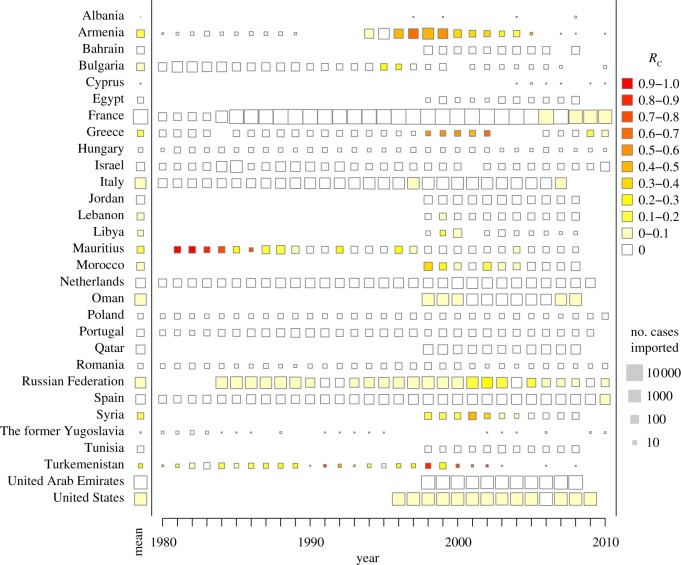
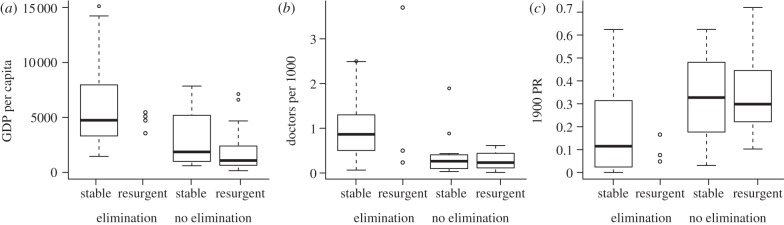
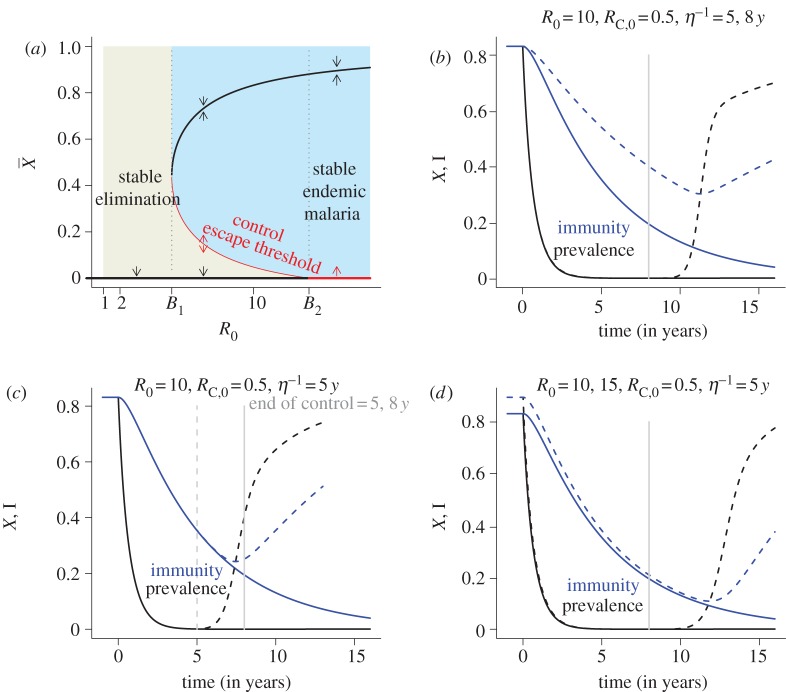
 ). In this context, ‘sticky’ means that two stable steady states exist. This bifurcation diagram shows the steady state endemicity as a function of the intrinsic potential for transmission, described by the basic reproductive number R0. The stability of endemic malaria is strongly dependent on R0, and the stability changes at ‘bifurcation’ points called B1 and B2 (vertical dotted lines). For values of R0 below B2, malaria elimination is stable (thick black line at
  ). For values of R0 above B1, endemic malaria is stable (described by the thick black curve). If B1 < R0 < B2, then malaria elimination and endemic malaria are both stable, and elimination is ‘sticky.’ To achieve elimination when it is sticky, endemic malaria must be suppressed below a curve describing an unsteady state called a ‘control escape threshold’ (the thin red curve) long enough for immunity to wane. Details and analysis of the model are found in the electronic supplementary material. (b–d) To illustrate how the ideas in this diagram play out in a simulated vector control campaign, vectorial capacity was sharply reduced for a time (at t = 0) and then allowed to return to its baseline (the vertical grey lines). If vectorial capacity is suppressed for long enough, then immunity wanes and elimination is a stable endpoint. If control is relaxed prematurely, then malaria is resurgent. (b) Two different scenarios were simulated with different rates of waning immunity (i.e. 5 versus 8 years). The outcome is sensitive to the rate at which immunity wanes—the slower it wanes, the longer vector control must be sustained for elimination to become sticky. (c) Two different scenarios were simulated to show the effect of the duration of sustained control (i.e. 5 versus 8 years). For a fixed rate of waning immunity (i.e. 5 years), the long-term outcomes depend on the duration of the control programmes—vector control must be sustained long enough for malaria immunity to wane, and if it is not, then malaria will be resurgent. (d) Two different scenarios were simulated to show the effect of baseline. All else equal, the outcome is sensitive to the level of baseline transmission—the higher the baseline, the longer vector control must be sustained before immunity has waned sufficiently.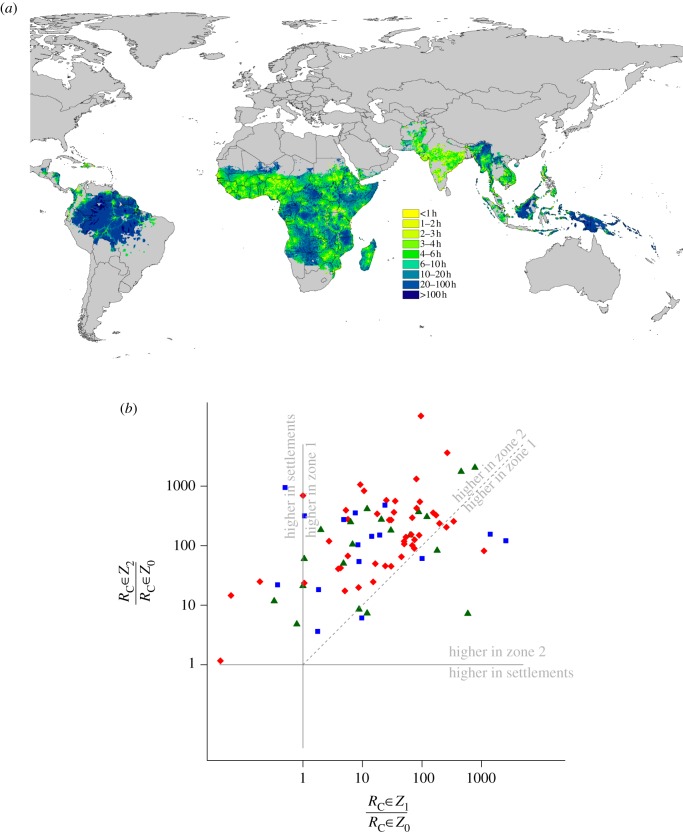
References
-
- Gramiccia G, Beales PF. 1988. In Principles and practice of malaria, vol. 2 (eds Wernsdorfer W, McGregor I.), pp. 1335–1378. Edinburgh, UK: Churchill Livingstone.
-
- Najera JA, Gonzalez-Silva M, Alonso PL. 2011. Some lessons for the future from the Global Malaria Eradication Programme (1955–1969). PLoS Med. 8, e1000412.10.1371/journal.pmed.1000412 (doi:10.1371/journal.pmed.1000412) - DOI - DOI - PMC - PubMed
-
- Enserink M, Roberts L. 2007. Did they really say… eradication? Science 318, 1544–1545.10.1126/science.318.5856.1544 (doi:10.1126/science.318.5856.1544) - DOI - DOI - PubMed
-
- RBMP. 2008. The global malaria action plan for a malaria free world. Geneva, Switzerland: Roll Back Malaria Partnership, World Health Organization.
-
- Alonso PL, et al. 2011. A research agenda to underpin malaria eradication. PLoS Med. 8, e1000406.10.1371/journal.pmed.1000406 (doi:10.1371/journal.pmed.1000406) - DOI - DOI - PMC - PubMed
Publication types
MeSH terms
Grants and funding
LinkOut - more resources
Full Text Sources
Other Literature Sources
Medical