


Pullout strength of misplaced pedicle screws in the thoracic and lumbar vertebrae - A cadaveric study
- PMID: 23798753
- PMCID: PMC3687899
- DOI: 10.4103/0019-5413.111502
Pullout strength of misplaced pedicle screws in the thoracic and lumbar vertebrae - A cadaveric study
Retraction in
-
Retraction notice.Indian J Orthop. 2014 Mar;48(2):144. Indian J Orthop. 2014. PMID: 24741134 Free PMC article. No abstract available.
Abstract
Background: The objective of this cadaveric study was to analyze the effects of iatrogenic pedicle perforations from screw misplacement on the mean pullout strength of lower thoracic and lumbar pedicle screws. We also investigated the effect of bone mineral density (BMD), diameter of pedicle screws, and the region of spine on the pullout strength of pedicle screws.
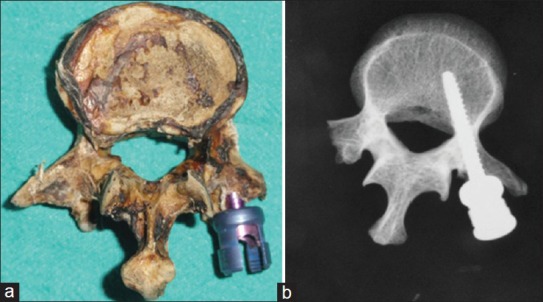
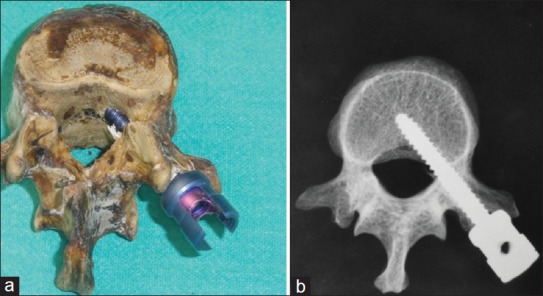
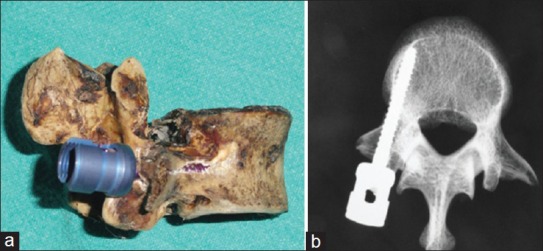
Materials and methods: Sixty fresh human cadaveric vertebrae (D10-L2) were harvested. Dual-energy X-ray absorptiometry (DEXA) scan of vertebrae was done for BMD. Titanium pedicle screws of different diameters (5.2 and 6.2 mm) were inserted in the thoracic and lumbar segments after dividing the specimens into three groups: a) standard pedicle screw (no cortical perforation); b) screw with medial cortical perforation; and c) screw with lateral cortical perforation. Finally, pullout load of pedicle screws was recorded using INSTRON Universal Testing Machine.
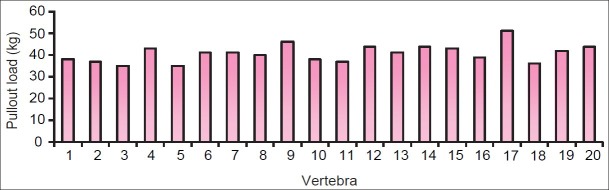
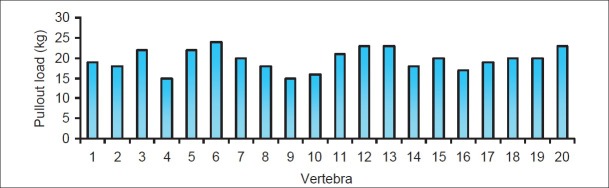
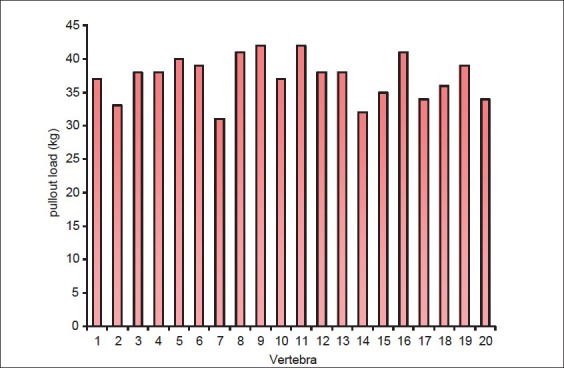
Results: Compared with standard placement, medially misplaced screws had 9.4% greater mean pullout strength and laterally misplaced screws had 47.3% lesser mean pullout strength. The pullout strength of the 6.2 mm pedicle screws was 33% greater than that of the 5.2 mm pedicle screws. The pullout load of pedicle screws in lumbar vertebra was 13.9% greater than that in the thoracic vertebra (P = 0.105), but it was not statistically significant. There was no significant difference between pullout loads of vertebra with different BMD (P = 0.901).
Conclusion: The mean pullout strength was less with lateral misplaced pedicle screws while medial misplaced pedicle screw had more pullout strength. The pullout load of 6.2 mm screws was greater than that of 5.2 mm pedicle screws. No significant correlation was found between bone mineral densities and the pullout strength of vertebra. Similarly, the pullout load of screw placed in thoracic and lumbar vertebrae was not significantly different.
Keywords: Misplaced pedicle screw; pullout strength; vertebra.
Conflict of interest statement
Figures
References
-
- Roy-Camille R, Saillant G, Mazel C. Internal fixation of the lumbar spine with pedicle screw plating. Clin Orthop Rel Res. 1986;203:7–17. - PubMed
-
- Brasiliense LB, Theodore N, Lazaro BC, Sayed ZA, Deniz FE, Sonntag VK, et al. Quantitative analysis of misplaced pedicle screws in the thoracic spine: How much pullout strength is lost? J Neurosurg Spine. 2010;12:503–8. - PubMed
-
- George DC, Krag MH, Johnson CC, Van Hal ME, Haugh LD, Grobler LJ. Hole preparation techniques for transpedicle screws. Effect on pull-out strength from human cadaveric vertebrae. Spine (Phila Pa 1976) 1991;16:181–4. - PubMed
-
- Kote R, Panjabi MM, Liu W. Multidirectional instability of the thoracic spine due to iatrogenic pedicle injuries during transpedicular fixation. Spine. 1997;22:1836–42. - PubMed
-
- Wittenberg RH, Lee KS, Shea M, White AA, 3rd, Hayes WC. Effect of screw diameter, insertion technique, and bone cement augmentation of pedicular screw fixation strength. Clin Orthop Rel Res. 1993;296:278–87. - PubMed
Publication types
LinkOut - more resources
Full Text Sources
Other Literature Sources