


Severe acute asthma exacerbation in children: a stepwise approach for escalating therapy in a pediatric intensive care unit
- PMID: 23798903
- PMCID: PMC3668947
- DOI: 10.5863/1551-6776-18.2.88
Severe acute asthma exacerbation in children: a stepwise approach for escalating therapy in a pediatric intensive care unit
Abstract
Objectives: An increasing prevalence of pediatric asthma has led to increasing burdens of critical illness in children with severe acute asthma exacerbations, often leading to respiratory distress, progressive hypoxia, and respiratory failure. We review the definitions, epidemiology, pathophysiology, and clinical manifestations of severe acute asthma, with a view to developing an evidence-based, stepwise approach for escalating therapy in these patients.
Methods: Subject headings related to asthma, status asthmaticus, critical asthma, and drug therapy were used in a MEDLINE search (1980-2012), supplemented by a manual search of personal files, references cited in the reviewed articles, and treatment algorithms developed within Le Bonheur Children's Hospital.
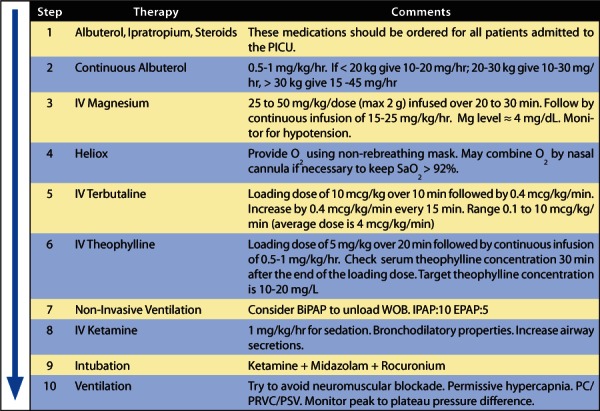
Results: Patients with asthma require continuous monitoring of their cardiorespiratory status via noninvasive or invasive devices, with serial clinical examinations, objective scoring of asthma severity (using an objective pediatric asthma score), and appropriate diagnostic tests. All patients are treated with β-agonists, ipratropium, and steroids (intravenous preferable over oral preparations). Patients with worsening clinical status should be progressively treated with continuous β-agonists, intravenous magnesium, helium-oxygen mixtures, intravenous terbutaline and/or aminophylline, coupled with high-flow oxygen and non-invasive ventilation to limit the work of breathing, hypoxemia, and possibly hypercarbia. Sedation with low-dose ketamine (with or without benzodiazepines) infusions may allow better toleration of non-invasive ventilation and may also prepare the patient for tracheal intubation and mechanical ventilation, if indicated by a worsening clinical status.
Conclusions: Severe asthma can be a devastating illness in children, but most patients can be managed by using serial objective assessments and the stepwise clinical approach outlined herein. Following multidisciplinary education and training, this approach was successfully implemented in a tertiary-care, metropolitan children's hospital.
Keywords: asthma; child; critical care; infant; respiratory failure; status asthmaticus.
Figures
Comment in
- J Pediatr Pharmacol Ther. 18:76.
References
-
- Kelly CS, Andersen CL, Pestian JP. Improved outcomes for hospitalized asthmatic children using a clinical pathway. Ann Allergy Asthma Immunol. 2000;84(5):509–516. et al. - PubMed
-
- Kaza V, Bandi V, Guntupalli KK. Acute severe asthma: recent advances. Curr Opinion Pulmon Med. 2007;13(1):1–7. - PubMed
-
- Birken CS, Parkin PC, Macarthur C. Asthma severity scores for preschoolers displayed weaknesses in reliability, validity, and responsiveness. J Clin Epidemiol. 2004;57(11):1177–1181. - PubMed
-
- Mannino DM, Homa DM, Akinbami LJ. Surveillance for asthma—United States, 1980–1999. MMWR Surveill Summ. 2002;51(1):1–13. et al. - PubMed
-
- Molfino NA, Nannini LJ, Martelli AN. Respiratory arrest in near-fatal asthma. N Engl J Med. 1991;324(5):285–288. et al. - PubMed
LinkOut - more resources
Full Text Sources
Other Literature Sources
Medical