


Moderation of antipsychotic-induced weight gain by energy balance gene variants in the RUPP autism network risperidone studies
- PMID: 23799528
- PMCID: PMC3693401
- DOI: 10.1038/tp.2013.26
Moderation of antipsychotic-induced weight gain by energy balance gene variants in the RUPP autism network risperidone studies
Abstract
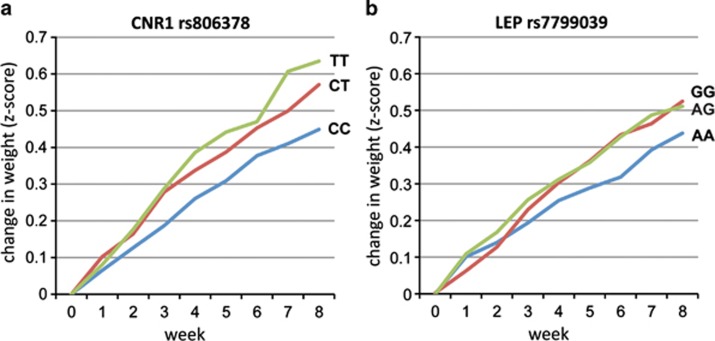
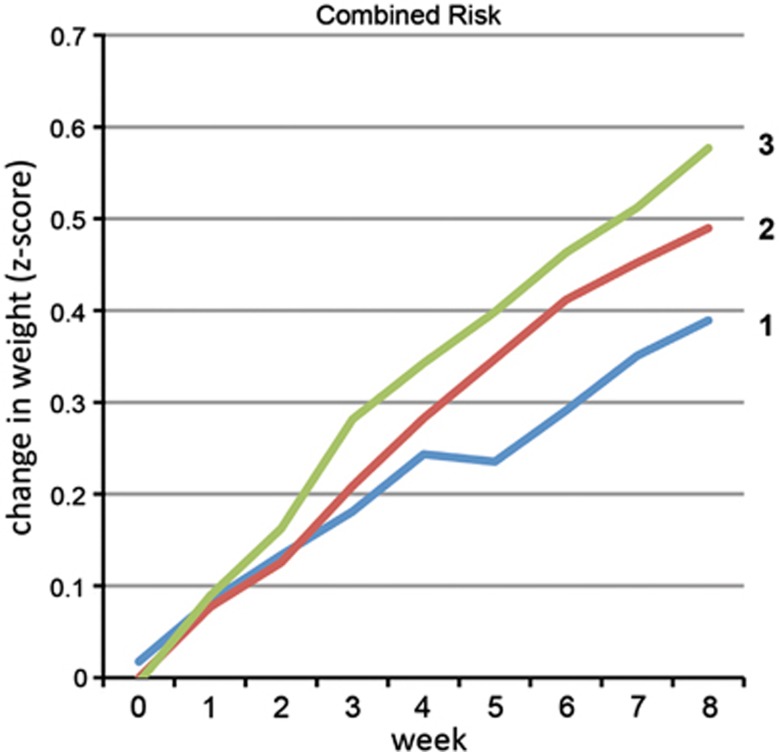
Second-generation antipsychotic exposure, in both children and adults, carries significant risk for excessive weight gain that varies widely across individuals. We queried common variation in key energy balance genes (FTO, MC4R, LEP, CNR1, FAAH) for their association with weight gain during the initial 8 weeks in the two NIMH Research Units on Pediatric Psychopharmacology Autism Network trials (N=225) of risperidone for treatment of irritability in children/adolescents aged 4-17 years with autism spectrum disorders. Variants in the cannabinoid receptor (CNR)-1 promoter (P=1.0 × 10(-6)), CNR1 (P=9.6 × 10(-5)) and the leptin (LEP) promoter (P=1.4 × 10(-4)) conferred robust-independent risks for weight gain. A model combining these three variants was highly significant (P=1.3 × 10(-9)) with a 0.85 effect size between lowest and highest risk groups. All results survived correction for multiple testing and were not dependent on dose, plasma level or ethnicity. We found no evidence for association with a reported functional variant in the endocannabinoid metabolic enzyme, fatty acid amide hydrolase, whereas body mass index-associated single-nucleotide polymorphisms in FTO and MC4R showed only trend associations. These data suggest a substantial genetic contribution of common variants in energy balance regulatory genes to individual antipsychotic-associated weight gain in children and adolescents, which supersedes findings from prior adult studies. The effects are robust enough to be detected after only 8 weeks and are more prominent in this largely treatment naive population. This study highlights compelling directions for further exploration of the pharmacogenetic basis of this concerning multifactorial adverse event.
Figures
References
-
- Allison DB, Mentore JL, Heo M, Chandler LP, Cappelleri JC, Infante MC, et al. Antipsychotic-induced weight gain: a comprehensive research synthesis. Am J Psychiatry. 1999;156:1686–1696. - PubMed
-
- Theisen FM, Gebhardt S, Haberhausen M, Heinzel-Gutenbrunner M, Wehmeier PM, Krieg JC, et al. Clozapine-induced weight gain: a study in monozygotic twins and same-sex sib pairs. Psychiatr Genet. 2005;15:285–289. - PubMed
-
- Nasrallah HA. Atypical antipsychotic-induced metabolic side effects: insights from receptor-binding profiles. Mol Psychiatry. 2008;13:27–35. - PubMed
-
- De Luca V, Mueller DJ, de Bartolomeis A, Kennedy JL. Association of the HTR2C gene and antipsychotic induced weight gain: a meta-analysis. Int J Neuropsychopharmacol. 2007;10:697–704. - PubMed
-
- Lett TA, Wallace TJ, Chowdhury NI, Tiwari AK, Kennedy JL, Muller DJ. Pharmacogenetics of antipsychotic-induced weight gain: review and clinical implications. Mol Psychiatry. 2011;17:242–266. - PubMed
Publication types
MeSH terms
Substances
Grants and funding
- U10MH66764/MH/NIMH NIH HHS/United States
- T32MH073517/MH/NIMH NIH HHS/United States
- U10 MH066768/MH/NIMH NIH HHS/United States
- U01 MH070009/MH/NIMH NIH HHS/United States
- U10MH66768/MH/NIMH NIH HHS/United States
- U10 MH066766/MH/NIMH NIH HHS/United States
- N01MH70010/MH/NIMH NIH HHS/United States
- N01 MH080011/DA/NIDA NIH HHS/United States
- K24 MH010805/MH/NIMH NIH HHS/United States
- U01 MH070010/MH/NIMH NIH HHS/United States
- N01MH70001/MH/NIMH NIH HHS/United States
- T32 MH073517/MH/NIMH NIH HHS/United States
- K23 MH094613/MH/NIMH NIH HHS/United States
- N01MH70009/MH/NIMH NIH HHS/United States
- U10MH66766/MH/NIMH NIH HHS/United States
- U10 MH066764/MH/NIMH NIH HHS/United States
LinkOut - more resources
Full Text Sources
Other Literature Sources
Medical
Molecular Biology Databases
Miscellaneous
