


TERT promoter mutations in ocular melanoma distinguish between conjunctival and uveal tumours
- PMID: 23799844
- PMCID: PMC3721405
- DOI: 10.1038/bjc.2013.312
TERT promoter mutations in ocular melanoma distinguish between conjunctival and uveal tumours
Abstract
Background: Recently, activating mutations in the TERT promoter were identified in cutaneous melanoma. We tested a cohort of ocular melanoma samples for similar mutations.
Methods: The TERT promoter region was analysed by Sanger sequencing in 47 uveal (ciliary body or choroidal) melanomas and 38 conjunctival melanomas.
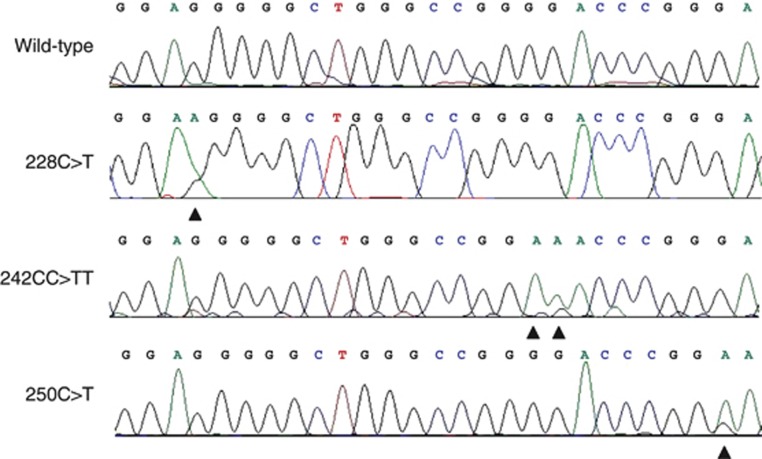
Results: Mutations of the TERT promoter were not identified in uveal melanomas, but were detected in 12 (32%) conjunctival melanomas. Mutations had a UV signature and were identical to those found in cutaneous melanoma.
Conclusion: Mutations of TERT promoter with UV signatures are frequent in conjunctival melanomas and favour a pathogenetic kinship with cutaneous melanomas. Absence of these mutations in uveal melanomas emphasises their genetic distinction from cutaneous and conjunctival melanomas.
Figures
References
-
- Ball NJ, Yohn JJ, Morelli JG, Norris DA, Golitz LE, Hoeffler JP. Ras mutations in human melanoma: a marker of malignant progression. J Invest Dermatol. 1994;102 (3:285–290. - PubMed
-
- Chapman PB, Hauschild A, Robert C, Haanen JB, Ascierto P, Larkin J, Dummer R, Garbe C, Testori A, Maio M, Hogg D, Lorigan P, Lebbe C, Jouary T, Schadendorf D, Ribas A, O'Day SJ, Sosman JA, Kirkwood JM, Eggermont AM, Dreno B, Nolop K, Li J, Nelson B, Hou J, Lee RJ, Flaherty KT, McArthur GA. Improved survival with vemurafenib in melanoma with BRAF V600E mutation. N Engl J Med. 2011;364 (26:2507–2516. - PMC - PubMed
-
- Curtin JA, Busam K, Pinkel D, Bastian BC. Somatic activation of KIT in distinct subtypes of melanoma. J Clin Oncol. 2006;24 (26:4340–4346. - PubMed
-
- Curtin JA, Fridlyand J, Kageshita T, Patel HN, Busam KJ, Kutzner H, Cho KH, Aiba S, Brocker EB, LeBoit PE, Pinkel D, Bastian BC. Distinct sets of genetic alterations in melanoma. N Engl J Med. 2005;353 (20:2135–2147. - PubMed
-
- Davies H, Bignell GR, Cox C, Stephens P, Edkins S, Clegg S, Teague J, Woffendin H, Garnett MJ, Bottomley W, Davis N, Dicks E, Ewing R, Floyd Y, Gray K, Hall S, Hawes R, Hughes J, Kosmidou V, Menzies A, Mould C, Parker A, Stevens C, Watt S, Hooper S, Wilson R, Jayatilake H, Gusterson BA, Cooper C, Shipley J, Hargrave D, Pritchard-Jones K, Maitland N, Chenevix-Trench G, Riggins GJ, Bigner DD, Palmieri G, Cossu A, Flanagan A, Nicholson A, Ho JW, Leung SY, Yuen ST, Weber BL, Seigler HF, Darrow TL, Paterson H, Marais R, Marshall CJ, Wooster R, Stratton MR, Futreal PA. Mutations of the BRAF gene in human cancer. Nature. 2002;417 (6892:949–954. - PubMed
Publication types
MeSH terms
Substances
LinkOut - more resources
Full Text Sources
Other Literature Sources
Medical
Molecular Biology Databases
Research Materials
Miscellaneous
