. 2013 Jun 25:13:91.
doi: 10.1186/1471-2229-13-91.

Genetic variation in four maturity genes affects photoperiod insensitivity and PHYA-regulated post-flowering responses of soybean

Affiliations

Genetic variation in four maturity genes affects photoperiod insensitivity and PHYA-regulated post-flowering responses of soybean

Meilan Xu et al. BMC Plant Biol. .

Abstract

Background: Absence of or low sensitivity to photoperiod is necessary for short-day crops, such as rice and soybean, to adapt to high latitudes. Photoperiod insensitivity in soybeans is controlled by two genetic systems and involves three important maturity genes: E1, a repressor for two soybean orthologs of Arabidopsis FLOWERING LOCUS T (GmFT2a and GmFT5a), and E3 and E4, which are phytochrome A genes. To elucidate the diverse mechanisms underlying photoperiod insensitivity in soybean, we assessed the genotypes of four maturity genes (E1 through E4) in early-flowering photoperiod-insensitive cultivars and their association with post-flowering responses.

Results: We found two novel dysfunctional alleles in accessions originally considered to have a dominant E3 allele according to known DNA markers. The E3 locus, together with E1 and E4, contained multiple dysfunctional alleles. We identified 15 multi-locus genotypes, which we subdivided into 6 genotypic groups by classifying their alleles by function. Of these, the e1-as/e3/E4 genotypic group required an additional novel gene (different from E1, E3, and E4) to condition photoperiod insensitivity. Despite their common pre-flowering photoperiod insensitivity, accessions with different multi-locus genotypes responded differently to the post-flowering photoperiod. Cultivars carrying E3 or E4 were sensitive to photoperiod for post-flowering characteristics, such as reproductive period and stem growth after flowering. The phytochrome A-regulated expression of the determinate growth habit gene Dt1, an ortholog of Arabidopsis TERMINAL FLOWER1, was involved in the persistence of the vegetative activity at the stem apical meristem of flower-induced plants under long-day conditions.

Conclusions: Diverse genetic mechanisms underlie photoperiod insensitivity in soybean. At least three multi-locus genotypes consisting of various allelic combinations at E1, E3, and E4 conferred pre-flowering photoperiod insensitivity to soybean cultivars but led to different responses to photoperiod during post-flowering vegetative and reproductive development. The phyA genes E3 and E4 are major controllers underlying not only pre-flowering but also post-flowering photoperiod responses. The current findings improve our understanding of genetic diversity in pre-flowering photoperiod insensitivity and mechanisms of post-flowering photoperiod responses in soybean.


Figures

Figure 1
Figure 1
Novel null alleles detected at the E3 locus in photoperiod-insensitive soybean accessions. A) Positions and types of mutations. B) Changes in predicted amino acid sequences; asterisks indicate stop codons. C) DNA markers distinguishing each of the recessive alleles from the others. Cultivars Darta and Nawiko have e3-fs and e3-ns, respectively. Harosoy has a dominant E3 allele. Marker diagnostic for e3-fs shown in left panel. Marker diagnostic for e3-ns shown in right panel. nd, not digested.
Figure 2
Figure 2
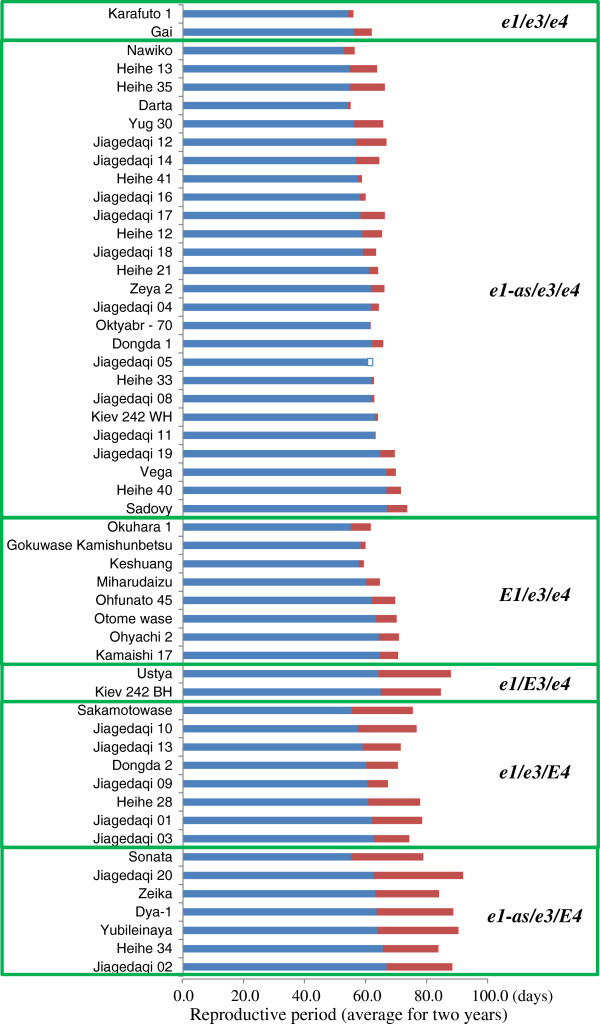
Variation in reproductive period among photoperiod-insensitive soybean accessions. Bars indicate the reproductive period (number of days from R1 to R8) under natural-daylength conditions with a maximum of 16.5 h in Sapporo, Japan (blue) and the increase (red) or decrease (open) in duration under artificially induced 20-hour long-daylength conditions. The designations e1, e3, and e4 refer to all of the dysfunctional alleles at these respective loci.
Figure 3
Figure 3
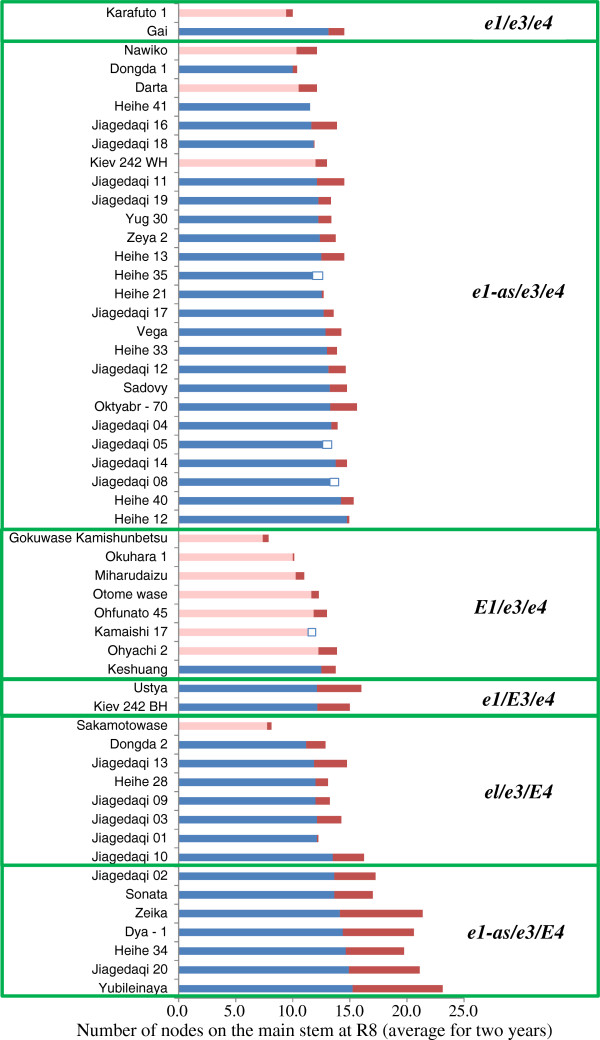
Variation in the number of nodes on the main stem among photoperiod-insensitive soybean accessions. Bars indicate the number of nodes produced under natural-daylength conditions with a maximum of 16.5 h in Sapporo, Japan (blue) and the increase (red) or decrease (open) in number of nodes under artificially induced 20-hour long-daylength conditions. Pink indicates the number of nodes produced by determinate dt1 accessions under natural-daylength conditions. The designations e1, e3, and e4 refer to all of the dysfunctional alleles at these respective loci.
Figure 4
Figure 4
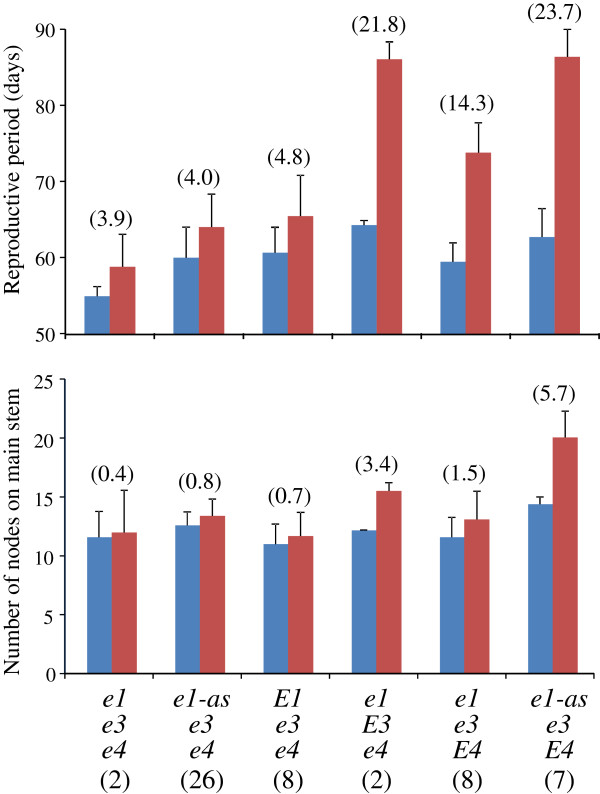
Average and 1 standard deviation (vertical bars) of reproductive period and number of nodes on main stem under ND (blue bars) and LD (red bars) in photoperiod-insensitive soybean accessions of different maturity genotypes. The difference between ND and LD is given in parentheses. The genotypic class E1/e3/e4 mostly consisted of determinate dt1 accessions. The designations e1, e3, and e4 refer to all of the dysfunctional alleles at these respective loci. Numerals within parentheses under genotypes indicate the number of accessions classified into each multi-locus genotype.
Figure 5
Figure 5
Different post-flowering photoperiod responses among Harosoy and its NILs for a determinate growth habit allele (dt1) and the maturity alleles e3 and e4 in two independent experiments using different light sources, R-light–enriched [blue] and FR-light–enriched [red] conditions. In the R-light–enriched condition, a combination of fluorescent and incandescent lamps with an R:FR ratio of 1.2 was used as the light source for 16 hours after dawn followed by lighting with the same light source for an additional 4 hours. The FR-light–enriched condition involved the use of both fluorescent and incandescent lamps with an R:FR ratio of 1.2 for 16 hours after dawn followed by lighting with incandescent lamps only for an additional 4 hours. A) Number of nodes (average ± 1 standard deviation) on the main stem at 30 days after flowering. B) Number of pods (average ± 1 standard deviation) more than 3.0 cm long at 30 days after flowering. Transcripts levels of Dt1 (GmTFL1b) at stem tips in different growth stages under (C) R-light–enriched and (D) FR-light–enriched conditions. Relative transcript levels (mean and standard error; n = 3) were analyzed by quantitative RT-PCR and normalized to β-tubulin (TUB). FL indicates time of flowering.
Figure 6
Figure 6
Proposed model of the genetic network comprising three maturity genes and one growth-habit gene affecting pre- and post-flowering photoperiod responses in soybean under LD. A) Photoperiod-sensitive plants with E1 or e1-as and either E3 or E4. PHYA-regulated E1 expression inhibits the expression of soybean orthologs of FT (GmFT2a and GmFT5a). Once induced by brief exposure to SD, flowering persists after the transfer to LD, but seed maturation and stem termination are inhibited under the control of PHYA encoded by the E3 and E4 alleles through activation of an unknown factor (Y) and upregulation of Dt1 expression, respectively. B) Photoperiod-insensitive plants of the e3/e4 group. Owing to the dysfunction of PHYA, flowering is induced under LD, which is followed by normal seed maturation and stem termination. C and D) Photoperiod-insensitive plants of C) the e1/E3/e4 or e1/e3/E4 group and D) the e1-as/e3/E4 group. In the e1/E3/e4 or e1/e3/E4 group, flowering is induced by the dysfunction of the E1 gene (panel C); whereas that in the e1-as/e3/E4 group is induced through an unknown factor (X) (panel D). Seed maturation of plants in these two groups is delayed similarly because of the presence of the E3 or E4 allele. However, stem growth after LD terminates earlier in the e1/E3/e4 or e1/e3/E4 group than in the e1-as/e3/E4 group: PHYA-mediated Dt1 expression under LD likely preserves the vegetative activity of the SAM to produce more nodes in the e1-as/e3/E4 group. The designations e1, e3, and e4 refer to all dysfunctional alleles at these loci. Solid and dotted arrows indicate activation and lack of activation, respectively.

References

    1. Watanabe S, Harada K, Abe J. Genetic and molecular bases of photoperiod responses of flowering in soybean. Breed Sci. 2012;61:531–543. doi: 10.1270/jsbbs.61.531. - DOI - PMC - PubMed
    1. Buzzell RI. Inheritance of a soybean flowering response to fluorescent-daylength conditions. Can J Genet Cytol. 1971;13:703–707.
    1. Buzzell RI, Voldeng HD. Inheritance of insensitivity to long day length. Soybean Genet Newsl. 1980;7:26–29.
    1. Saindon G, Voldeng HD, Beversdorf WD, Buzzell RI. Genetic control of long daylength response in soybean. Crop Sci. 1989;29:1436–1439. doi: 10.2135/cropsci1989.0011183X002900060021x. - DOI
    1. Cober ER, Tanner JW, Voldeng HD. Genetic control of photoperiod response in early-maturing near-isogenic soybean lines. Crop Sci. 1996;36:601–605. doi: 10.2135/cropsci1996.0011183X003600030013x. - DOI

Publication types

MeSH terms