. 2013 Jun 20:4:147.
doi: 10.3389/fphys.2013.00147. eCollection 2013.

Mitochondria and FOXO3: breath or die

Affiliations

Mitochondria and FOXO3: breath or die

Judith Hagenbuchner et al. Front Physiol. .

Abstract

Forkhead box O (FOXO) transcription factors are regulators of cell-type specific apoptosis and cell cycle arrest but also control longevity and reactive oxygen species (ROS). ROS-control by FOXO is mediated by transcriptional activation of detoxifying enzymes such as Superoxide dismutase 2 (SOD2), Catalase or Sestrins or by the repression of mitochondrial respiratory chain proteins resulting in reduced mitochondrial activity. FOXO3 also regulates the adaptation to hypoxia by reducing mitochondrial mass and oxygen consumption during HIF-1α activation. In neuronal tumor cells, FOXO3 triggers ROS-accumulation as a consequence of transient mitochondrial outer membrane permeabilization, which is essential for FOXO3-induced apoptosis in these cells. Cellular ROS levels are affected by the FOXO-targets Bim, BclxL, and Survivin. All three proteins localize to mitochondria and affect mitochondrial membrane potential, respiration and cellular ROS levels. Bim-activation by FOXO3 causes mitochondrial depolarization resulting in a transitory decrease of respiration and ROS production. Survivin, on the other hand, actively changes mitochondrial architecture, respiration-efficacy and energy metabolism. This ability distinguishes Survivin from other anti-apoptotic proteins such as BclxL, which inhibits ROS by inactivating Bim but does not alter mitochondrial function. Importantly, FOXO3 simultaneously also activates ROS-detoxification via induction of SESN3. In this paper we discuss the hypothesis that the delicate balance between ROS-accumulation by Bim-triggered mitochondrial damage, mitochondrial architecture and ROS-detoxifying proteins determines cell fate. We provide evidence for a FOXO self-reactivating loop and for novel functions of FOXO3 in controlling mitochondrial respiration of neuronal cells, which further supports the current view that FOXO transcription factors are information-integrating sentinels of cellular stress and critical modulators of cell homeostasis.

Keywords: BH3-only proteins; Bcl2-rheostat; forkhead transcription factor; mitochondrial fission; mitochondrial respiration.


Figures
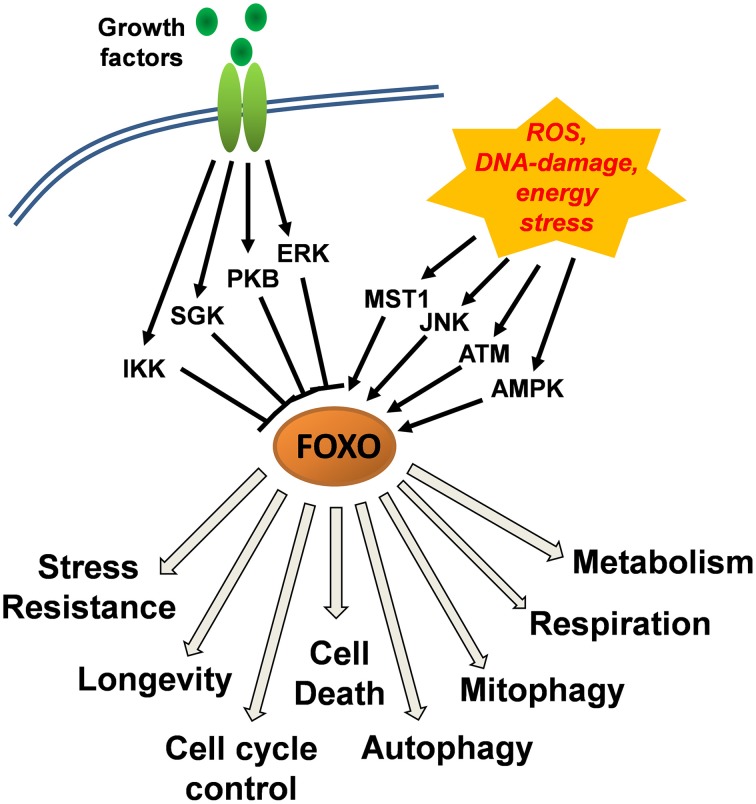
Figure 1
Figure 1
Control of FOXO function downstream of growth-factor and stress-induced kinase signaling cascades. Growth factor signaling via protein kinase B (PKB), serum- and glucocorticoid-induced kinase (SGK), IkB-kinase (IKK), and extracellular-signal regulated kinase (ERK) causes inactivation of FOXO transcription factors and their export from the nucleus. Jun-N-terminal kinase (JNK) and mammalian STE20-like protein kinase 1 (MST1) that are activated upon cellular stress, induce the nuclear accumulation of FOXOs. A main trigger of JNK activation is accumulation of cellular reactive oxygen species (ROS) which together with DNA-damage also activate ataxia telangiectasia mutated (ATM) kinase and induce the interaction between ATM and FOXO and its nuclear accumulation. AMP-activated kinase (AMPK) functions as a cellular energy sensor that increases the activity of nuclear FOXO factors. AMPK thereby acts in concert with either low growth factor availability or high cellular stress and further steers FOXO target recognition.
Figure 2
Figure 2
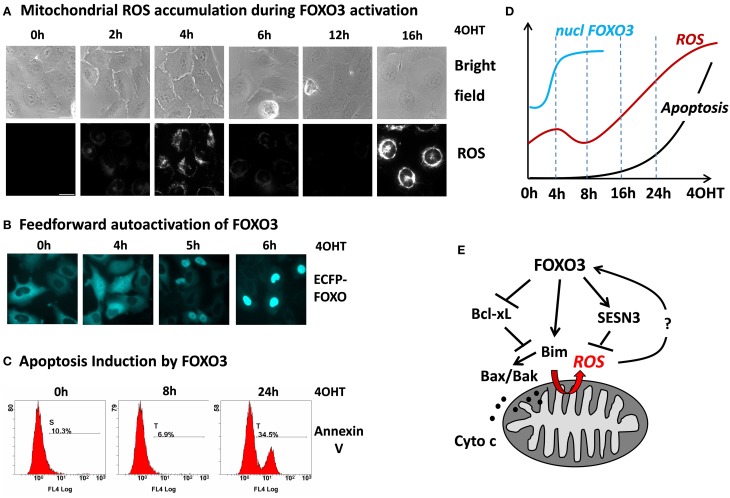
FOXO3 activation causes biphasic ROS accumulation at mitochondria leading to feed forward activation and apoptosis. SH-EP neuroblastoma cells expressing a conditional FOXO3-ERtm protein were treated with 4-OH-tamoxifene (4OHT), which leads to functional activation of this transgene. FOXO3 induces a first ROS accumulation at 4 h with complete SESN3-dependent decay of ROS between 8 and 14 h and strong secondary accumulation of ROS afterwards that finally leads to apoptotic cell death. Accumulation of ROS was detected using MitoTracker Red CMH2XROS (Invitrogen) by live-cell imaging in an Axiovert200M microscope (Zeiss) (A). Subsequent to the first ROS peak triggered by FOXO3(A3)ERtm nuclear accumulation of ECFP-FOXO3wt is observed suggesting amplifying feed forward activation of additional FOXO3 molecules after primary FOXO3 activation (B). Apoptosis was determined by Annexin-V staining in a FC500 flow cytometer (Beckman-Coulter) (C). The chronology of cellular events in response to FOXO3 activation: after 4 h ECFP-tagged FOXO3 starts to accumulate in the nucleus (blue line, data based on quantification of nuclear FOXO3 by live cell imaging analysis), ROS accumulates first after 4 h, followed by decay to background ROS levels and a second much more intensive ROS accumulation (red line) that also marks the onset of cell death (black line, based on time course experiments using flow cytometric analysis of annexin-V staining). The data was compiled from analyses shown in (A–C), additional unpublished data or data from (Hagenbuchner et al., 2012a) (D). Model of cell death/stress resistance regulation by FOXO3 involving the biphasic accumulation of mitochondrial ROS downstream of Bim, which may constitute a feed forward signal to overcome the ROS-protective capacity of SESN3 (E).
Figure 3
Figure 3
The FOXO3-target Survivin reduces mitochondrial respiration and induces mitochondrial fission in neuronal tumor cells via Drp1 recruitment to mitochondria. Ectopic expression of the anti-apoptotic protein Survivin in neuroblastoma cells reduces basal and FCCP-activated mitochondrial respiration to about one third of control cells. Oxygen consumption of the cells and mitochondrial function were analyzed by high-resolution respirometry (Kuznetsov et al., 2008), using a two-channel Oroboros Oxygraph respirometer. This reduced respiratory activity results from almost absence of respiratory complex I activity (data not shown; ***P < 0.001, student's t-test) (A). Survivin recruits DNM1L/Drp1 to mitochondria and induces mitochondrial fission. Microscopic images were acquired on an Axiovert200M microscope equipped with an Apotome_2 module (B). Mitochondrial fission is associated with apoptosis-protection and significantly reduced capability to accumulate ROS in response to FOXO3 activation or treatment with chemotherapeutic agents (see text) (Hagenbuchner et al., 2012b).
Figure 4
Figure 4
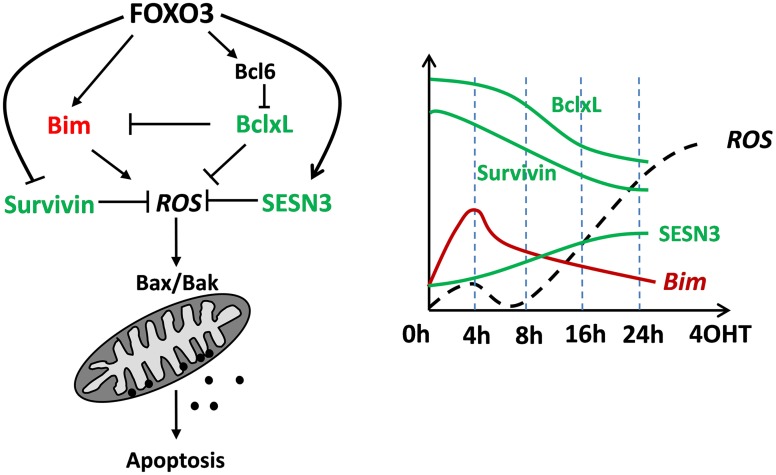
A conceptional view on how FOXO3 regulates mitochondrial ROS and apoptotic cell death in neuronal cells and neuroblastoma tumor cells. Transitory induction of pro-apoptotic Bim by FOXO3 constitutes a first mitochondria-damaging signal that triggers the primary ROS peak at 4 h. In parallel the ROS-detoxifying SESN3 accumulates and critically regulates decay of the ROS after 4–6 h. Bim-neutralizing BclxL and Survivin are both repressed by FOXO3, thereby lowering the ability of the cell to cope with apoptosis-inducing signals. This concerted regulation of pro- and anti-apoptotic ROS-affecting proteins overcomes the protective effect of SESN3 after about 16 h leading to a sharp and continuous increase in ROS, which finally leads to apoptotic cell death. The schematic presentation is based on several time-course immunoblot experiments and data from fluorescence-based mitochondrial ROS measurements not included in this paper.

References

    1. Arden K. C. (2008). FOXO animal models reveal a variety of diverse roles for FOXO transcription factors. Oncogene 27, 2345–2350 10.1038/onc.2008.27 - DOI - PubMed
    1. Bakker W. J., Harris I. S., Mak T. W. (2007). FOXO3a is activated in response to hypoxic stress and inhibits HIF1-induced apoptosis via regulation of CITED2. Mol. Cell. 28, 941–953 10.1016/j.molcel.2007.10.035 - DOI - PubMed
    1. Braeckman B. P., Vanfleteren J. R. (2007). Genetic control of longevity in C. elegans. Exp. Gerontol. 42, 90–98 10.1016/j.exger.2006.04.010 - DOI - PubMed
    1. Brent M. M., Anand R., Marmorstein R. (2008). Structural basis for DNA recognition by FoxO1 and its regulation by posttranslational modification. Structure 16, 1407–1416 10.1016/j.str.2008.06.013 - DOI - PMC - PubMed
    1. Brunet A., Sweeney L. B., Sturgill J. F., Chua K. F., Greer P. L., Lin Y., et al. (2004). Stress-dependent regulation of FOXO transcription factors by the SIRT1 deacetylase. Science 303, 2011–2015 10.1126/science.1094637 - DOI - PubMed