


Increasing girls' knowledge about human papillomavirus vaccination with a pre-test and a national leaflet: a quasi-experimental study
- PMID: 23802703
- PMCID: PMC3698036
- DOI: 10.1186/1471-2458-13-611
Increasing girls' knowledge about human papillomavirus vaccination with a pre-test and a national leaflet: a quasi-experimental study
Abstract
Background: Adolescent girls are at an age to be involved in the decision about HPV vaccination uptake and therefore need adequate information about the vaccination. This study assesses to what extent reading an official information leaflet about HPV contributes to girls' knowledge levels, and to what extent an increase in knowledge is boosted by a pre-test measurement.
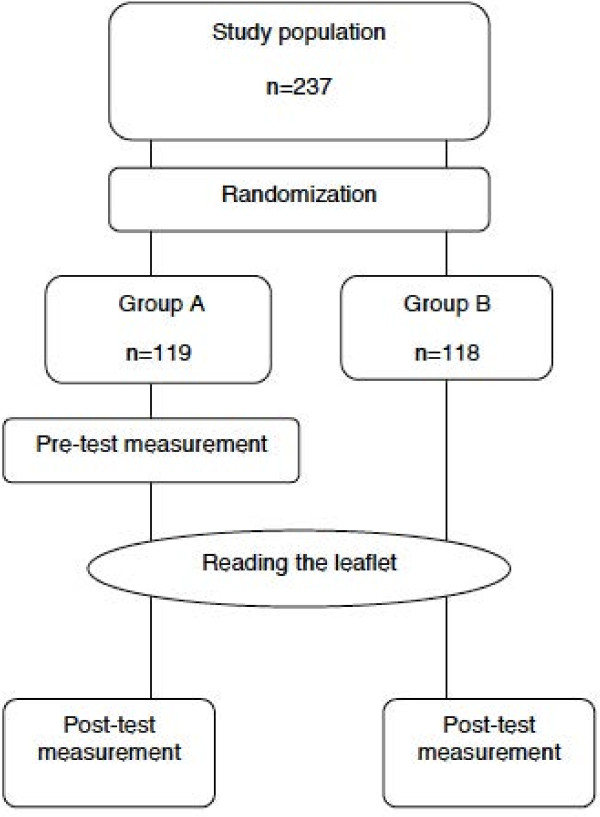
Methods: Participants (girls aged 11-14 years) were systematically allocated to group A that completed a pre-test measurement (12 true/false statements) or to group B that did not complete it. Subsequently, both groups read the HPV leaflet and completed the post-test measurement.
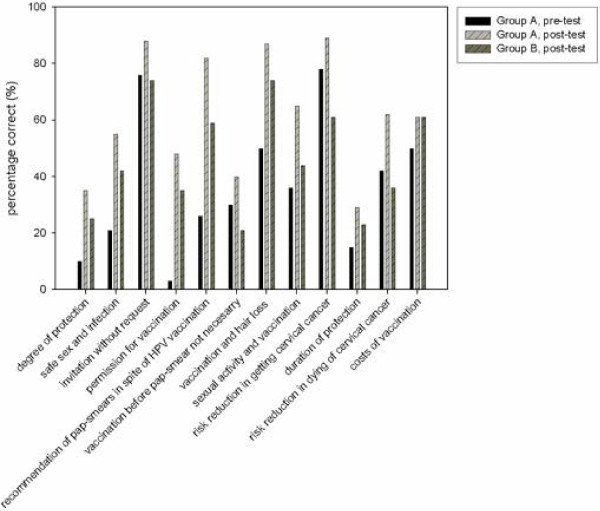
Results: The response rate was 237/287 (83%). Pre-test scores in group A (M = 3.6, SD = 1.81, p < 0.001) were lower than post-test mean knowledge scores (0-10) in group B (M = 4.6, SD = 2.05). Post-test knowledge scores in group A were higher than those in group B [6.2 (SD = 2.06) versus 4.6 (SD = 2.05), p < 0.001]. In the post-test measurement, about a third of both groups knew that vaccinations do not give 100% protection against cervical cancer and that the duration of protection is unknown.
Conclusions: Reading the information leaflet had a positive effect on knowledge, even more so when boosted by a pre-test measurement. However, knowledge on the degree and duration of protection against cervical cancer remained limited. Focusing girls' attention on important aspects before they start reading the leaflet (e.g. by including a quiz on the first page) may serve to raise their awareness of these aspects.
Figures
References
-
- Kollar LM, Kahn JA. Education about human papillomavirus and human papillomavirus vaccines in adolescents. Adolescent and Pediatric Gynecology. 2008;20:479–483. - PubMed
-
- Baseman JG, Koutsky LA. The epidemiology of human papillomavirus infections. J Clin Virol. 2005;32(Suppl 1):S16–S24. - PubMed
-
- Koutsky L. Epidemiology of genital human papillomavirus infection. Am J Med. 1997;102:3–8. - PubMed
Publication types
MeSH terms
Substances
LinkOut - more resources
Full Text Sources
Other Literature Sources
Medical
