


Using online health communities to deliver patient-centered care to people with chronic conditions
- PMID: 23803284
- PMCID: PMC3713879
- DOI: 10.2196/jmir.2476
Using online health communities to deliver patient-centered care to people with chronic conditions
Abstract
Background: Our health care system faces major threats as the number of people with multiple chronic conditions rises dramatically.
Objective: To study the use of Online Health Communities (OHCs) as a tool to facilitate high-quality and affordable health care for future generations.
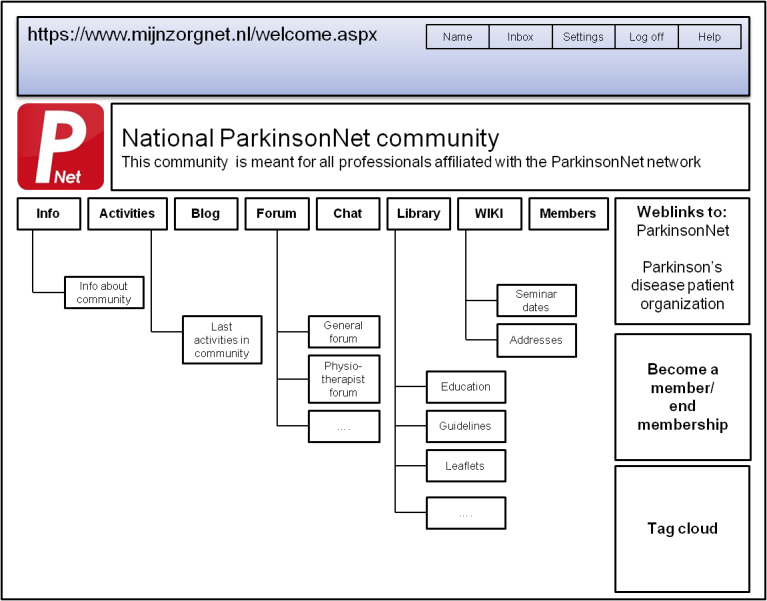
Methods: OHCs are Internet-based platforms that unite either a group of patients, a group of professionals, or a mixture of both. Members interact using modern communication technologies such as blogs, chats, forums, and wikis. We illustrate the use of OHCs for ParkinsonNet, a professional network for Parkinson disease whose participants-both patients and professionals-use various types of OHCs to deliver patient-centered care.
Results: We discuss several potential applications in clinical practice. First, due to rapid advances in medical knowledge, many health professionals lack sufficient expertise to address the complex health care needs of chronic patients. OHCs can be used to share experiences, exchange knowledge, and increase disease-specific expertise. Second, current health care delivery is fragmented, as many patients acquire relationships with multiple professionals and institutions. OHCs can bridge geographical distances and enable interdisciplinary collaboration across institutions and traditional echelons. Third, chronic patients lack adequate tools to self-manage their disease. OHCs can be used to actively engage and empower patients in their health care process and to tailor care to their individual needs. Personal health communities of individual patients offer unique opportunities to store all medical information in one central place, while allowing transparent communication across all members of each patient's health care team.
Conclusions: OHCs are a powerful tool to address some of the challenges chronic care faces today. OHCs help to facilitate communication among professionals and patients and support coordination of care across traditional echelons, which does not happen spontaneously in busy practice.
Keywords: Internet; Parkinson disease; chronic disease; community networks; long-term care; patient-centered care.
Conflict of interest statement
Conflicts of Interest: Professor Jan Kremer (Professor in reproductive medicine) and Professor BR Bloem (Professor in Neurology, with movement disorders as special interest) are the initiators of the online community platform MijnZorgnet [18] described in this paper.
Figures
References
-
- Anderson G. Chronic Care: Making the Case for Ongoing Care. Princeton: Robert Wood Johnson Foundation; 2010. [2012-12-05]. 6CgH4LRi1 http://www.rwjf.org/content/rwjf/en/research-publications/find-rwjf-rese....
-
- Institute of Medicine Board on Healthcare Retooling for an Aging America: Building the Health Care Workforce. 2008. [2012-12-05]. http://www.iom.edu/Reports/2008/Retooling-for-an-Aging-America-Building-.... - PubMed
-
- Brownlee S. Overtreated: why too much medicine is making us sicker and poorer. New York: Bloomsbury; 2007.
-
- Kowdley G, Ashbaker D. Health care costs in America—technology as a major driver. J Surg Educ. 2011;68(3):231–8. - PubMed
-
- Christensen C. The innovator's prescription: a disruptive solution for health care. New York: McGraw-Hill; 2009.
Publication types
MeSH terms
LinkOut - more resources
Full Text Sources
Other Literature Sources
Medical
