


High concentrations of a urinary biomarker of polyphenol intake are associated with decreased mortality in older adults
- PMID: 23803472
- PMCID: PMC3743274
- DOI: 10.3945/jn.113.177121
High concentrations of a urinary biomarker of polyphenol intake are associated with decreased mortality in older adults
Abstract
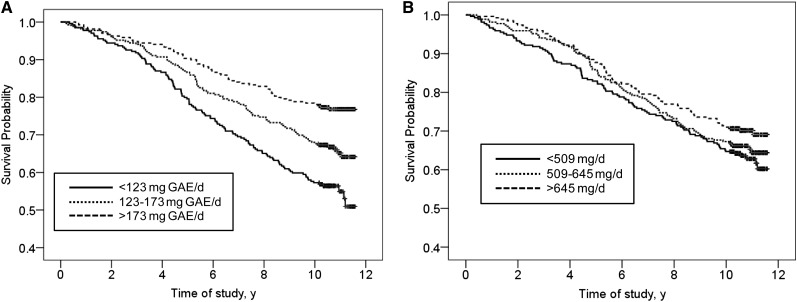
Polyphenols might have a role in the prevention of several chronic diseases, but evaluating total dietary polyphenol (TDP) intake from self-reported questionnaires is inaccurate and unreliable. A promising alternative is to use total urinary polyphenol (TUP) concentration as a proxy measure of intake. The current study evaluated the relationship between TUPs and TDPs and all-cause mortality during a 12-y period among older adult participants. The study population included 807 men and women aged 65 y and older from the Invecchiare in Chianti study, a population-based cohort study of older adults living in the Chianti region of Tuscany, Italy. TUP concentrations were measured at enrolment (1998-2000) using the Folin-Ciocalteau assay after a solid-phase extraction. TDPs were also estimated at baseline throughout a validated food frequency questionnaire and using our database based on USDA and Phenol-Explorer databases. We modeled associations using Kaplan-Meier survival and Cox proportional hazards models, with adjustment for potential confounders. During the 12-y follow-up, 274 participants (34%) died. At enrollment, TUP excretion adjusted for age and sex tended to be greater in participants who survived [163 ± 62 mg gallic acid equivalents (GAE)/d)] than in those who died (143 ± 63 mg GAE/d) (P = 0.07). However, no significant differences were observed for TDPs. In the multivariable Cox model, participants in the highest tertile of TUP at enrolment had a lower mortality rate than those in the lowest tertile [HR = 0.70 (95% CI: 0.49-0.99); P-trend = 0.045], whereas no significant associations were found between TDP and overall mortality. TUP is an independent risk factor for mortality among community-dwelling older adults, suggesting that high dietary intake of polyphenols may be associated with longevity.
Conflict of interest statement
Author disclosures: R. Zamora-Ros, M. Rabassa, A. Cherubini, M. Urpí-Sardà, S. Bandinelli, L. Ferrucci, and C. Andres-Lacueva, no conflicts of interest.
Figures
References
-
- Agudo A, Cabrera L, Amiano P, Ardanaz E, Barricarte A, Berenguer T, Chirlaque MD, Dorronsoro M, Jakszyn P, Larrañaga N, et al. Fruit and vegetable intakes, dietary antioxidant nutrients, and total mortality in Spanish adults: findings from the Spanish cohort of the European Prospective Investigation into Cancer and Nutrition (EPIC-Spain). Am J Clin Nutr. 2007;85:1634–42. - PubMed
-
- Pérez-Jiménez J, Fezeu L, Touvier M, Arnault N, Manach C, Hercberg S, Galan P, Scalbert A. Dietary intake of 337 polyphenols in French adults. Am J Clin Nutr. 2011;93:1220–8. - PubMed
-
- Cazarolli LH, Zanatta L, Alberton EH, Figueiredo MS, Folador P, Damazio RG, Pizzolatti MG, Silva FR. Flavonoids: prospective drug candidates. Mini Rev Med Chem. 2008;8:1429–40. - PubMed
-
- Kampa M, Nifli AP, Notas G, Castanas E. Polyphenols and cancer cell growth. Rev Physiol Biochem Pharmacol. 2007;159:79–113. - PubMed
-
- Yao LH, Jiang YM, Shi J, Tomás-Barberán FA, Datta N, Singanusong R, Chen SS. Flavonoids in food and their health benefits. Plant Foods Hum Nutr. 2004;59:113–22. - PubMed
Publication types
MeSH terms
Substances
LinkOut - more resources
Full Text Sources
Other Literature Sources
