Review
. 2013 Jul;8(7):694-702.
doi: 10.4161/epi.25201. Epub 2013 Jun 17.

Epigenetic modulation of the immune function: a potential target for tolerance

Affiliations
Review

Epigenetic modulation of the immune function: a potential target for tolerance

Beatriz Suárez-Álvarez et al. Epigenetics. 2013 Jul.

Abstract

Great efforts in the field of solid organ transplantation are being devoted to identifying biomarkers that allow a transplanted patient's immune status to be established. Recently, it has been well documented that epigenetic mechanisms like DNA methylation and histone modifications regulate the expression of immune system-related genes, modifying the development of the innate and adaptive immune responses. An in-depth knowledge of these epigenetic mechanisms could modulate the immune response after transplantation and to develop new therapeutic strategies. Epigenetic modifiers, such as histone deacetylase (HDAC) inhibitors have considerable potential as anti-inflammatory and immunosuppressive agents, but their effect on transplantation has not hitherto been known. Moreover, the detection of epigenetic marks in key immune genes could be useful as biomarkers of rejection and progression among transplanted patients. Here, we describe recent discoveries concerning the epigenetic regulation of the immune system, and how this knowledge could be translated to the field of transplantation.

Keywords: DNA methylation; histone modifications; rejection; tolerance.


Figures
None
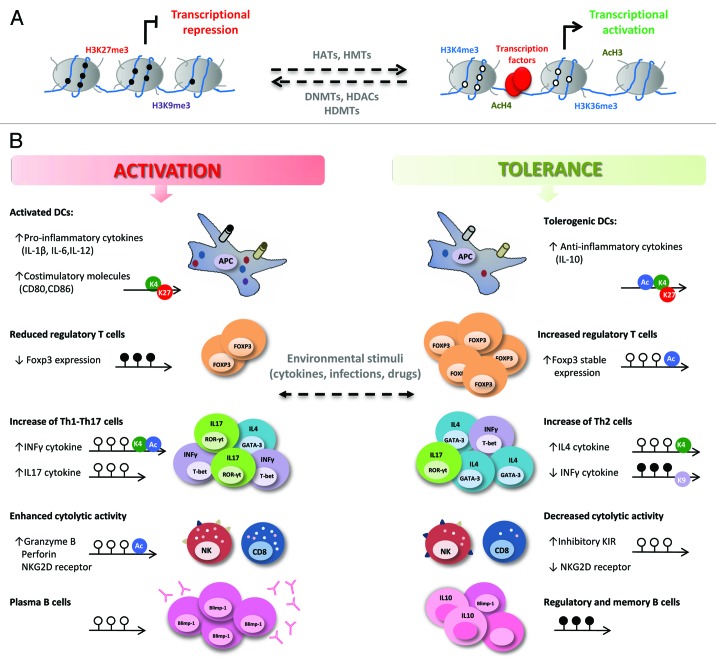
Figure 1. Epigenetic regulation of the immune response in transplantation. (A) DNA methylation and histone modifications allow changes in chromatin structure that influence gene transcription. DNA methylation (black circles) and repressive histone marks (H3K27me3, H3K9me3, etc.) are associated with closed chromatin and gene repression while DNA demethylation (white circles) and active histone modifications (AcH3, AcH4, H3K4me3, H3K36me3, etc.) are correlated with an open chromatin structure, facilitating transcription factor binding and transcription. Enzymes such as histone acetyltransferases (HATs), histone deacetylases (HDACs), histone methyltransferases (HMTs), histone demethylases (HDMTs) and DNA methyltransferases (DNMTs), establish and maintain the balance between these modifications. (B) Changes in the chromatin structure of key genes in the immune responses that take place in organ transplantation can contribute to alloimmunity or tolerance. Epigenetic modifications (DNA methylation and histone modifications) regulate gene expression in different cell types in several ways: (1) the expression of pro-inflammatory (IL12, IL-1β, IL-6, TNF-α), regulatory (IL-10) cytokines, and co-stimulatory molecules (CD80, CD86, CD40) is modified in antigen-presenting cells (APCs); (2) DNA demethylation and histone deacetylation increase the stable expression of the FoxP3 transcription factor, strengthening the suppressive function of Treg cells; (3) in CD4+ T cells, the differentiation of naive CD4+ T cells into “helper” T cells (Th1, Th2, Th17) and the plasticity among them is modulated; (4) the transcription of cytotoxic molecules (granzyme B and perforin) and activating receptors (NKG2D) is inhibited, and the expression of inhibitory KIR is enhanced in memory CD8+ T cells and NK cells, promoting allograft acceptance; (5) mature B cell differentiation into antibody-producing cells is controlled, decreasing allorecognition by donor-specific antibodies and preventing graft rejection. DNA methylation and demethylation are represented by black and white lollipops, respectively; histone modifications are shown as circles: green, H3K4me3; red, H3K27me3; purple, H3K9me3; blue, acetylation of H3 or H4.
None
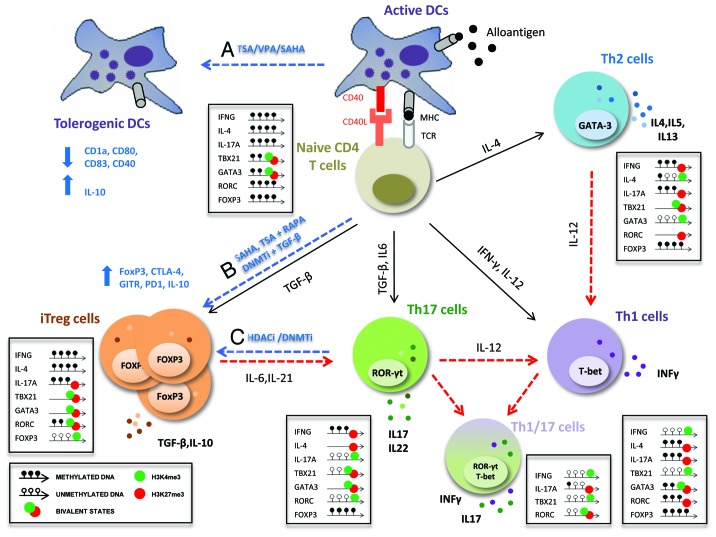
Figure 2. Targeting the activation and plasticity of CD4 T cells by HDAC inhibitors. After activation, CD4 T cells are directed toward different subsets of effector T cells (Th1, Th2 or Th17) or regulatory T cells (Treg) with specialized functions. These processes are regulated by epigenetic modifications that allow stable and heritable lineages but at the same time maintain the capacity to respond to environmental changes and switch from one lineage to another (plasticity). Dashed red lines indicate the plasticity and flexibility among CD4+ T cell subsets regulated by epigenetic mechanisms; dashed blue lines show the epigenetic treatments proposed for providing tolerance after transplantation. Epigenetic status of key transcription factors and cytokines essential for plasticity are shown for each CD4 T cell subset. This molecular mechanism may be related to poised, bivalent epigenetic stages (i.e., permissive H3K4me3 plus repressive H3K27me3 marks) in opposing lineages. HDAC inhibitors (HDACi) are believed to modulate the balance between immunity and tolerance: (A) TSA, VPA and SAHA diminish the expression of MHC class II and co-stimulatory molecules (CD1a, CD40, CD80, CD83), and disruption of HDAC11 increases IL-10 expression in DCs, favoring immune tolerance; (B) TSA and SAHA increase mRNA levels of FoxP3, CTLA4, GITR, PD-1 and IL-10, promoting the peripheral conversion of T cells into iTreg cells and enhancing suppressive function in vitro and in vivo; (C) an interesting approach is the use of epigenetic inhibitors to block the conversion of iTreg into Th17/Th1 cells in an inflammatory environment or the differentiation of effector T cells (Th1, Th17) into regulatory T cells with suppressive functions.

References

    1. Rodriguez-Cortez VC, Hernando H, de la Rica L, Vento R, Ballestar E. Epigenomic deregulation in the immune system. Epigenomics. 2011;3:697–713. doi: 10.2217/epi.11.99. - DOI - PubMed
    1. Suarez-Alvarez B, Rodriguez RM, Fraga MF, López-Larrea C. DNA methylation: a promising landscape for immune system-related diseases. Trends Genet. 2012;28:506–14. doi: 10.1016/j.tig.2012.06.005. - DOI - PubMed
    1. Schildberg FA, Hagmann CA, Böhnert V, Tolba RH. Improved transplantation outcome by epigenetic changes. Transpl Immunol. 2010;23:104–10. doi: 10.1016/j.trim.2010.05.001. - DOI - PubMed
    1. McCaughan JA, McKnight AJ, Courtney AE, Maxwell AP. Epigenetics: time to translate into transplantation. Transplantation. 2012;94:1–7. doi: 10.1097/TP.0b013e31824db9bd. - DOI - PubMed
    1. Rodriguez RM, Suarez-Alvarez B, Salvanés R, Muro M, Martínez-Camblor P, Colado E, et al. DNA methylation dynamics in blood after hematopoietic cell transplant. PLoS One. 2013;8:e56931. doi: 10.1371/journal.pone.0056931. - DOI - PMC - PubMed

Publication types