


Biomimetic assembly and activation of [FeFe]-hydrogenases
- PMID: 23803769
- PMCID: PMC3793303
- DOI: 10.1038/nature12239
Biomimetic assembly and activation of [FeFe]-hydrogenases
Abstract
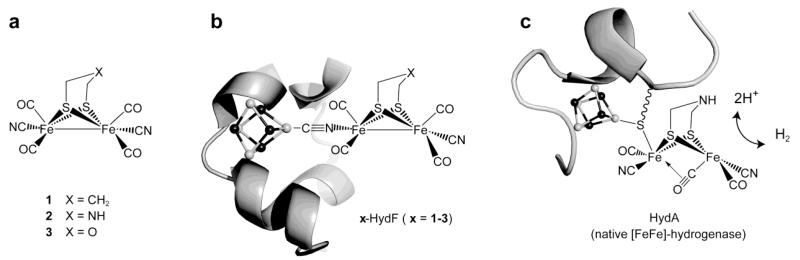
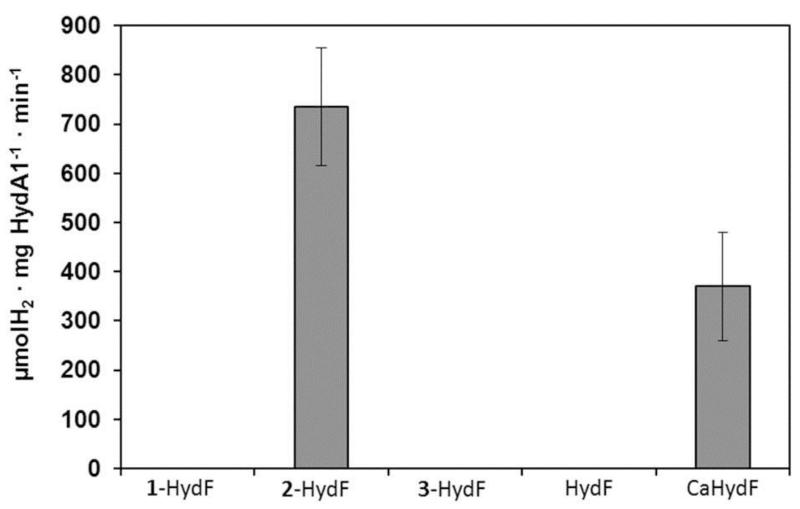
Hydrogenases are the most active molecular catalysts for hydrogen production and uptake, and could therefore facilitate the development of new types of fuel cell. In [FeFe]-hydrogenases, catalysis takes place at a unique di-iron centre (the [2Fe] subsite), which contains a bridging dithiolate ligand, three CO ligands and two CN(-) ligands. Through a complex multienzymatic biosynthetic process, this [2Fe] subsite is first assembled on a maturation enzyme, HydF, and then delivered to the apo-hydrogenase for activation. Synthetic chemistry has been used to prepare remarkably similar mimics of that subsite, but it has failed to reproduce the natural enzymatic activities thus far. Here we show that three synthetic mimics (containing different bridging dithiolate ligands) can be loaded onto bacterial Thermotoga maritima HydF and then transferred to apo-HydA1, one of the hydrogenases of Chlamydomonas reinhardtii algae. Full activation of HydA1 was achieved only when using the HydF hybrid protein containing the mimic with an azadithiolate bridge, confirming the presence of this ligand in the active site of native [FeFe]-hydrogenases. This is an example of controlled metalloenzyme activation using the combination of a specific protein scaffold and active-site synthetic analogues. This simple methodology provides both new mechanistic and structural insight into hydrogenase maturation and a unique tool for producing recombinant wild-type and variant [FeFe]-hydrogenases, with no requirement for the complete maturation machinery.
Figures
Comment in
-
Bioinorganic chemistry: Enzymes activated by synthetic components.Nature. 2013 Jul 4;499(7456):40-1. doi: 10.1038/nature12260. Epub 2013 Jun 26. Nature. 2013. PMID: 23803763 No abstract available.
References
-
- Tard C, Pickett CJ. Structural and Functional Analogues of the Active Sites of the [Fe]-, [NiFe]-, and [FeFe]-Hydrogenases. Chemical Reviews. 2009;109:2245–2274. - PubMed
-
- Cracknell JA, Vincent KA, Armstrong FA. Enzymes as working or inspirational electrocatalysts for fuel cells and electrolysis. Chemical Reviews. 2008;108:2439–2461. - PubMed
-
- Hambourger M, et al. [FeFe]-Hydrogenase-Catalyzed H2 production in a photoelectrochemical biofuel cell. Journal of the American Chemical Society. 2008;130:2015–2022. - PubMed
-
- Krishnan S, Armstrong FA. Order-of-magnitude enhancement of an enzymatic hydrogen-air fuel cell based on pyrenyl carbon nanostructures. Chemical Science. 2012;3:1015–1023.
-
- Ciaccafava A, et al. An innovative powerful and mediatorless H2/O2 biofuel cell based on an outstanding bioanode. Electrochemistry Communications. 2012;23:25–28.
