. 2013 Jul;8(7):685-93.
doi: 10.4161/epi.24976. Epub 2013 May 17.

The MORC family: new epigenetic regulators of transcription and DNA damage response

Affiliations

The MORC family: new epigenetic regulators of transcription and DNA damage response

Da-Qiang Li et al. Epigenetics. 2013 Jul.

Abstract

Microrchidia (MORC) is a highly conserved nuclear protein superfamily with widespread domain architectures that intimately link MORCs with signaling-dependent chromatin remodeling and epigenetic regulation. Accumulating structural and biochemical evidence has shed new light on the mechanistic action and emerging role of MORCs as epigenetic regulators in diverse nuclear processes. In this Point of View, we focus on discussing recent advances in our understanding of the unique domain architectures of MORC family of chromatin remodelers and their potential contribution to epigenetic control of DNA template-dependent processes such as transcription and DNA damage response. Given that the deregulation of MORCs has been linked with human cancer and other diseases, further efforts to uncover the structure and function of MORCs may ultimately lead to the development of new approaches to intersect with the functionality of MORC family of chromatin remodeling proteins to correct associated pathogenesis.

Keywords: DNA damage response; MORC; chromatin remodeling; epigenetic regulation; transcription.


Figures
None
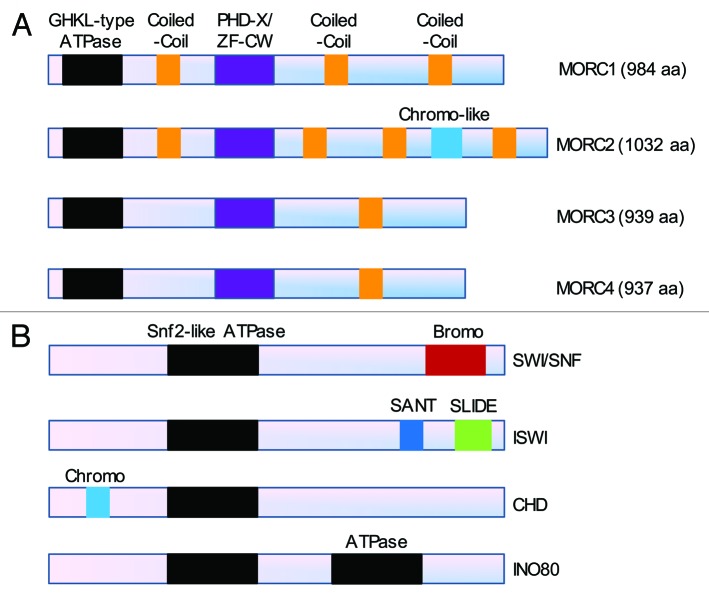
Figure 1. Comparison of the domain architecture between the MORC family (A) and the well-characterized four classes of chromatin remodeling complexes (B). (A) Members of the MORC family contain a conserved GHKL-type ATPase domain at their N-terminus, a PHD-X/ZF-CW domain in their midst and varied coiled-coil domains. In addition, MORC2 protein contains a chromo-like domain at its carboxy-terminus. (B) The ATPase subunits of the four classes of chromatin remodeling complexes including SWI/SNF (SWItch/sucrose non-fermentable), ISWI (imitation switch), CHD (chromodomain, helicase, DNA binding) and INO80 (inositol requiring 80) contain a common Snf2-like ATPase domain and other functional domains as indicated.,
None
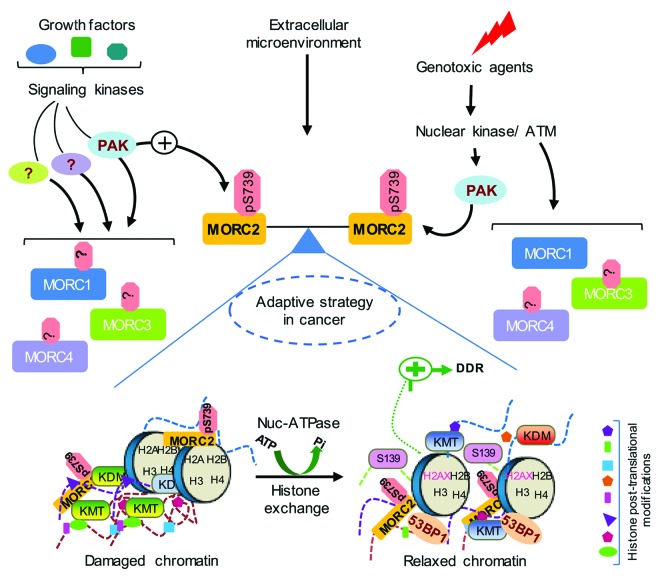
Figure 2. Proposed model for the physiologic role of MORCs. MORCs control a variety of cellular and physiological functions in response to growth factor signaling, extracellular microenvironment, and genotoxic stress. Posttranslational modification of MORCs by upstream kinases might modulate their cellular functions. PAK1 phosphorylates MORC2 at serine 739 in response to both genotoxic stress and growth factor signaling and directs an effective DDR by an ATP-dependent chromatin remodeling event. Domain architecture of MORCs will provide essential insights into their specific and non-redundant roles in epigenetic regulation via recognition of various posttranslational modifications of histones or functional interactions with histone modifying enzymes. MORCs are deregulated in a variety of cancers and possibly function as a critical balance for efficient crosstalk between growth factor signaling and DDR. Collectively, these will contribute to adaptive survival strategies and therapy resistance often observed in cancer. DDR, DNA damage response.

References

    1. Iyer LM, Abhiman S, Aravind L. MutL homologs in restriction-modification systems and the origin of eukaryotic MORC ATPases. Biol Direct. 2008;3:8. doi: 10.1186/1745-6150-3-8. - DOI - PMC - PubMed
    1. Iyer LM, Anantharaman V, Wolf MY, Aravind L. Comparative genomics of transcription factors and chromatin proteins in parasitic protists and other eukaryotes. Int J Parasitol. 2008;38:1–31. doi: 10.1016/j.ijpara.2007.07.018. - DOI - PubMed
    1. Inoue N, Hess KD, Moreadith RW, Richardson LL, Handel MA, Watson ML, et al. New gene family defined by MORC, a nuclear protein required for mouse spermatogenesis. Hum Mol Genet. 1999;8:1201–7. doi: 10.1093/hmg/8.7.1201. - DOI - PubMed
    1. Li DQ, Nair SS, Ohshiro K, Kumar A, Nair VS, Pakala SB, et al. MORC2 signaling integrates phosphorylation-dependent, ATPase-coupled chromatin remodeling during the DNA damage response. Cell Rep. 2012;2:1657–69. doi: 10.1016/j.celrep.2012.11.018. - DOI - PMC - PubMed
    1. Kimura Y, Sakai F, Nakano O, Kisaki O, Sugimoto H, Sawamura T, et al. The newly identified human nuclear protein NXP-2 possesses three distinct domains, the nuclear matrix-binding, RNA-binding, and coiled-coil domains. J Biol Chem. 2002;277:20611–7. doi: 10.1074/jbc.M201440200. - DOI - PubMed

Publication types

Substances

LinkOut - more resources