


Pattern separation and pattern completion in Alzheimer's disease: evidence of rapid forgetting in amnestic mild cognitive impairment
- PMID: 23804525
- PMCID: PMC4310474
- DOI: 10.1002/hipo.22162
Pattern separation and pattern completion in Alzheimer's disease: evidence of rapid forgetting in amnestic mild cognitive impairment
Abstract
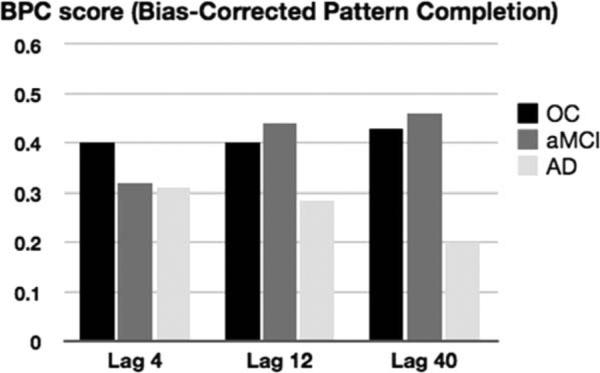
Over the past four decades, the characterization of memory loss associated with Alzheimer's disease (AD) has been extensively debated. Recent iterations have focused on disordered encoding versus rapid forgetting. To address this issue, we used a behavioral pattern separation task to assess the ability of the hippocampus to create and maintain distinct and orthogonalized visual memory representations in patients with amnestic mild cognitive impairment (aMCI) and mild AD. We specifically used a lag-based continuous recognition paradigm to determine whether patients with aMCI and mild AD fail to encode visual memory representations or whether these patients properly encode representations that are rapidly forgotten. Consistent with the rapid forgetting hypothesis of AD, we found that patients with aMCI demonstrated decreasing pattern separation rates as the lag of interfering objects increased. In contrast, patients with AD demonstrated consistently poor pattern separation rates across three increasingly longer lags. We propose a continuum that reflects underlying hippocampal neuropathology whereby patients with aMCI are able to properly encode information into memory but rapidly lose these memory representations, and patients with AD, who have extensive hippocampal and parahippocampal damage, cannot properly encode information in distinct, orthogonal representations. Our results also revealed that whereas patients with aMCI demonstrated similar behavioral pattern completion rates to healthy older adults, patients with AD showed lower pattern completion rates when we corrected for response bias. Finally, these behavioral pattern separation and pattern completion results are discussed in terms of the dual process model of recognition memory.
Keywords: encoding; familiarity; hippocampus; recognition memory; recollection.
Copyright © 2013 Wiley Periodicals, Inc.
Figures




References
-
- Adjutant General's Office . Army individual test battery: Manual of directions and scoring. War Department; Washington, DC: 1944.
-
- Ally BA, Jones GE, Cole JA, Budson AE. The P300 component in patients with Alzheimer's disease and their biological children. Biol Psychol. 2006;72:180–187. - PubMed
Publication types
MeSH terms
Grants and funding
LinkOut - more resources
Full Text Sources
Other Literature Sources
Medical
Miscellaneous
