The Sac1 domain of SYNJ1 identified mutated in a family with early-onset progressive Parkinsonism with generalized seizures
- PMID: 23804563
- PMCID: PMC3790461
- DOI: 10.1002/humu.22372
The Sac1 domain of SYNJ1 identified mutated in a family with early-onset progressive Parkinsonism with generalized seizures
Abstract
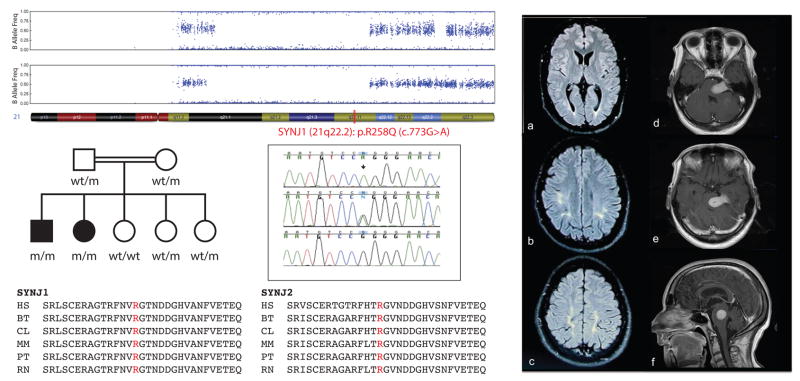
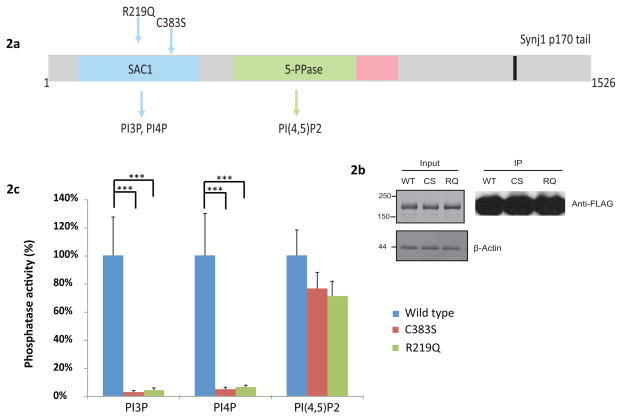
This study aimed to elucidate the genetic causes underlying early-onset Parkinsonism (EOP) in a consanguineous Iranian family. To attain this, homozygosity mapping and whole-exome sequencing were performed. As a result, a homozygous mutation (c.773G>A; p.Arg258Gln) lying within the NH2 -terminal Sac1-like inositol phosphatase domain of polyphosphoinositide phosphatase synaptojanin 1 (SYNJ1), which has been implicated in the regulation of endocytic traffic at synapses, was identified as the disease-segregating mutation. This mutation impaired the phosphatase activity of SYNJ1 against its Sac1 domain substrates in vitro. We concluded that the SYNJ1 mutation identified here is responsible for the EOP phenotype seen in our patients probably due to deficiencies in its phosphatase activity and consequent impairment of its synaptic functions. Our finding not only opens new avenues of investigation in the synaptic dysfunction mechanisms associated with Parkinsonism, but also suggests phosphoinositide metabolism as a novel therapeutic target for Parkinsonism.
Keywords: SYNJ1; autosomal recessive Parkinsonism; homozygosity mapping; whole-exome sequencing.
© 2013 WILEY PERIODICALS, INC.
Conflict of interest statement
Figures
References
-
- Akrami SM, Osati Z. Is consanguineous marriage religiously encouraged? Islamic and Iranian considerations. J Biosoc Sci. 2007;39(2):313–316. - PubMed
-
- Camargos S, Scholz S, Simon-Sanchez J, Paisan-Ruiz C, Lewis P, Hernandez D, Ding J, Gibbs JR, Cookson MR, Bras J, et al. DYT16, a novel young-onset dystonia-parkinsonism disorder: identification of a segregating mutation in the stress-response protein PRKRA. Lancet Neurol. 2008;7(3):207–215. - PubMed
Publication types
MeSH terms
Substances
Grants and funding
- R01MH095797/MH/NIMH NIH HHS/United States
- R01 NS072359/NS/NINDS NIH HHS/United States
- P30 DA018343/DA/NIDA NIH HHS/United States
- R01 NS060809/NS/NINDS NIH HHS/United States
- R01NS079388/NS/NINDS NIH HHS/United States
- R01NS072359/NS/NINDS NIH HHS/United States
- R01 NS060123/NS/NINDS NIH HHS/United States
- R01 NS079388/NS/NINDS NIH HHS/United States
- R01NS060809/NS/NINDS NIH HHS/United States
- R37NS036251/NS/NINDS NIH HHS/United States
- R01 MH095797/MH/NIMH NIH HHS/United States
- R37 NS036251/NS/NINDS NIH HHS/United States
- R01 NS056049/NS/NINDS NIH HHS/United States
LinkOut - more resources
Full Text Sources
Other Literature Sources
Molecular Biology Databases
Research Materials