


Simultaneous alcohol and marijuana use among U.S. high school seniors from 1976 to 2011: trends, reasons, and situations
- PMID: 23806871
- PMCID: PMC3786028
- DOI: 10.1016/j.drugalcdep.2013.05.031
Simultaneous alcohol and marijuana use among U.S. high school seniors from 1976 to 2011: trends, reasons, and situations
Abstract
Background: Simultaneous alcohol and marijuana (SAM) use raises significant concern due to the potential for additive or interactive psychopharmacological effects. However, no nationally representative studies are available that document prevalence, trends, or related factors in US youth SAM use.
Methods: Nationally representative cross-sectional samples of 12th grade students surveyed in the Monitoring the Future project from 1976 to 2011 provided data on SAM use. Analyses were conducted in 2012.
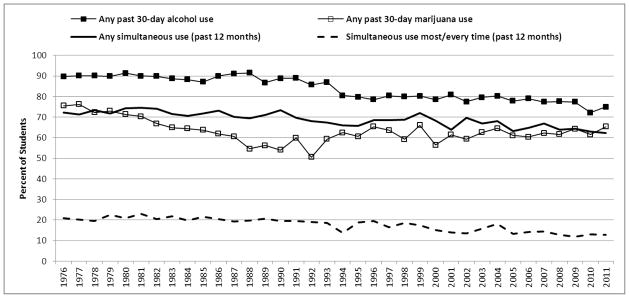
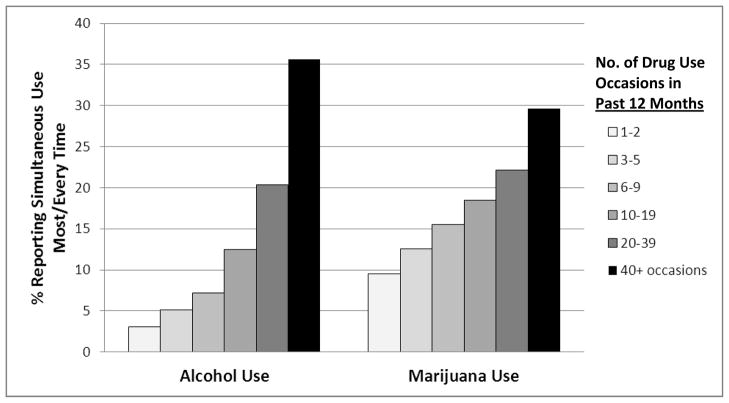
Results: In 2011, 23% of all U.S. high school seniors reported any SAM use. Among seniors reporting any past 12-month marijuana use, 62% reported any SAM use and 13% reported SAM use most or every time they used marijuana. SAM use consistently followed trends for past 30-day alcohol use over time. SAM use showed significant variation by psychosocial and demographic characteristics and was strongly associated with higher substance use levels, but occurred across the substance use spectrum. Certain reasons for alcohol or marijuana use (to increase effects of another drug; I'm hooked) and situations of alcohol or marijuana use (park/beach, car, party) were strongly associated with SAM use.
Conclusions: A sizable proportion of US high school seniors reported SAM use, and it appeared to occur frequently in social use situations that could impact both the public as well as youth drug users. SAM use appears to be a complex behavior that is incidental to general substance use patterns as well as associated with (a) specific simultaneous reasons (or expectancies), and (b) heavy substance use and perceived dependence, especially on alcohol.
Keywords: Adolescent; Alcohol; Marijuana; Simultaneous drug use.
Copyright © 2013 Elsevier Ireland Ltd. All rights reserved.
Conflict of interest statement
Figures
References
-
- Bachman JG, Johnston LD, O’Malley PM, Schulenberg JE. The Monitoring the Future Project After Thirty-seven Years: Design and Procedures (Monitoring the Future Occasional Paper No 76) Ann Arbor, MI: Institute for Social Research, The University of Michigan; 2011. [Accessed April 4, 2012]. Available at: http://monitoringthefuture.org/pubs/occpapers/occ76.pdf.
-
- Belgrave BE, Bird KD, Chesher GB, Jackson DM, Lubbe KE, Starmer GA, Teo RK. The effect of (−) trans-delta9-tetrahydrocannabinol, alone and in combination with ethanol, on human performance. Psychopharmacology. 1979;62:53–60. - PubMed
-
- Brière FN, Fallu J-S, Descheneaux A, Janosz M. Predictors and consequences of simultaneous alcohol and cannabis use in adolescents. Addict Behav. 2011;36:785–788. - PubMed
-
- Chesher GB, Franks HM, Hensley VR, Hensley WJ, Jackson DM, Starmer GA, Teo RK. The interaction of ethanol and delta9-tetrahydrocannabinol in man: effects on perceptual, cognitive and motor functions. Med J Aust. 1976;2:159–163. - PubMed
Publication types
MeSH terms
Grants and funding
LinkOut - more resources
Full Text Sources
Other Literature Sources
Medical
Miscellaneous
