


Implications of prion polymorphisms
- PMID: 23807178
- PMCID: PMC3904311
- DOI: 10.4161/pri.25566
Implications of prion polymorphisms
Abstract
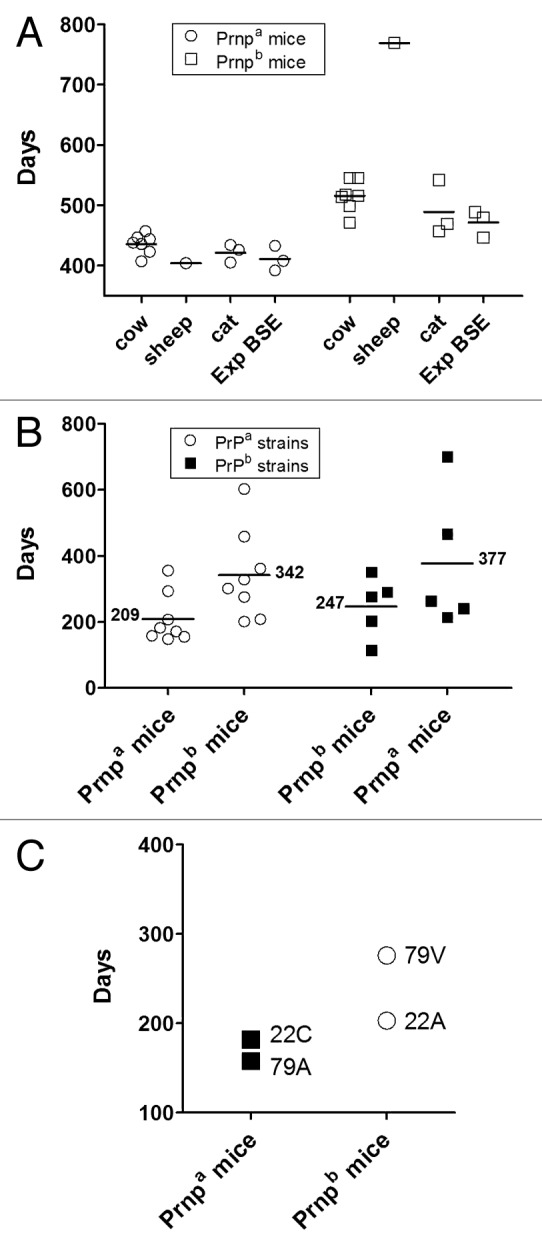
The sequence of a host's prion protein (PrP) can affect that host's susceptibility to prion disease and is the primary basis for the species barrier to transmission. Yet within many species, polymorphisms of the prion protein gene (Prnp) exist, each of which can further affect susceptibility or influence incubation period, pathology and phenotype. As strains are defined by these features (incubation period, pathology, phenotype), polymorphisms may also lead to the preferential propagation or generation of certain strains. In our recent study of the mouse Prnp(a) and Prnp(b) polymorphisms (which produced the proteins PrP(a) and PrP(b), respectively), we found differences in aggregation tendency, strain adaptability and conformational variability. Comparing our in vitro data with that of in vivo studies, we found that differing incubation periods between Prnp(a) and Prnp(b) mice can primarily be explained on the basis of faster or more efficient aggregation of PrP(a). In addition, and more importantly, we found that the faithful propagation of strains in Prnp(b) mice can be explained by the ability of PrP(b) to adopt a wider range of conformations. This adaptability allows PrP(b) to successfully propagate the structural features of a seed. In contrast, Prnp(a) mice revert PrP(b) strains into PrP(a) -type strains, and overall they have a narrower distribution of incubation periods. This can be explained by PrP(a) having fewer preferred conformations. We propose that Prnp polymorphisms are one route by which certain prion strains may preferentially propagate. This has significant implications for prion disease, chronic wasting disease (CWD) in particular, as it is spreading through North America. Deer which are susceptible to CWD also carry polymorphisms which influence their susceptibility. If these polymorphisms also preferentially allow strain diversification and propagation, this may accelerate the crossing of species barriers and propagation of the disease up the food chain.
Keywords: adaptation; aggregation; amyloid; kinetics; mouse; polymorphism; prion; propagation; species barrier; strain.
Figures
Comment on
-
Mouse prion protein polymorphism Phe-108/Val-189 affects the kinetics of fibril formation and the response to seeding: evidence for a two-step nucleation polymerization mechanism.J Biol Chem. 2013 Feb 15;288(7):4772-81. doi: 10.1074/jbc.M112.414581. Epub 2013 Jan 2. J Biol Chem. 2013. PMID: 23283973 Free PMC article.
References
-
- Wilson R, Plinston C, Hunter N, Casalone C, Corona C, Tagliavini F, et al. Chronic wasting disease and atypical forms of bovine spongiform encephalopathy and scrapie are not transmissible to mice expressing wild-type levels of human prion protein. J Gen Virol. 2012;93:1624–9. doi: 10.1099/vir.0.042507-0. - DOI - PubMed
Publication types
MeSH terms
Substances
LinkOut - more resources
Full Text Sources
Other Literature Sources
Research Materials
