


Urbanicity and autism spectrum disorders
- PMID: 23807204
- PMCID: PMC4511947
- DOI: 10.1007/s10803-013-1875-y
Urbanicity and autism spectrum disorders
Abstract
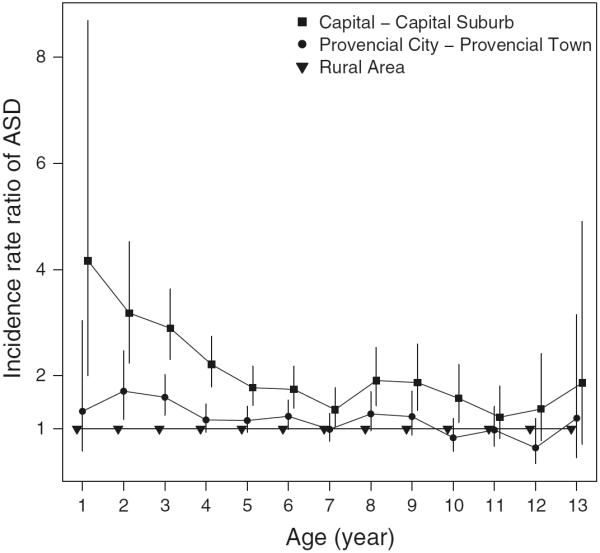
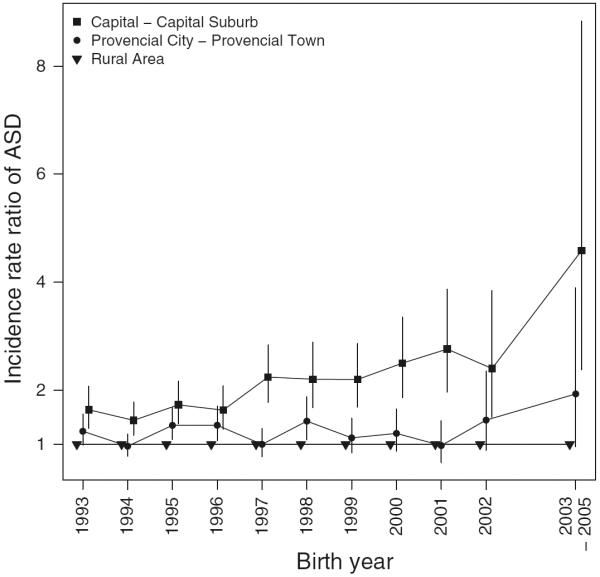
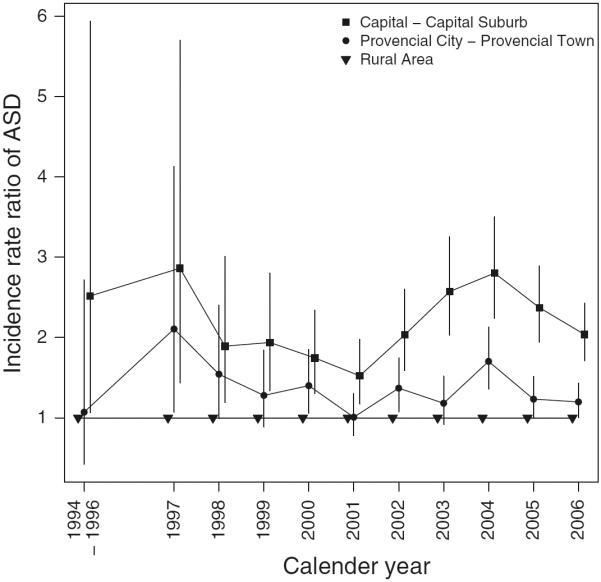
The etiology of autism spectrum disorders (ASD) is for the majority of cases unknown and more studies of risk factors are needed. Geographic variation in ASD occurrence has been observed, and urban residence has been suggested to serve as a proxy for etiologic and identification factors in ASD. We examined the association between urbanicity level and ASD at birth and during childhood. The study used a Danish register-based cohort of more than 800,000 children of which nearly 4,000 children were diagnosed with ASD. We found a dose-response association with greater level of urbanicity and risk of ASD. This association was found for residence at birth as well as residence during childhood. Further, we found an increased risk of ASD in children who moved to a higher level of urbanicity after birth. Also, earlier age of ASD diagnosis in urban areas was observed. While we could not directly examine the specific reasons behind these associations, our results demonstrating particularly strong associations between ASD diagnosis and post-birth migration suggest the influence of identification-related factors such as access to services might have a substantive role on the ASD differentials we observed.
Figures
References
-
- Andersen PK, Borgan Ø, Gill RD, Keiding N. Statistical models based on counting processes. Springer; New York: 1997.
-
- Boyle CA, Boulet S, Schieve LA, Cohen RA, Blumberg SJ, Yeargin-Allsopp M, et al. Trends in the prevalence of developmental disabilities in US Children, 1997–2008. Pediatrics. 2011;127:1034–1042. - PubMed
-
- Breslow NE, Day NE. Statistical methods in cancer research volume II—The design and analysis of cohort studies. 82nd ed. IARC Scientific Publications; France: 1987. - PubMed
-
- Centers for Disease Control and Prevention Prevalence of autism spectrum disorders—Autism and developmental disabilities monitoring network, 14 sites, United States, 2008. MMWR Surveillance Summaries. 2012;61:1–19. - PubMed
-
- Chen CY, Liu CY, Su WC, Huang SL, Lin KM. Urbanicity-related variation in help-seeking and services utilization among preschool-age children with autism in Taiwan. Journal of Autism and Developmental Disorders. 2008;38:489–497. - PubMed
Publication types
MeSH terms
Grants and funding
LinkOut - more resources
Full Text Sources
Other Literature Sources
