


High prevalence and incidence of high-grade anal intraepithelial neoplasia among young Thai men who have sex with men with and without HIV
- PMID: 23807271
- PMCID: PMC3706028
- DOI: 10.1097/QAD.0b013e328360a509
High prevalence and incidence of high-grade anal intraepithelial neoplasia among young Thai men who have sex with men with and without HIV
Abstract
Background: Men who have sex with men (MSM) are at elevated risk of having anal cancer. However, the prevalence and incidence among MSM of high-grade anal intraepithelial neoplasia (HGAIN), the putative precursor of anal cancer, is understudied, particularly in Asians.
Methods: A total of 123 HIV-positive and 123 HIV-negative MSM were enrolled at the Thai Red Cross AIDS Research Centre in Bangkok, Thailand, and followed for 12 months. Anal sample collection for human papillomavirus (HPV) genotyping and high-resolution anoscopy (HRA) with biopsies were performed at every visit.
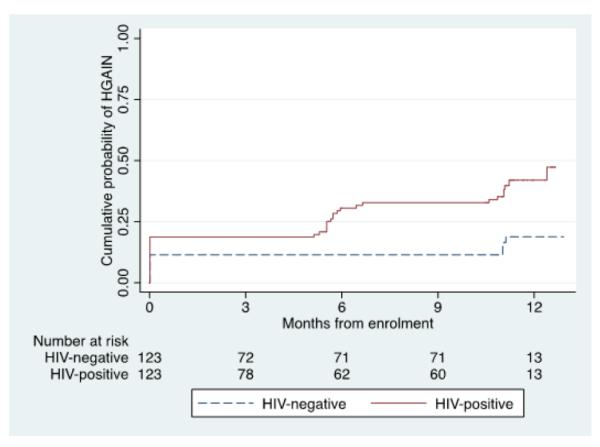
Results: Mean age at enrollment was 28.9 years. HIV-positive MSM were more commonly infected with high-risk HPV types in the anus than HIV-negative MSM (57.5 vs. 36.6%; P = 0.001). The prevalence of HGAIN was 18.9% in HIV-positive and 11.4% in HIV-negative MSM (P = 0.1). The incidence of HGAIN at 12 months was 29% in HIV-positive and 8% in HIV-negative MSM (P = 0.001). The hazard ratios for incident HGAIN in multivariate models were 5.16 [95% confidence interval (CI) 1.89-14.08, P < 0.001] in MSM with persistent HPV 16 and/or 18 infection and 2.62 (95% CI 1.04-6.61, P = 0.042) in HIV-positive MSM.
Conclusions: Approximately one-third of HIV-positive MSM developed incident HGAIN within 12 months. Given the relative increased prevalence of HIV among MSM worldwide, local HGAIN data are needed to guide practitioners, policy makers, and communities in planning for strategies to screen for and treat HGAIN in this population.
Figures
References
-
- Piketty C, Selinger-Leneman H, Grabar S, et al. Marked increase in the incidence of invasive anal cancer among HIV-infected patients despite treatment with combination antiretroviral therapy. AIDS. 2008 Jun 19;22(10):1203–1211. - PubMed
-
- Patel P, Hanson DL, Sullivan PS, et al. Incidence of types of cancer among HIV-infected persons compared with the general population in the United States, 1992-2003. Ann Intern Med. 2008 May 20;148(10):728–736. - PubMed
-
- Daling JR, Madeleine MM, Johnson LG, et al. Human papillomavirus, smoking, and sexual practices in the etiology of anal cancer. Cancer. 2004 Jul 15;101(2):270–280. - PubMed
Publication types
MeSH terms
Grants and funding
LinkOut - more resources
Full Text Sources
Other Literature Sources
Medical
