


Review
doi: 10.1089/humc.2013.087.
Epub 2013 Jun 29.
Lessons learned from the clinical development and market authorization of Glybera
Affiliations
- PMID: 23808604
- PMCID: PMC3992977
- DOI: 10.1089/humc.2013.087
Item in Clipboard
Review
Lessons learned from the clinical development and market authorization of Glybera
Hum Gene Ther Clin Dev.
2013 Jun.
Abstract
Bryant and colleagues follow the development of Glybera (alipogene tiparvovec), the first gene therapy product approved in the European Union, from early preclinical studies through the approval process. They review key data from human and animal studies with an emphasis on issues that will be critical to other gene therapy products. The article concludes with an analysis of the complex review process that eventually led to Glybera's approval.
Figures
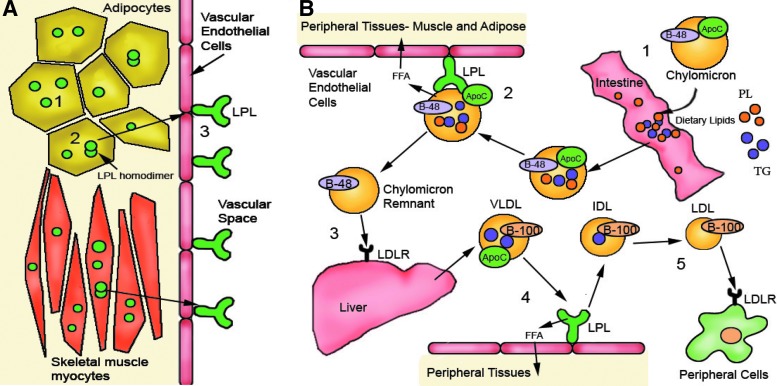
Production and function of lipoprotein lipase (LPL). (A) LPL is synthesized primarily in adipocytes, but also in skeletal muscle, heart, lung, liver, and other organs to a lesser degree (1). LPL forms homodimers in the cell before being secreted (2) and translocated to the vascular endothelial surface. LPL is then anchored to heparan sulfate proteoglycans that line the vascular endothelial cell surface (3). (B) Dietary fats entering the intestine are packaged into chylomicrons in enterocytes (1). The chylomicrons are then secreted into the lymphatic space. After finding their way back into the blood, chylomicrons encounter LPL anchored to the vascular endothelial surface. ApoCII on the surface of the chylomicron serves as a cofactor for LPL (2), allowing LPL to hydrolyze the triglyceride (TG) core of the chylomicron to produce free fatty acids (FFAs). These FFAs can then be taken up by peripheral tissues. The chylomicron remnant, depleted of TG, is taken up by the liver via low-density lipoprotein receptor (LDLR) binding to ApoE (3) and then transformed into very low–density lipoprotein (VLDL). At this point, ApoB-48 is exchanged for ApoB-100. VLDL is then secreted into the plasma, where it can contact LPL again. On this interaction, LPL hydrolyzes the VLDL TG core and produces FFA (4), an essential step in the conversion to intermediate-density lipoprotein (IDL). IDL can then be further converted into low-density lipoprotein (LDL), which can be taken up by peripheral cells via LDLR for use by the tissues (5). ApoC, apolipoprotein CII; B-48, B-100, apolipoproteins B-48 and B-100; LDLR, low-density lipoprotein receptor; PL, phospholipid.
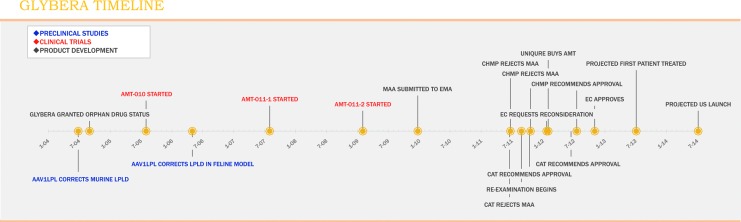
Timeline of events related to approval of Glybera. Note: Preclinical studies are listed by date of publication. CHMP, Committee for Human Medicinal Products; EC, European Commission; CAT, Committee for Advanced Therapies; EMA, European Medicines Agency; MAA, Marketing Authorization Application.
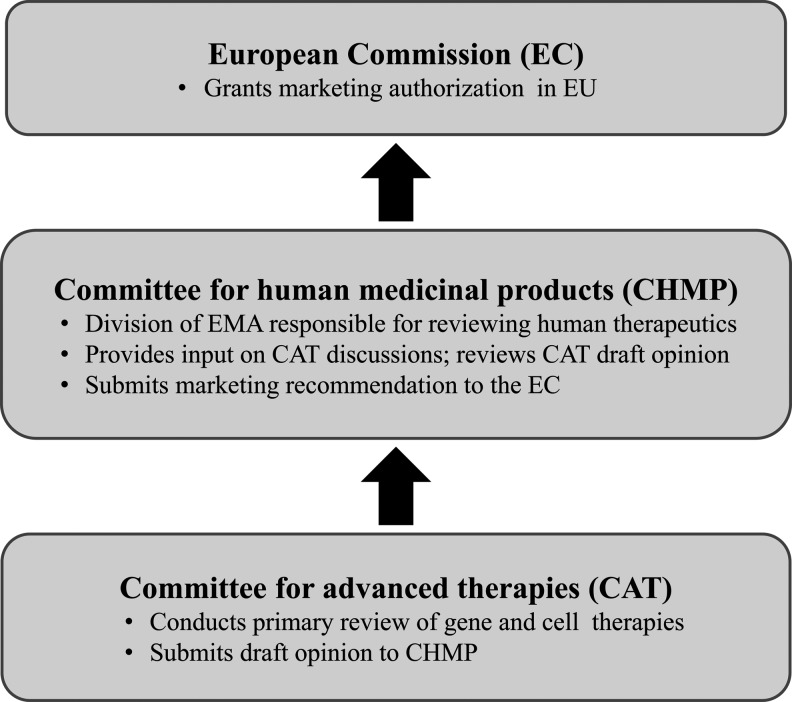
Centralized approval process in the European Union (EU). The scientific review of human therapeutics is carried out by the Committee for Human Medicinal Products (CHMP), a division of the European Medicines Agency (EMA). For gene and cell therapies, a primary review is performed by the Committee for Advanced Therapies (CAT), an independent specialist committee composed of five CHMP members and representatives selected by EU member states, as well as European Commission (EC)-appointed patient and clinician representatives. Although the CAT adopts a draft opinion on marketing applications, the CHMP is ultimately responsible for making a recommendation to the EC, which has the final authority to grant marketing approval.
References
-
- Atchison R.W. Casto B.C. Hammon W.M. Adenovirus-associated defective virus particles. Science. 1965;149:754–756. - PubMed
-
- Brunzell J.D. Familial lipoprotein lipase deficiency. In: Pagon R.A., editor; Bird T.D., editor; Dolan C.R., editor; Stephens K., editor; Adam M.P., editor. GeneReviews. University of Washington Press; Seattle, WA: 1999. - PubMed
-
- Carpentier A.C. Frisch F. Labbe S.M., et al. Effect of alipogene tiparvovec (AAV1-LPLS447X) on postprandial chylomicron metabolism in lipoprotein lipase-deficient patients. J. Clin. Endocrinol. Metab. 2012;97:1635–1644. - PubMed
-
- European Medicines Agency (EMA) Assessment Report: Glybera. European Medicines Agency; London: 2012.
Publication types
MeSH terms
Substances
Grants and funding
LinkOut - more resources
Full Text Sources
Other Literature Sources
