. 2013 Oct;29(10):1361-4.
doi: 10.1089/AID.2013.0175. Epub 2013 Aug 2.

Nautilus: a bioinformatics package for the analysis of HIV type 1 targeted deep sequencing data

Affiliations

Nautilus: a bioinformatics package for the analysis of HIV type 1 targeted deep sequencing data

Gustavo H Kijak et al. AIDS Res Hum Retroviruses. 2013 Oct.

Abstract

The advent of next generation sequencing technologies is providing new insight into HIV-1 diversity and evolution, which has created the need for bioinformatics tools that could be applied to the characterization of viral quasispecies. Here we present Nautilus, a bioinformatics package for the analysis of HIV-1 targeted deep sequencing data. The DeepHaplo module determines the nucleotide base frequency and read depth at each position and computes the haplotype frequencies based on the linkage among polymorphisms in the same next generation sequence read. The Motifs module computes the frequency of the variants in the setting of their sequence context and mapping orientation, which allows for the validation of polymorphisms and haplotypes when strand bias is suspected. Both modules are accessed through a user-friendly GUI, which runs on Mac OS X (version 10.7.4 or later), and are based on Python, JAVA, and R scripts. Nautilus is available from www.hivresearch.org/research.php?ServiceID=5&SubServiceID=6 .


Figures
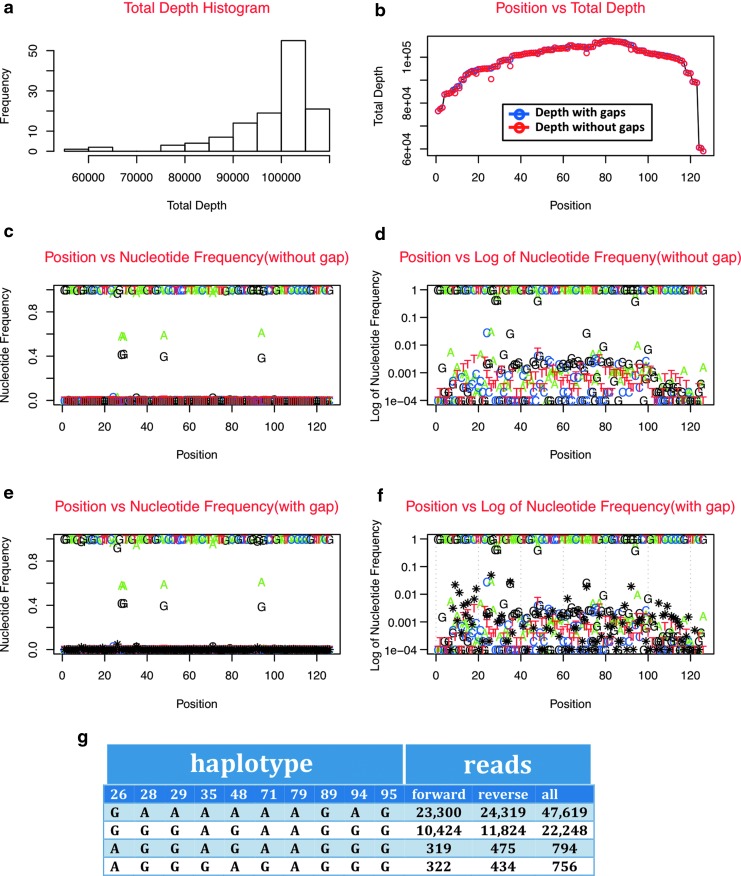
FIG. 1.
FIG. 1.
Read depth and frequencies of single nucleotide variants and haplotypes can be computed by the DeepHaplo module. (a) Histogram of the distribution of sequencing depth at each position. (b) Scatterplot of the sequencing depth at each position acknowledging or ignoring alignment gaps (blue and red symbols, respectively). The frequency of each variant at each position can be visualized either acknowledging (d, f) or ignoring alignment gaps (c, e) in linear (c, e) or logarithmic scales (d, f). (g) The frequency of haplotypes that involve linkage among polymorphisms in positions of interest is computed using a hash algorithm. The number of reads in each mapping orientation that support each haplotype can be used to discern true signals from sequencing artifacts.
FIG. 2.
FIG. 2.
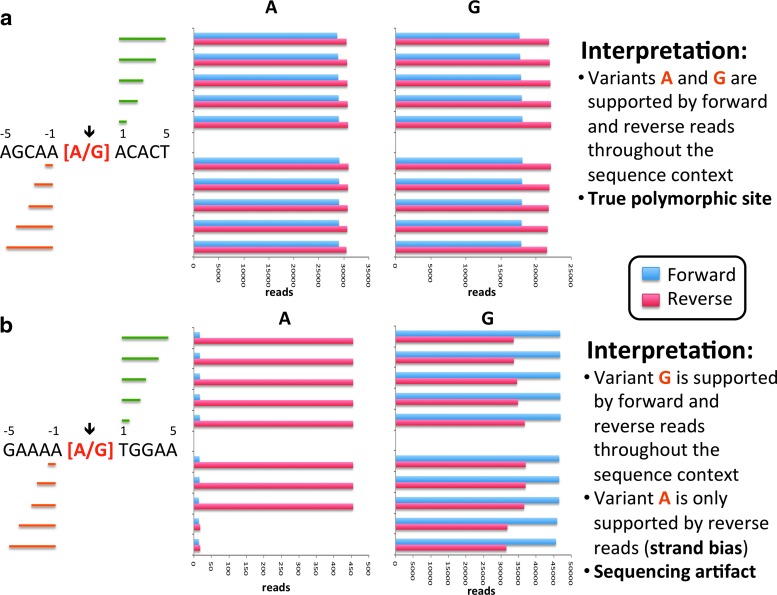
The Motifs module provides information about the frequency of single nucleotide variants based on mapping orientation and the sequence context surrounding the putatively polymorphic position. (a) Profile of a true polymorphic site. The detected variants along with the sequence context of the position are shown. Each cluster of bars in the chart represents the count of reads supporting the variant in question in each orientation (color coded) and context. For example, the top cluster depicts the number of forward and reverse reads supporting AACACT and GACACT, while the bottom cluster depicts the number of forward and reverse reads supporting AGCAAA and AGCAAG. Intermediate clusters indicate shorter sequence contexts. (b) Profile of a sequencing artifact due to strand bias. In this case, the G variant is supported by forward and reverse reads in various sequence contexts, whereas the A variant is supported only by reads from the reverse mapping orientation.

References

    1. Coffin J. Swanstrom R. HIV pathogenesis: Dynamics and genetics of viral populations and infected cells. Cold Spring Harbor Perspect Med. 2013;3:a012526. - PMC - PubMed
    1. Shankarappa R. Margolick JB. Gange SJ, et al. Consistent viral evolutionary changes associated with the progression of human immunodeficiency virus type 1 infection. J Virol. 1999;73:10489–10502. - PMC - PubMed
    1. Glenn TC. Field guide to next-generation DNA sequencers. Mol Ecol Resour. 2011;11:759–769. - PubMed
    1. Beerenwinkel N. Gunthard HF. Roth V. Metzner KJ. Challenges and opportunities in estimating viral genetic diversity from next-generation sequencing data. Front Microbiol. 2012;3:329. - PMC - PubMed
    1. Henn MR. Boutwell CL. Charlebois P, et al. Whole genome deep sequencing of HIV-1 reveals the impact of early minor variants upon immune recognition during acute infection. PLoS Pathog. 2012;8:e1002529. - PMC - PubMed

Publication types