Review
. 2013 Jun;11 Suppl 1(0 1):265-76.
doi: 10.1111/jth.12217.

The transition of prothrombin to thrombin

Affiliations
Review

The transition of prothrombin to thrombin

S Krishnaswamy. J Thromb Haemost. 2013 Jun.

Abstract

The proteolytic conversion of prothrombin to thrombin catalyzed by prothrombinase is one of the more extensively studied reactions of blood coagulation. Sophisticated biophysical and biochemical insights into the players of this reaction were developed in the early days of the field. Yet, many basic enzymological questions remained unanswered. I summarize new developments that uncover mechanisms by which high substrate specificity is achieved, and the impact of these strategies on enzymic function. Two principles emerge that deviate from conventional wisdom that has otherwise dominated thinking in the field. (i) Enzymic specificity is dominated by the contribution of exosite binding interactions between substrate and enzyme rather than by specific recognition of sequences flanking the scissile bond. Coupled with the regulation of substrate conformation as a result of the zymogen to proteinase transition, novel mechanistic insights result for numerous aspects of enzyme function. (ii) The transition of zymogen to proteinase following cleavage is not absolute and instead, thrombin can reversibly interconvert between zymogen-like and proteinase-like forms depending on the complement of ligands bound to it. This establishes new paradigms for considering proteinase allostery and how enzyme function may be modulated by ligand binding. These insights into the action of prothrombinase on prothrombin have wide-ranging implications for the understanding of function in blood coagulation.

Keywords: enzyme regulation; proteinase allostery; prothrombin; prothrombinase; serine proteinase; substrate specificity; thrombin.


Figures

Figure 1
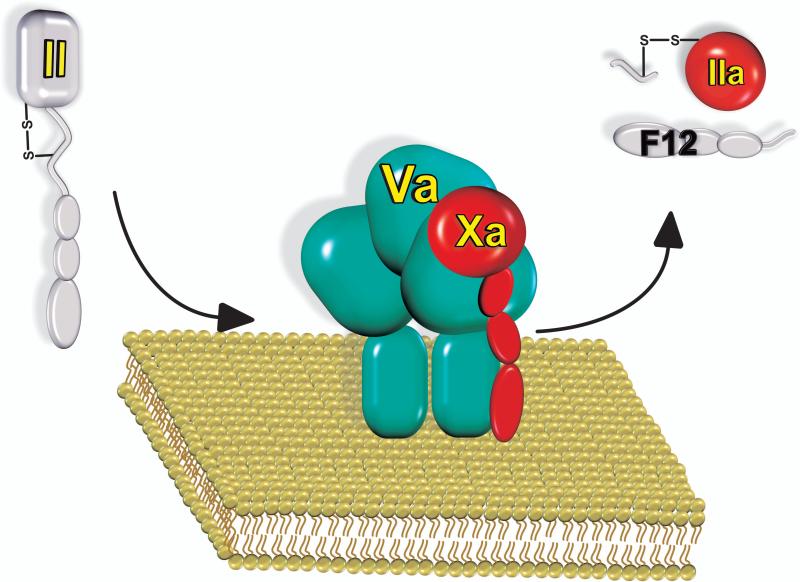
Figure 1. Prothrombin is activated by a membrane-bound enzyme complex
Prothrombinase assembles through reversible interactions between the serine proteinase Xa and the protein cofactor Va on membranes containing phosphatidylserine. The enzyme complex cleaves the zymogen, prothrombin (II) at two sites to produce thrombin (IIa), which is composed of two chains in disulphide linkage and the release of the N-terminal propiece fragment 1.2 (F12).
Figure 2
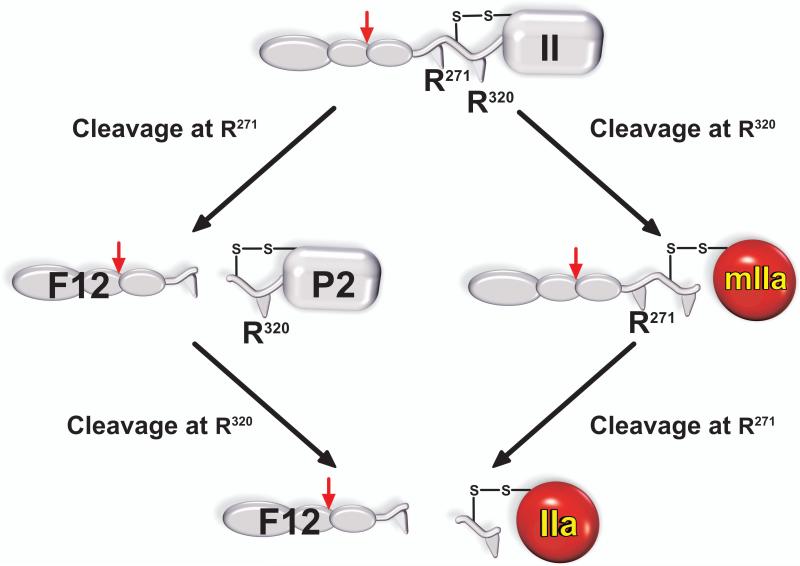
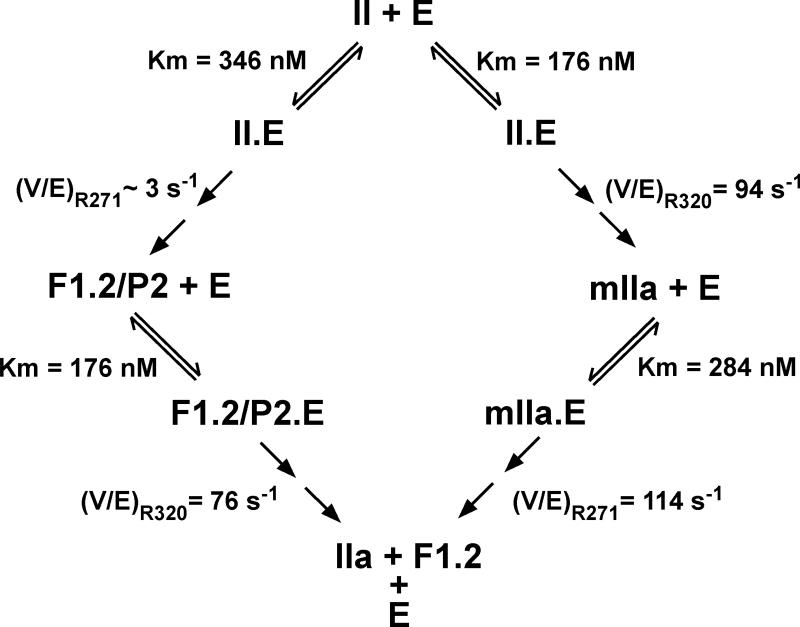
Figure 2. Pathways for the proteolytic conversion of prothrombin to thrombin
The conversion of prothrombin to thrombin results from cleavages following Arg271 and Arg320. Initial cleavage following Arg271 yields the pathway on the left and produces the zymogen, prethrombin 2 (P2) and the propiece, fragment 1.2 (F12) as intermediates. P2 requires further processing at Arg320 to yield thrombin. The pathway on the right arises from initial cleavage following Arg320, which produces the proteinase meizothrombin (mIIa) as an intermediate. Further cleavage following Arg271 is required to yield IIa and the propiece, F12. The Arg155 site (Red Arrow) is susceptible to thrombin cleavage and separates the fragment 1 region from fragment 2 within F12.
Figure 3
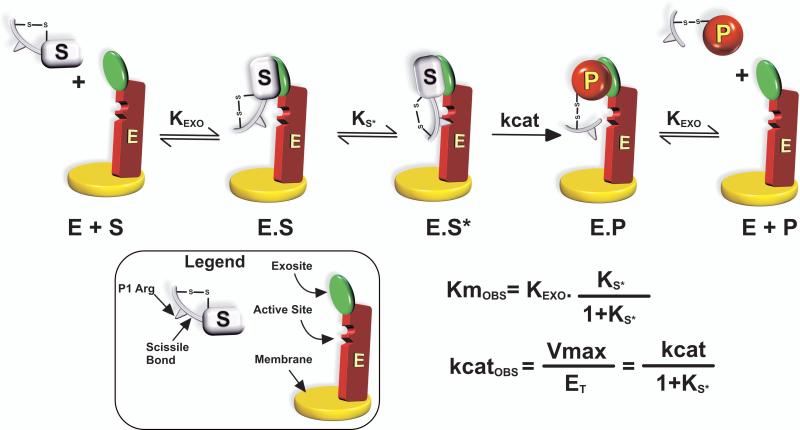
Figure 3. Multi-step Pathway for Protein Substrate Recognition by Prothrombinase
Kinetic scheme resolved for the action of prothrombinase on P2. The initial binding interaction between substrate (S) and prothrombinase (E) to form ES results from exosite-dependent interactions between S and E. Exosite binding is followed by a unimolecular binding step in which structures flanking the cleavage site engage the active-site of the enzyme before catalysis can occur. The product (P) is also bound to E by exosite interactions before it is released. The graphical legend highlights the important features of S and E. The composite nature of the steady state kinetic constants is illustrated by derivation employing the rapid equilibrium assumption. Ks* is defined as [E.S]/[E.S*].
Figure 4
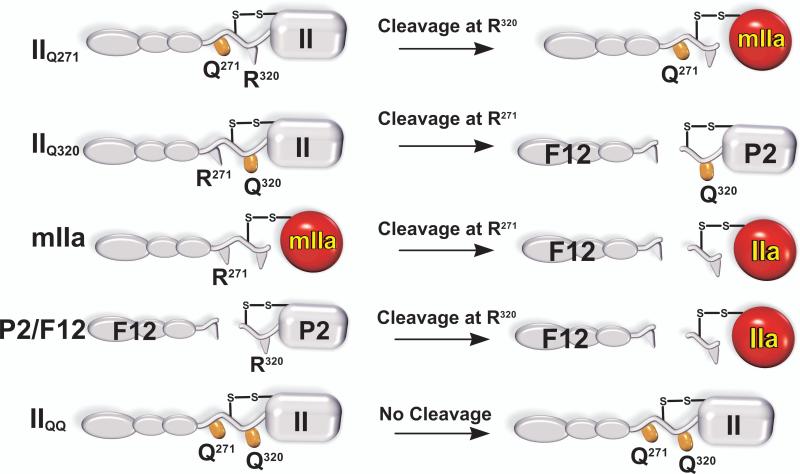
Figure 4. Substrate Derivatives for Kinetic Studies of all Possible Half-Reactions of Prothrombin Activation
Cleavage of the individual sites in intact prothrombin was assessed using prothrombin variants in which the two arginines were individually rendered uncleavable by mutation to Gln. The intermediates mIIa and P2/F12 were used to assess cleavage at the individual sites following cleavage at the first site. IIQQ denotes a prothrombin variant in which both Arg side chains were mutated to Gln to yield an uncleavable derivative. The products formed upon the limiting action of prothrombinase on these substrate variants are illustrated.
Figure 5
Figure 5. Steady State Kinetic Constants for the Half-Reactions of Prothrombin Activation
Kinetic constants measured for the individual half-reactions are listed. V/E denotes Vmax/E for the indicated cleavage reactions and is more appropriate than referring to this term as kcat. Taken from Orcutt & Krishnaswamy (17).
Figure 6
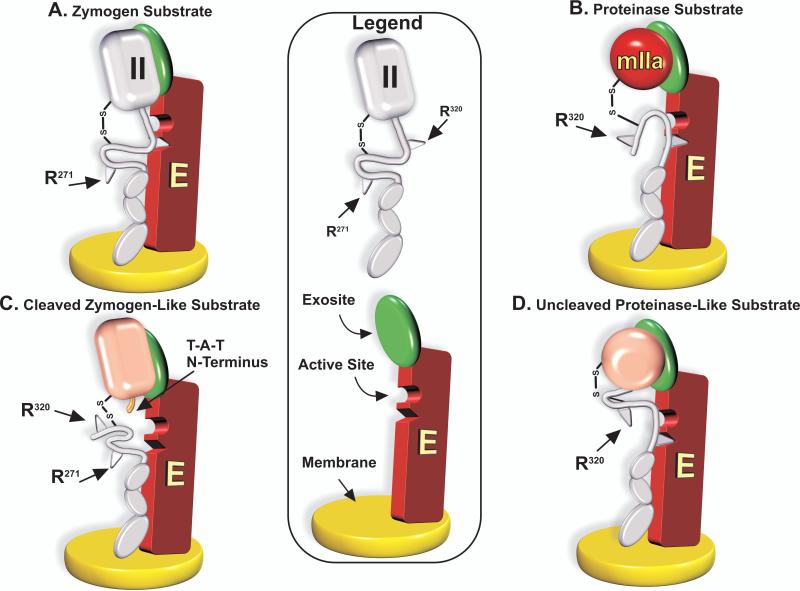
Figure 6. Presentation of the Cleavage Sites for Active-site Docking is Driven by the Zymogen or Proteinase-Like Character of Exosite-Bound Substrate
Exosite-binding constrains substrate presentation such that when the substrate is the zymogen, Arg320 preferentially engages the active-site and is cleaved (Panel A). Conversely, the Arg271 site is readily cleaved when the substrate is the proteinase (Panel B). Prior cleavage at Arg320 yields impaired subsequent cleavage at Arg271 in a variant that remains zymogen-like and is defective in making the transition to proteinase (Panel C). Conversely conformational activation and stabilisation of uncleaved prothrombin in a proteinase-like state yields increased cleavage at Arg271 at the expense of cleavage at Arg320 (Panel D).
Figure 7
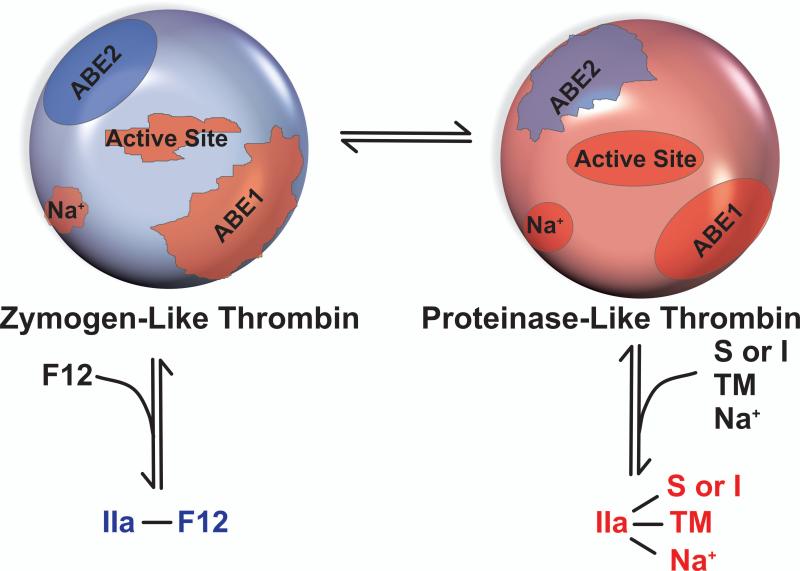
Figure 7. Ligand-Dependent Interconversions of Thrombin Between Zymogen- and Proteinase-Like Forms
In the zymogen-like configuration, ABE1, the Na+ site and the active-site are not optimally configured while F12 binding to ABE2 is thermodynamically favoured. The reverse is true for the proteinase-like state in which ligands targeting ABE1, Na+ and the active-site bind more favourably while ABE2 is not optimally configured. Consequently, binding of F12 to ABE2 favours the zymogen-like form while substrates or inhibitors (S or I), Na+ or thrombomodulin (TM) favour the proteinase-like form. It remains to be established as to whether other ligands for ABE1 (i.e. proteinase activated receptor 1 (70), fibrinogen (71)) or ABE2 (i.e. heparin (72), glycoprotein 1bα (73,74)) replicate the effects seen with F12 and TM at biologically relevant concentrations.
Figure 8
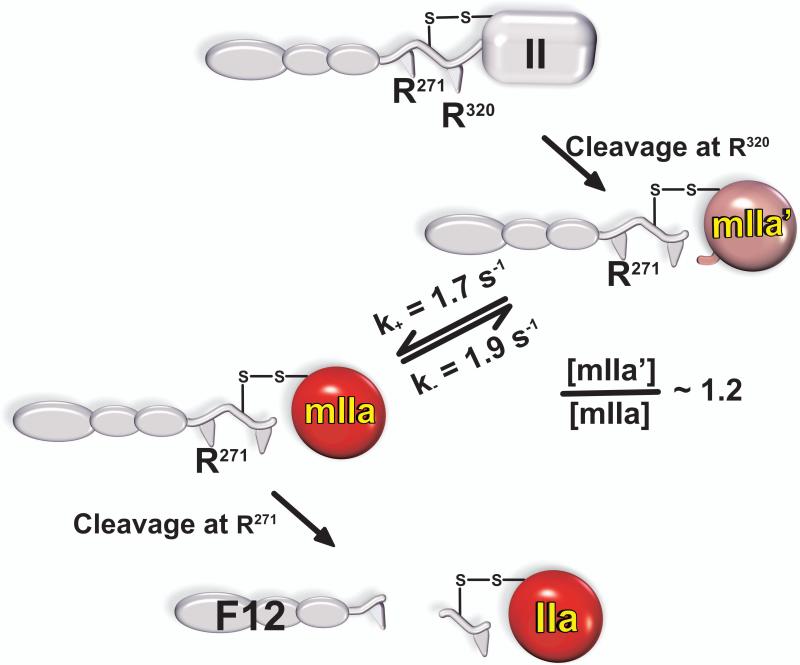
Figure 8. A New Rate-Limiting Step in the Conversion of Prothrombin to Thrombin
Initial cleavage of prothrombin following Arg320 yields a zymogen-like form (mIIa’) that interconverts slowly and reversibly with the proteinase-like form (mIIa). Because the proteinase-like conformation is required for further cleavage at Arg271, it is only mIIa rather than mIIa’ that is processed to thrombin. The reversible conversion of mIIa’ to mIIa there represents a previously unanticipated rate-limiting step in thrombin formation.

References

    1. Mann KG, Jenny RJ, Krishnaswamy S. Cofactor Proteins in the Assembly and Expression of Blood Clotting Enzyme Complexes. Annu. Rev. Biochem. 1988;57:915–956. - PubMed
    1. Mann KG, Nesheim ME, Church WR, Haley P, Krishnaswamy S. Surface-dependent reactions of the vitamin K-dependent enzyme complexes. Blood. 1990;76:1–16. - PubMed
    1. Schenone M, Furie BC, Furie B. The blood coagulation cascade. Curr. Opin. Hematol. 2004;11:272–277. - PubMed
    1. Nesheim ME, Tracy RP, Mann KG. “Clotspeed,” a mathematical simulation of the functional properties of prothrombinase. J. Biol. Chem. 1984;259:1447–1453. - PubMed
    1. Higgins DL, Callahan PJ, Prendergast FG, Nesheim ME, Mann KG. Lipid mobility in the assembly and expression of the activity of the prothrombinase complex. J. Biol. Chem. 1985;260:3604–3612. - PubMed

Publication types

MeSH terms