


Ontogeny of polycystic ovary syndrome and insulin resistance in utero and early childhood
- PMID: 23809624
- PMCID: PMC3732450
- DOI: 10.1016/j.fertnstert.2013.05.023
Ontogeny of polycystic ovary syndrome and insulin resistance in utero and early childhood
Abstract
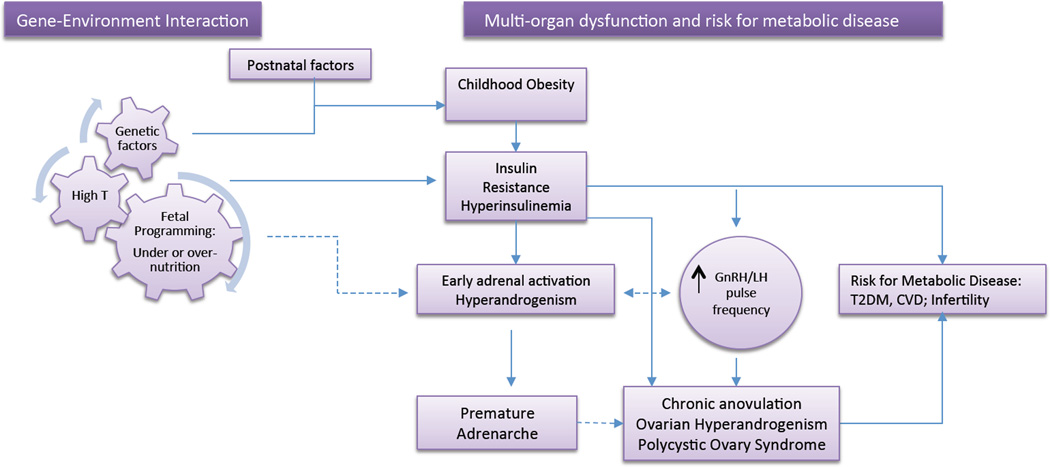
Polycystic ovary syndrome (PCOS) is a prevalent hyperandrogenic infertility and cardiometabolic disorder that increases a woman's lifetime risk of type 2 diabetes mellitus. It is heritable and intensely familial. Progress toward a cure has been delayed by absence of an etiology. Evidence is mounting, however, for in utero T excess, together with gestational hyperglycemia, contributing to either early differentiation of PCOS or phenotypic amplification of its genotypes. Abnormal endocrine, ovarian, and hyperinsulinemic traits are detectable as early as 2 months of age in daughters of women with PCOS, with adiposity enhancement of hyperinsulinemia during childhood potentially contributing to hyperandrogenism and LH excess by adolescence. These findings encourage increasing clinical focus on early childhood markers for adiposity and hyperinsulinemia accompanying ovarian and adrenal endocrine abnormalities that precede a diagnosable PCOS phenotype. They raise the possibility for lifestyle or therapeutic intervention before and during pregnancy or during childhood and adolescence alleviating the manifestations of a familial genetic predisposition to PCOS.
Copyright © 2013 American Society for Reproductive Medicine. Published by Elsevier Inc. All rights reserved.
Figures
References
-
- Eilertsen TB, Vanky E, Carlsen SM. Anti-Mullerian hormone in the diagnosis of polycystic ovary syndrome: can morphologic description be replaced? Hum Reprod. 2012;27:2494–2502. - PubMed
-
- Fauser BC, Tarlatzis BC, Rebar RW, Legro RS, Balen AH, Lobo R, Carmina E, Chang J, Yildiz BO, Laven JS, Boivin J, Petraglia F, Wijeyeratne CN, Norman RJ, Dunaif A, Franks S, Wild RA, Dumesic D, Barnhart K. Consensus on women's health aspects of polycystic ovary syndrome (PCOS): the Amsterdam ESHRE/ASRM-Sponsored 3rd PCOS Consensus Workshop Group. Fertil Steril. 2012;97:28–38. - PubMed
-
- Hampton T. NIH Panel: Name Change, New Priorities Advised for Polycystic Ovary Syndrome. JAMA. 2013;309:863. - PubMed
-
- Zawadski JK, Dunaif A. Diagnostic criteria for poly- cystic ovary syndrome; towards a rational approach. In: Dunaif A, Givens JR, Haseltine FP, Merriam GR, editors. Polycystic Ovary Syndrome. Boston, MA: Blackwell Scientific Publications; 1992. pp. 377–384.
-
- Xita N, Tsatsoulis A. Review: fetal programming of polycystic ovary syndrome by androgen excess: evidence from experimental, clinical, and genetic association studies. The Journal of Clinical Endocrinology and Metabolism. 2006;91:1660–1666. - PubMed
Publication types
MeSH terms
Substances
Grants and funding
LinkOut - more resources
Full Text Sources
Other Literature Sources
Medical
