


Mouse allergen is the major allergen of public health relevance in Baltimore City
- PMID: 23810154
- PMCID: PMC3800085
- DOI: 10.1016/j.jaci.2013.05.005
Mouse allergen is the major allergen of public health relevance in Baltimore City
Abstract
Background: Cockroach and mouse allergens have both been implicated as causes in inner-city asthma morbidity in multicenter studies, but whether both allergens are clinically relevant within specific inner-city communities is unclear.
Objective: Our study aimed to identify relevant allergens in Baltimore City.
Methods: One hundred forty-four children (5-17 years old) with asthma underwent skin prick tests at baseline and had clinical data collected at baseline and 3, 6, 9, and 12 months. Home settled dust samples were collected at the same time points for quantification of indoor allergens. Participants were grouped based on their sensitization and exposure status to each allergen. All analyses were adjusted for age, sex, and serum total IgE level.
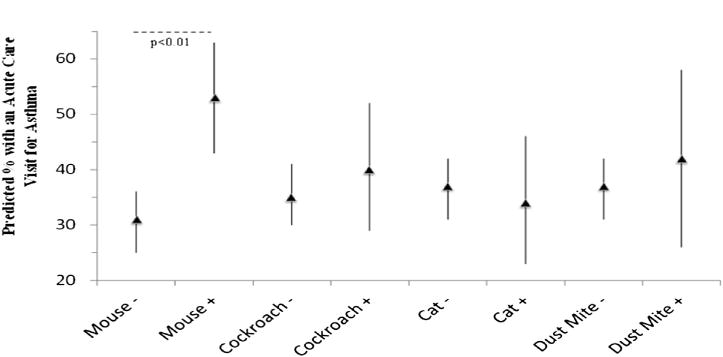
Results: Forty-one percent were mouse sensitized/exposed, and 41% were cockroach sensitized/exposed based on bedroom floor exposure data. Mouse sensitization/exposure was associated with acute care visits, decreased FEV1/forced vital capacity percentage values, fraction of exhaled nitric oxide levels, and bronchodilator reversibility. Cockroach sensitization/exposure was only associated with acute care visits and bronchodilator reversibility when exposure was defined by using bedroom floor allergen levels. Mouse-specific IgE levels were associated with poor asthma health across a range of outcomes, whereas cockroach-specific IgE levels were not. The relationships between asthma outcomes and mouse allergen were independent of cockroach allergen. Although sensitization/exposure to both mouse and cockroach was generally associated with worse asthma, mouse sensitization/exposure was the primary contributor to these relationships.
Conclusions: In a community with high levels of both mouse and cockroach allergens, mouse allergen appears to be more strongly and consistently associated with poor asthma outcomes than cockroach allergen. Community-level asthma interventions in Baltimore should prioritize reducing mouse allergen exposure.
Keywords: FVC; Feno; Forced vital capacity; Fraction of exhaled nitric oxide; Inner-city asthma; PR; Prevalence ratio; childhood asthma; cockroach allergen; indoor allergens; mouse allergen.
Copyright © 2013 American Academy of Allergy, Asthma & Immunology. Published by Mosby, Inc. All rights reserved.
Conflict of interest statement
Disclosure of potential conflict of interest: R. D. Peng has received royalties from Springer Publishing. G. B. Diette has been supported by one or more grants from the National Institutes of Health (NIH)/National Institute of Environmental Health Sciences/Environmental Protection Agency and has consultancy arrangements with GlaxoSmithKline and Fenzian. E. C. Matsui has been supported by one or more grants from the NIH and has received a Phadia Research Form Award. The rest of the authors declare that they have no relevant conflicts of interest.
Figures
Comment in
-
Will the real inner-city allergen please stand up?J Allergy Clin Immunol. 2013 Oct;132(4):836-7. doi: 10.1016/j.jaci.2013.06.046. Epub 2013 Aug 24. J Allergy Clin Immunol. 2013. PMID: 23978444 No abstract available.
References
-
- Moorman JE, Zahran H, Truman BI, Molla MT, Centers for Disease Control and Prevention (CDC) Current asthma prevalence—United States, 2006–2008. MMWR Surveill Summ. 2011;60(suppl):84–6. - PubMed
-
- Centers for Disease Control and Prevention. Vital signs: asthma prevalence, disease characteristics, and self-management education—United States, 2001–2009. MMWR Morb Mortal Wkly Rep. 2011;60:547–52. - PubMed
-
- Torjusen E, Saams J, Peng R, Breysse P, Diette G, Matsui EC. Mouse allergen exposure is associated with increased exhaled nitric oxide levels and decreased lung function among mouse sensitized children with asthma [abstract] J Allergy Clin Immunol. 2010;125(Suppl 2):AB125.
-
- Matsui EC, Eggleston PA, Buckley TJ, Krishnan JA, Breysse PN, Rand CS, et al. Household mouse allergen exposure and asthma morbidity in inner-city preschool children. Ann Allergy Asthma Immunol. 2006;97:514–20. - PubMed
-
- Phipatanakaul W, Eggleston PA, Wright EC, Wood RA, National Cooperative Inner-City Asthma Study Mouse allergen II. The relationship of mouse allergen exposure to mouse sensitization and asthma morbidity in inner-city children with asthma. J Allergy Clin Immunol. 2000;106:1075–80. - PubMed
Publication types
MeSH terms
Substances
Grants and funding
- P50ES015903/ES/NIEHS NIH HHS/United States
- R34 AI074928/AI/NIAID NIH HHS/United States
- P01 ES018176/ES/NIEHS NIH HHS/United States
- U01AI083238/AI/NIAID NIH HHS/United States
- K24 ES021098/ES/NIEHS NIH HHS/United States
- M01-RR00052/RR/NCRR NIH HHS/United States
- M01 RR000052/RR/NCRR NIH HHS/United States
- R01 AI070630/AI/NIAID NIH HHS/United States
- U01 AI083238/AI/NIAID NIH HHS/United States
- R01AI070630/AI/NIAID NIH HHS/United States
- P50 ES015903/ES/NIEHS NIH HHS/United States
- P01ES018176/ES/NIEHS NIH HHS/United States
LinkOut - more resources
Full Text Sources
Other Literature Sources
Medical
Research Materials
