


PIK3R1 mutations cause syndromic insulin resistance with lipoatrophy
- PMID: 23810378
- PMCID: PMC3710759
- DOI: 10.1016/j.ajhg.2013.05.019
PIK3R1 mutations cause syndromic insulin resistance with lipoatrophy
Abstract
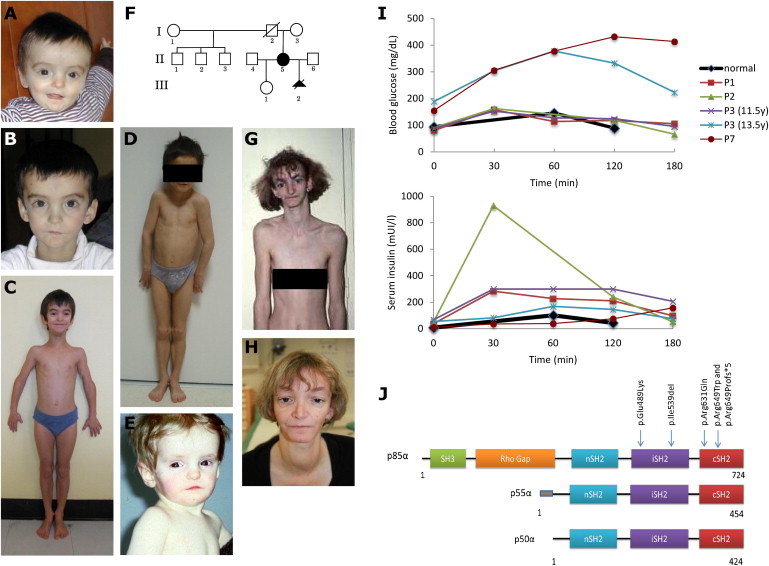
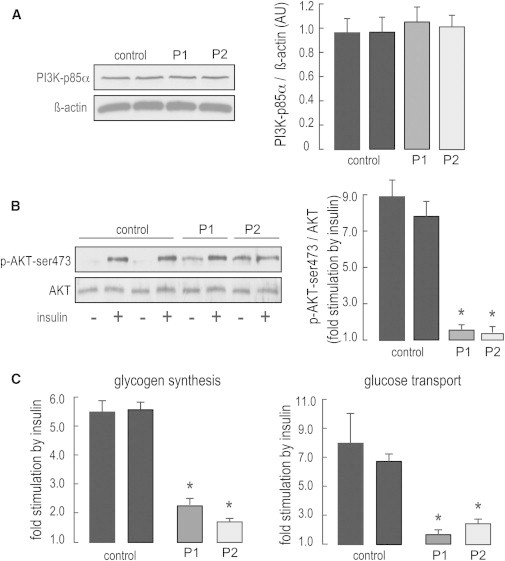
Short stature, hyperextensibility of joints and/or inguinal hernia, ocular depression, Rieger anomaly, and teething delay (SHORT) syndrome is a developmental disorder with an unknown genetic cause and hallmarks that include insulin resistance and lack of subcutaneous fat. We ascertained two unrelated individuals with SHORT syndrome, hypothesized that the observed phenotype was most likely due to de novo mutations in the same gene, and performed whole-exome sequencing in the two probands and their unaffected parents. We then confirmed our initial observations in four other subjects with SHORT syndrome from three families, as well as 14 unrelated subjects presenting with syndromic insulin resistance and/or generalized lipoatrophy associated with dysmorphic features and growth retardation. Overall, we identified in nine affected individuals from eight families de novo or inherited PIK3R1 mutations, including a mutational hotspot (c.1945C>T [p.Arg649Trp]) present in four families. PIK3R1 encodes the p85α, p55α, and p50α regulatory subunits of class IA phosphatidylinositol 3 kinases (PI3Ks), which are known to play a key role in insulin signaling. Functional data from fibroblasts derived from individuals with PIK3R1 mutations showed severe insulin resistance for both proximal and distal PI3K-dependent signaling. Our findings extend the genetic causes of severe insulin-resistance syndromes and provide important information with respect to the function of PIK3R1 in normal development and its role in human diseases, including growth delay, Rieger anomaly and other ocular affections, insulin resistance, diabetes, paucity of fat, and ovarian cysts.
Copyright © 2013 The American Society of Human Genetics. Published by Elsevier Inc. All rights reserved.
Figures
Comment in
-
Autosomal dominant PIK3R1 mutations cause SHORT syndrome.Clin Genet. 2014 Mar;85(3):228-9. doi: 10.1111/cge.12262. Epub 2013 Sep 23. Clin Genet. 2014. PMID: 24033310
References
-
- Semple R.K., Savage D.B., Cochran E.K., Gorden P., O’Rahilly S. Genetic syndromes of severe insulin resistance. Endocr. Rev. 2011;32:498–514. - PubMed
-
- Koenig R., Brendel L., Fuchs S. SHORT syndrome. Clin. Dysmorphol. 2003;12:45–49. - PubMed
-
- Karadeniz N.N., Kocak-Midillioglu I., Erdogan D., Bökesoy I. Is SHORT syndrome another phenotypic variation of PITX2? Am. J. Med. Genet. A. 2004;130A:406–409. - PubMed
-
- Rivière J.B., Mirzaa G.M., O’Roak B.J., Beddaoui M., Alcantara D., Conway R.L., St-Onge J., Schwartzentruber J.A., Gripp K.W., Nikkel S.M., Finding of Rare Disease Genes (FORGE) Canada Consortium De novo germline and postzygotic mutations in AKT3, PIK3R2 and PIK3CA cause a spectrum of related megalencephaly syndromes. Nat. Genet. 2012;44:934–940. - PMC - PubMed
Publication types
MeSH terms
Substances
Supplementary concepts
Grants and funding
- RC2 HL102926/HL/NHLBI NIH HHS/United States
- HL-102924/HL/NHLBI NIH HHS/United States
- RC2 HL102924/HL/NHLBI NIH HHS/United States
- HL-102926/HL/NHLBI NIH HHS/United States
- HL-102925/HL/NHLBI NIH HHS/United States
- RC2 HL103010/HL/NHLBI NIH HHS/United States
- HL-102923/HL/NHLBI NIH HHS/United States
- RC2 HL102923/HL/NHLBI NIH HHS/United States
- UC2 HL102926/HL/NHLBI NIH HHS/United States
- UC2 HL103010/HL/NHLBI NIH HHS/United States
- HL-103010/HL/NHLBI NIH HHS/United States
- UC2 HL102923/HL/NHLBI NIH HHS/United States
- UC2 HL102924/HL/NHLBI NIH HHS/United States
- RC2 HL102925/HL/NHLBI NIH HHS/United States
- UC2 HL102925/HL/NHLBI NIH HHS/United States
LinkOut - more resources
Full Text Sources
Other Literature Sources
Medical
Molecular Biology Databases
Miscellaneous
