


Regional anaesthesia to prevent chronic pain after surgery: a Cochrane systematic review and meta-analysis
- PMID: 23811426
- PMCID: PMC3793661
- DOI: 10.1093/bja/aet213
Regional anaesthesia to prevent chronic pain after surgery: a Cochrane systematic review and meta-analysis
Abstract
Background: Regional anaesthesia may reduce the risk of persistent (chronic) pain after surgery, a frequent and debilitating condition. We compared regional anaesthesia vs conventional analgesia for the prevention of persistent postoperative pain (PPP).
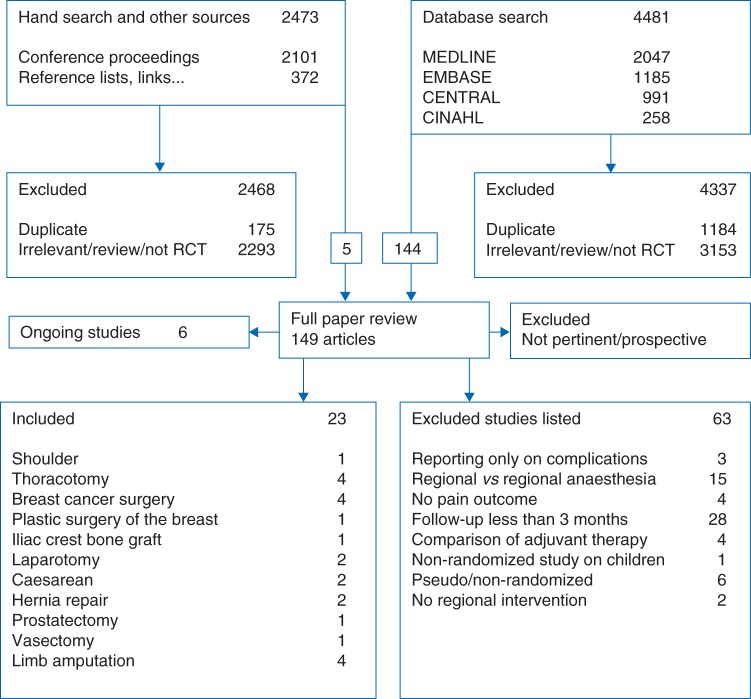
Methods: We searched the Cochrane Central Register of Controlled Trials, PubMed, EMBASE, and CINAHL from their inception to May 2012, limiting the results to randomized, controlled, clinical trials (RCTs), supplemented by a hand search in conference proceedings. We included RCTs comparing regional vs conventional analgesia with a pain outcome at 6 or 12 months. The two authors independently assessed methodological quality and extracted data. We report odds ratios (ORs) with 95% confidence intervals (CIs) as our summary statistic based on random-effects models. We grouped studies according to surgical interventions.
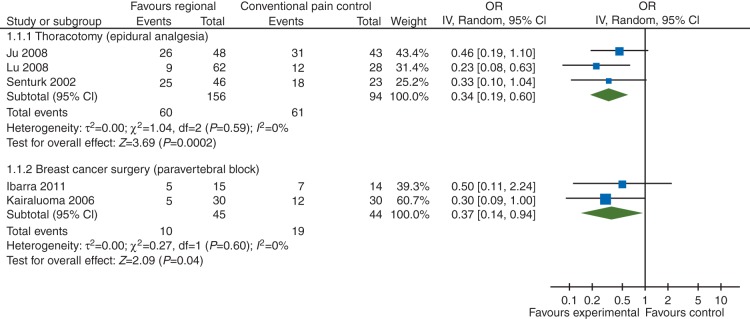
Results: We identified 23 RCTs. We pooled data from 250 participants in three trials after thoracotomy with outcomes at 6 months. Data favoured epidural anaesthesia for the prevention of PPP with an OR of 0.33 (95% CI 0.20-0.56). We pooled two studies investigating paravertebral block for breast cancer surgery; pooled data of 89 participants with outcomes ≈ 6 months favoured paravertebral block with an OR of 0.37 (95% CI 0.14-0.94). Adverse effects were reported sparsely.
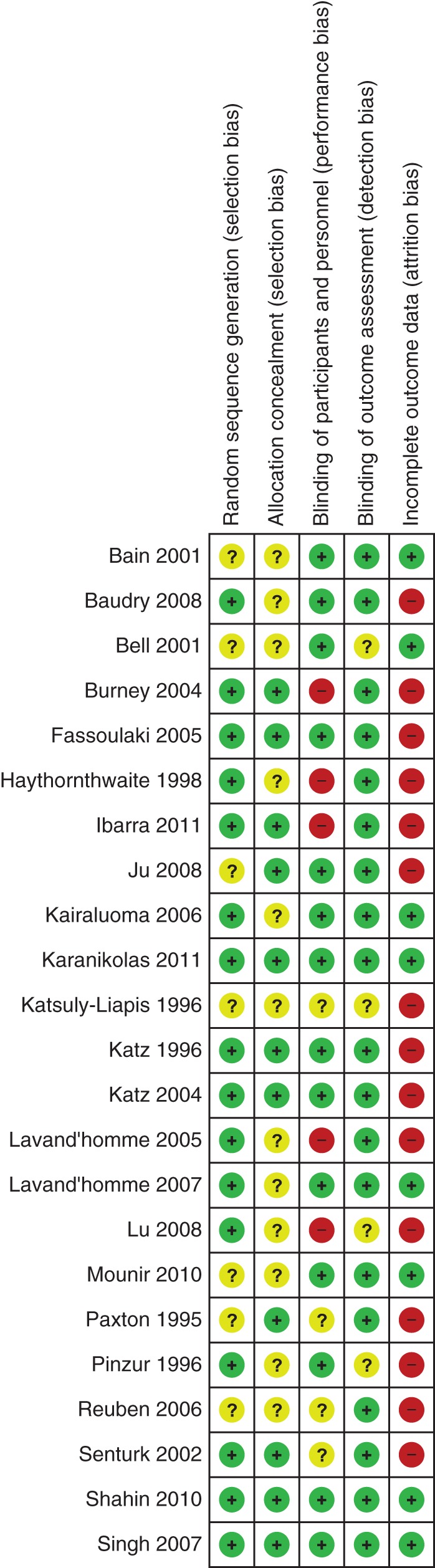
Conclusions: Epidural anaesthesia and paravertebral block, respectively, may prevent PPP after thoracotomy and breast cancer surgery in about one out of every four to five patients treated. Small numbers, performance bias, attrition, and incomplete outcome data especially at 12 months weaken our conclusions.
Keywords: chronic pain; meta-analysis; prevention; regional anaesthesia; systematic review.
Figures
References
-
- Finnerup NB, Sindrup SH, Jensen TS. The evidence for pharmacological treatment of neuropathic pain. Pain. 2010;150:573–81. - PubMed
-
- Kehlet H, Jensen TS, Woolf CJ. Persistent postsurgical pain: risk factors and prevention. Lancet. 2006;367:1618–25. - PubMed
-
- Macrae WA. Chronic post-surgical pain: 10 years on. Br J Anaesth. 2008;101:77–86. - PubMed
-
- Gottschalk A, Cohen SP, Yang S, Ochroch EA. Preventing and treating pain after thoracic surgery. Anesthesiology. 2006;104:594–600. - PubMed
-
- Sng BL, Sia AT, Quek K, Woo D, Lim Y. Incidence and risk factors for chronic pain after caesarean section under spinal anaesthesia. Anaesth Intensive Care. 2009;37:748–52. - PubMed
Publication types
MeSH terms
Grants and funding
LinkOut - more resources
Full Text Sources
Other Literature Sources
Medical
