. 2013 Jul;108(4):366.
doi: 10.1007/s00395-013-0366-9. Epub 2013 Jun 28.

Phenotyping and outcome on contemporary management in a German cohort of patients with peripartum cardiomyopathy

Affiliations

Phenotyping and outcome on contemporary management in a German cohort of patients with peripartum cardiomyopathy

A Haghikia et al. Basic Res Cardiol. 2013 Jul.

Abstract

Peripartum cardiomyopathy (PPCM) is a life-threatening heart disease developing towards the end of pregnancy or in the months following delivery in previously healthy women in terms of cardiac disease. Enhanced oxidative stress and the subsequent cleavage of the nursing hormone Prolactin into an anti-angiogenic 16 kDa subfragment emerged as a potential causal factor of the disease. We established a prospective registry with confirmed PPCM present in 115 patients (mean baseline left ventricular ejection fraction, LVEF: 27 ± 9 %). Follow-up data (6 ± 3 months) showed LVEF improvement in 85 % and full recovery in 47 % while 15 % failed to recover with death in 2 % of patients. A positive family history of cardiomyopathy was present in 16.5 %. Pregnancy-associated hypertension was associated with a better outcome while a baseline LVEF ≤ 25 % was associated with a worse outcome. A high recovery rate (96 %) was observed in patients obtaining combination therapy with beta-blocker, angiotensin-converting enzyme (ACE) inhibitors/angiotensin-receptor-blockers (ARBs) and bromocriptine. Increased serum levels of Cathepsin D, the enzyme that generates 16 kDa Prolactin, miR-146a, a direct target of 16 kDa Prolactin, N-terminal-pro-brain-natriuretic peptide (NT-proBNP) and asymmetric dimethylarginine (ADMA) emerged as biomarkers for PPCM. In conclusion, low baseline LVEF is a predictor for poor outcome while pregnancy-induced hypertensive disorders are associated with a better outcome in this European PPCM cohort. The high recovery rate in this collective is associated with a treatment concept using beta-blockers, ACE inhibitors/ARBs and bromocriptine. Increased levels of Cathepsin D activity, miR-146a and ADMA in serum of PPCM patients support the pathophysiological role of 16 kDa Prolactin for PPCM and may be used as a specific diagnostic marker profile.


Figures
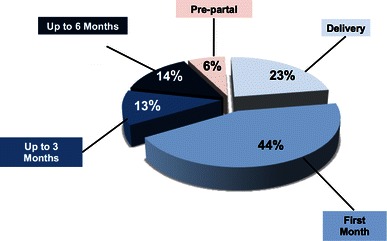
Fig. 1
Fig. 1
Time of diagnosis in relation to delivery in PPCM patients n = 90
Fig. 2
Fig. 2
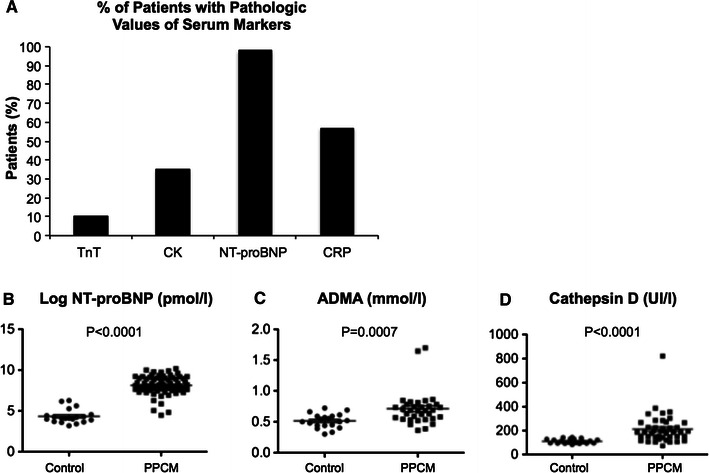
a Percentage of PPCM patients with normal (TnT normal <0.01 μg/l, NT-proBNP normal in women <146 μg/l, CK normal in women <145 U/l, CRP normal <8 mg/l) and with pathophysiologic relevant serum levels of TnT (n = 49), CK (n = 63), NT-proBNP (n = 69) and CRP (n = 72) at the time of diagnosis. Baseline serum levels of b NT-proBNP (PPCM, n = 69; control, n = 19), c ADMA (PPCM, n = 34; control, n = 19) and d Cathepsin D (PPCM, n = 43; Control, n = 19). p value compares PPCM vs. healthy postpartum controls
Fig. 3
Fig. 3
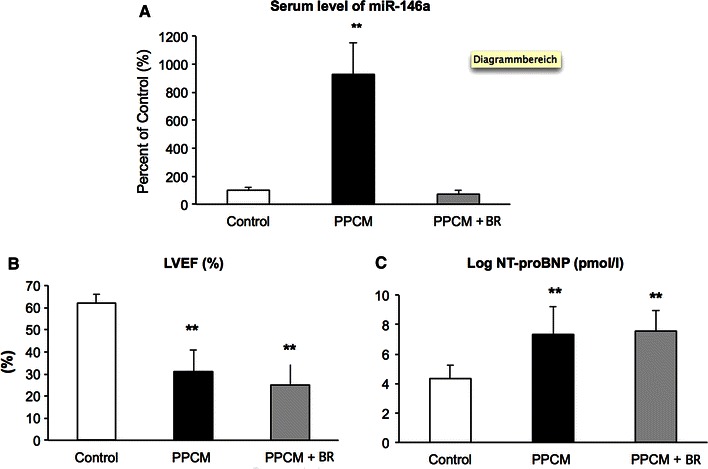
a Bar graph displaying elevated serum levels of miR-146a of patients with acute PPCM without bromocriptine (n = 40) compared with healthy postpartal controls (n = 19) and with acute PPCM patients who obtained already bromocriptine (BR) for 3–7 days when blood samples were taken (n = 17). b Bar graph showing baseline LVEF and c NT-proBNP in the same PPCM patients with or without early bromocriptine (BR) treatment. **p = 0.001 vs. Control
Fig. 4
Fig. 4
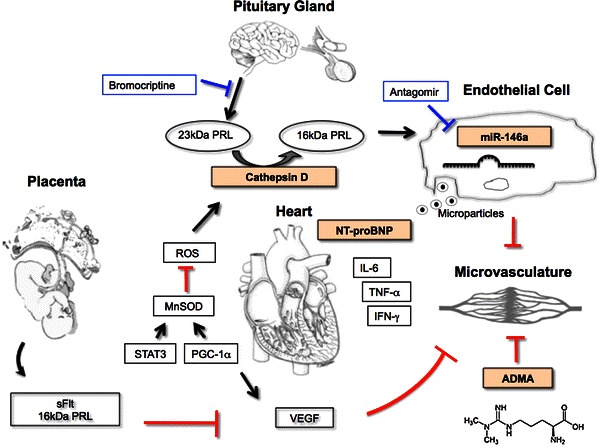
Scheme depicting the pathophysiological circuits in PPCM. Note that Cathepsin D, NT-proBNP, miR-146a and ADMA were tested as potential biomarkers of PPCM in this study. The scheme illustrates the release of Prolactin from the pituitary gland towards the end of pregnancy, which under conditions of enhanced oxidative stress (ROS) in the myocardium is proteolytically cleaved to a 16 kDa fragment by Cathepsin D. In healthy myocardium this process is prevented by antioxidative factors such as MnSOD, which is regulated by certain transcription factors such as STAT3 and PGC1-α. The 16 kDa Prolactin leads to increased miR-146a expression in endothelial cells, which exerts angiotoxic effects and impairs via an exosome-mediated paracrine fashion the metabolic activity of cardiomyocytes and the crosstalk between endothelial cells and cardiomyocytes via down-regulation of ErbB4. An imbalance between VEGF and the soluble VEGF receptor sFlt as well as increased ADMA levels add to the anti-angiogenetic effects of the 16 kDa Prolactin-miR-146a axis. Blocking Prolactin with bromocriptine or inhibition of the 16 kDa Prolactin effector miR-146a with antagomirs prevents or attenuates detrimental effects of 16 kDa Prolactin. Enhanced levels of pro-inflammatory cytokines such as IL-6, TNF-α and IFN-γ as previously reported point to an additional inflammatory component within the pathomechanisms of PPCM. NT-proBNP as an unspecific marker of heart failure is increased in almost all PPCM patients. ROS reactive oxygen species, MnSOD manganese Superoxide Dismutase, STAT3 signal transducer and activator of transcription 3, PGC-1α peroxisome proliferator-activated receptor gamma, coactivator 1 alpha, sFlt soluble fms-like tyrosine kinase-1, VEGF vascular endothelial growth factor, IL-6 interleukin-6, TNF-α tumor necrosis factor-α, IFN-γ interferon-γ, ADMA asymmetric dimethylarginine

References

    1. Anderssohn M, Rosenberg M, Schwedhelm E, Zugck C, Lutz M, Luneburg N, Frey N, Boger RH. The l-Arginine-asymmetric dimethylarginine ratio is an independent predictor of mortality in dilated cardiomyopathy. J Card Fail. 2012;18:904–911. doi: 10.1016/j.cardfail.2012.10.011. - DOI - PubMed
    1. Blauwet LA, Cooper LT. Diagnosis and management of peripartum cardiomyopathy. Heart. 2011;97:1970–1981. doi: 10.1136/heartjnl-2011-300349. - DOI - PubMed
    1. Elkayam U. Clinical characteristics of peripartum cardiomyopathy in the United States: diagnosis, prognosis, and management. J Am Coll Cardiol. 2011;58:659–670. doi: 10.1016/j.jacc.2011.03.047. - DOI - PubMed
    1. Fett JD. Peripartum cardiomyopathy. Insights from Haiti regarding a disease of unknown etiology. Minn Med. 2002;85:46–48. - PubMed
    1. Forster O, Hilfiker-Kleiner D, Ansari AA, Sundstrom JB, Libhaber E, Tshani W, Becker A, Yip A, Klein G, Sliwa K. Reversal of IFN-gamma, oxLDL and prolactin serum levels correlate with clinical improvement in patients with peripartum cardiomyopathy. Eur J Heart Fail. 2008;10:861–868. doi: 10.1016/j.ejheart.2008.07.005. - DOI - PubMed

Publication types

MeSH terms