. 2013 Jul 16;110(29):11887-92.
doi: 10.1073/pnas.1306074110. Epub 2013 Jun 27.

Context-dependent signaling defines roles of BMP9 and BMP10 in embryonic and postnatal development

Affiliations

Context-dependent signaling defines roles of BMP9 and BMP10 in embryonic and postnatal development

Hao Chen et al. Proc Natl Acad Sci U S A. .

Abstract

Many important signaling pathways rely on multiple ligands. It is unclear if this is a mechanism of safeguard via redundancy or if it serves other functional purposes. In this study, we report unique insight into this question by studying the activin receptor-like kinase 1 (ALK1) pathway. Despite its functional importance in vascular development, the physiological ligand or ligands for ALK1 remain to be determined. Using conventional knockout and specific antibodies against bone morphogenetic protein 9 (BMP9) or BMP10, we showed that BMP9 and BMP10 are the physiological, functionally equivalent ligands of ALK1 in vascular development. Timing of expression dictates the in vivo requisite role of each ligand, and concurrent expression results in redundancy. We generated mice (Bmp10(9/9)) in which the coding sequence of Bmp9 replaces that of Bmp10. Surprisingly, analysis of Bmp10(9/9) mice demonstrated that BMP10 has an exclusive function in cardiac development, which cannot be substituted by BMP9. Our study reveals context-dependent significance in having multiple ligands in a signaling pathway.

Keywords: angiogenesis; heart development; heart homeostasis; hereditary hemorrhagic telangiectasia.


Conflict of interest statement

The authors declare no conflict of interest.

Figures

Fig. 1.
Fig. 1.
Neutralization of BMP10 causes defective vascular development in Bmp9-deficient neonatal mice. (A) Fluorescence images of low (Top) and higher magnification (Middle and Bottom) of retinal vasculature. Neonatal mice were treated with PBS or anti-BMP10 (462732; R&D Systems) on P2 and P4, at 10 mg/kg. Whole mount P7 mouse retinas were stained with isolectin B4 to visualize overall vasculature, and anti-αSMA for arteries. Dotted line at Middle marks the edge of retinal cup. (Scale bars: Top, 500 μm; Middle, 200 μm; Bottom, 25 μm.) (B) Quantification of vascular extension measured by the ratio of the distance from the ONH to the edge of the vascular network, over the distance from the ONH to the edge of retinal cup marked by the dotted line in A, Middle. Twelve representative measurements were taken from three treated retinas for each group. Results are shown as mean ± SD. (C) Quantification of vascular density. Total pixel counts from 12 representative images from three retinas of each condition. Results are expressed as mean ± SD *P < 0.05, **P < 0.002, ***P < 0.0005.
Fig. 2.
Fig. 2.
Simultaneous blockade of BMP9 and BMP10 with neutralizing antibodies causes defective vascular development in C57BL/6 neonates and enhances vascular sprouting in vitro. (A) Starting at P1, anti-BMP9 (7A6), anti-BMP10 (462732; R&D Systems), or ALK1Fc were dosed every other day, at 10 mg/kg. Whole mount retinas of P8 mice were stained with isolectin B4 and anti-αSMA (Upper). (Scale bar: 200 μm.) Lower shows higher magnification views of boxed areas in Upper. (Scale bar: 100 μm.) (B) Tracheas of P8 mice were stained with PECAM-1 for blood vasculature (Upper), and LYVE-1 for lymphatic vasculature (Lower). (Scale bar: 250 μm.) (C) Serum induced up-regulation of SMAD6 expression in HUVECs in the presence of anti-BMP9 (7A6), anti-BMP10 (462732; R&D Systems), or both antibodies. Square dots represent each data point (n = 3). (D) HUVEC-coated beads were cultured in the presence of indicated agents. HUVEC sprouts were visualized by staining with DAPI and Alexa Fluor 488-phalloidin. (Scale bar: 175 μm.) Average sprout length from eight beads of each condition is shown. AU, arbitrary unit. Results are shown as mean ± SD ***P < 0.0005.
Fig. 3.
Fig. 3.
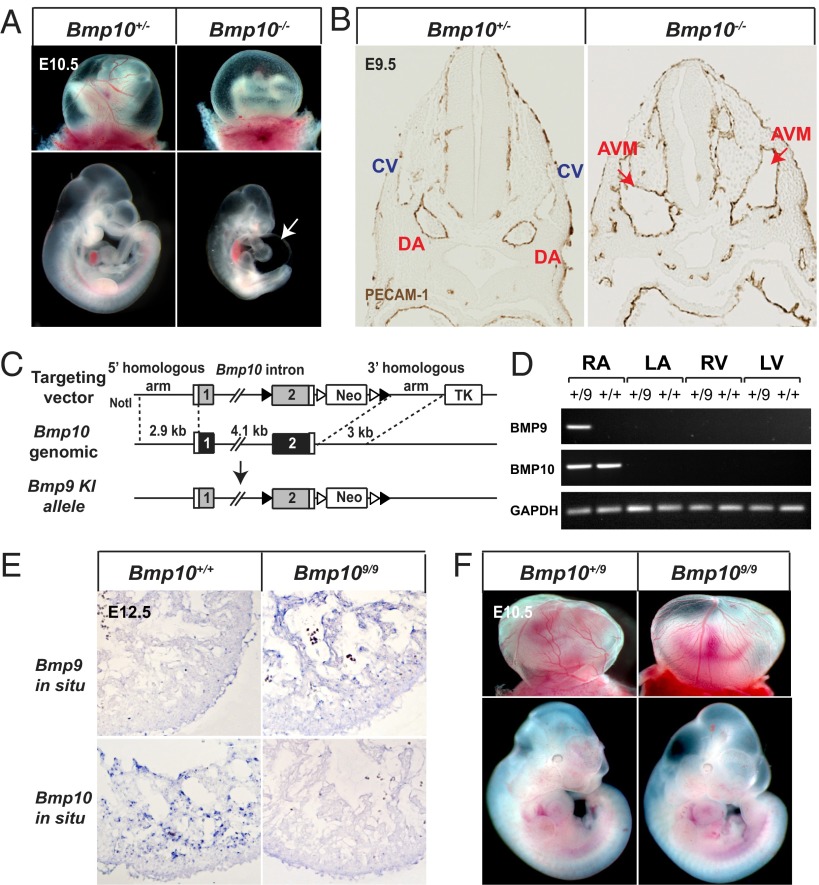
BMP10 is required for early vascular development and this role is interchangeable with BMP9. (A) Gross morphology of E10.5 yolk sac and embryos of control and Bmp10−/−. (B) Paraffin section of E9.5 embryos stained with PECAM-1 for blood vessels. (C) Targeting vector was designed to make the Bmp9 knock-in allele. (D) RT-PCR expression analysis of Bmp9 and Bmp10 in adult heterozygous Bmp9 knock-in (Bmp10+/9) mice. (E) In situ hybridization on embryonic hearts of WT and homozygous Bmp9 knock-in (Bmp109/9) embryos. (F) E10.5 yolk sac and embryos of control and Bmp109/9 animals.
Fig. 4.
Fig. 4.
Ectopic expression of BMP9 in the heart fails to fully compensate the loss of BMP10. (A) Histological analysis of E14.5 hearts. Middle shows higher magnification views of the left ventricle wall. Bottom shows immunohistological staining with anti-Ki67 antibody. Asterisks denote pericardial edema. (B) Model of BMP10’s dual role in early embryonic development.

References

    1. Abdalla SA, Letarte M. Hereditary haemorrhagic telangiectasia: Current views on genetics and mechanisms of disease. J Med Genet. 2006;43(2):97–110. - PMC - PubMed
    1. Govani FS, Shovlin CL. Hereditary haemorrhagic telangiectasia: A clinical and scientific review. Eur J Hum Genet. 2009;17(7):860–871. - PMC - PubMed
    1. Lenato GM, Guanti G. Hereditary haemorrhagic telangiectasia (HHT): Genetic and molecular aspects. Curr Pharm Des. 2006;12(10):1173–1193. - PubMed
    1. Seki T, Yun J, Oh SP. Arterial endothelium-specific activin receptor-like kinase 1 expression suggests its role in arterialization and vascular remodeling. Circ Res. 2003;93(7):682–689. - PubMed
    1. Oh SP, et al. Activin receptor-like kinase 1 modulates transforming growth factor-beta 1 signaling in the regulation of angiogenesis. Proc Natl Acad Sci USA. 2000;97(6):2626–2631. - PMC - PubMed

Publication types

MeSH terms