


Discrimination, harassment, abuse, and bullying in the workplace: contribution of workplace injustice to occupational health disparities
- PMID: 23813664
- PMCID: PMC3884002
- DOI: 10.1002/ajim.22221
Discrimination, harassment, abuse, and bullying in the workplace: contribution of workplace injustice to occupational health disparities
Abstract
Background: This paper synthesizes research on the contribution of workplace injustices to occupational health disparities.
Methods: We conducted a broad review of research and other reports on the impact of workplace discrimination, harassment, and bullying on workers' health and on family and job outcomes.
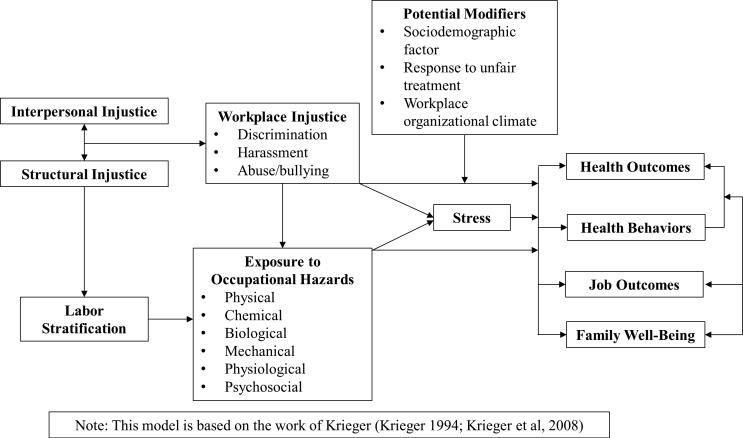
Results: Members of demographic minority groups are more likely to be victims of workplace injustice and suffer more adverse outcomes when exposed to workplace injustice compared to demographic majority groups. A growing body of research links workplace injustice to poor psychological and physical health, and a smaller body of evidence links workplace injustice to unhealthy behaviors. Although not as well studied, studies show that workplace injustice can influence workers' health through effects on workers' family life and job-related outcomes.
Conclusion: Injustice is a key contributor to occupational health injustice and prospective studies with oversample of disadvantaged workers and refinement of methods for characterizing workplace injustices are needed.
Keywords: bullying; discrimination; health disparities; sexual harassment; workplace abuse.
© 2013 Wiley Periodicals, Inc.
Figures
References
-
- Agudelo-Suarez A, Gil-Gonzalez D, Ronda-Perez E, Porthe V, Paramio-Perez G, Garcia AM, Gari A. Discrimination, work and health in immigrant populations in Spain. Social Science & Medicine. 2009;68:1866–1874. - PubMed
-
- Alexis O, Vydelingum V. The lived experience of overseas black and minority ethnic nurses in the NHS in the south of England. Diversity in Health and Social Care. 2004;1:13–20.
-
- Allan HT, Cowie H, Smith P. Overseas nurses’ experiences of discrimination: a case of racist bullying? J Nurs Manag. 2009;17:898–906. - PubMed
-
- Alleyne A. Black identity and workplace oppression. Counselling & Psychotherapy Research. 2004;4:4–8.
-
- Badgett M. The wage effects of sexual orientation discrimination. Industrial and Labor Relations Review. 1995:726–739.
Publication types
MeSH terms
Grants and funding
LinkOut - more resources
Full Text Sources
Other Literature Sources
Medical
