


Comprehensive review: antitumor necrosis factor agents in inflammatory bowel disease and factors implicated in treatment response
- PMID: 23814608
- PMCID: PMC3667472
- DOI: 10.1177/1756283X13479826
Comprehensive review: antitumor necrosis factor agents in inflammatory bowel disease and factors implicated in treatment response
Abstract
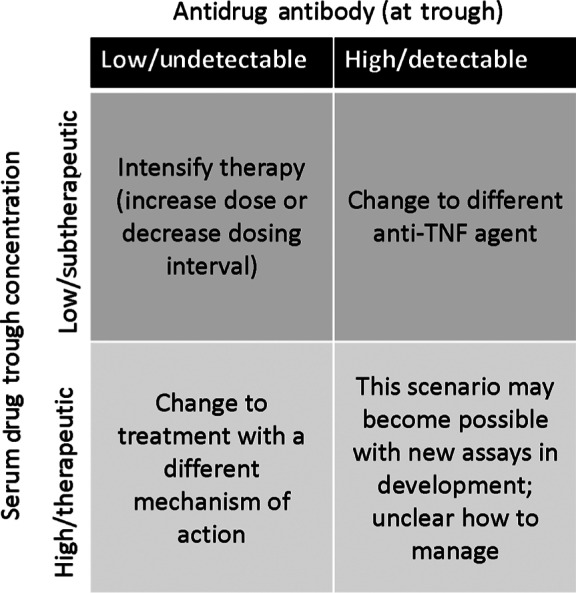
Antitumor necrosis factor α (anti-TNF) agents have dramatically influenced management of refractory inflammatory bowel disease (IBD). However, not all patients respond to treatment and some lose response or become intolerant over time. Immunogenicity, a well established phenomenon with anti-TNF agents, may have important clinical implications in patients with IBD. A comprehensive review of available evidence demonstrating how drug concentrations, immunogenicity, and other factors influence outcomes with anti-TNF agents was performed. PubMed, EMBASE, Biosis, Dialog, and Conference Papers Index were searched from 1 January 1995 to 7 April 2012 to identify clinical trials in adult and pediatric patients with IBD treated with anti-TNF agents for Crohn's disease or ulcerative colitis. Data on serum drug levels and immunogenicity and their relationship with clinical efficacy and safety outcomes were extracted and examined. Serum infliximab concentrations correlated with clinical efficacy and treatment outcomes in patients with IBD; this relationship is less well characterized with adalimumab and certolizumab pegol concentrations. In multiple studies, the presence and level of antibodies to infliximab correlated with loss of clinical efficacy and increased risk of infusion reactions. The incidence and clinical impact of antibody formation with adalimumab or certolizumab in IBD is becoming evident as more data become available. Current, enzyme-linked immunosorbent assay based anti-TNF antibody assays are suboptimal in that results are often inconclusive and comparisons between agents cannot be made. Measurement of anti-TNF agent drug concentrations and assessment of immunogenicity has the potential to positively impact clinical decision making during anti-TNF therapy for IBD. As assays are optimized, it is expected that the clinical impact of these determinations will be better characterized.
Keywords: Crohn’s disease; adalimumab; antitumor necrosis factor α; certolizumab; enzyme-linked immunosorbent assay; immunogenicity; inflammatory bowel disease; infliximab; ulcerative colitis.
Conflict of interest statement
Figures


References
-
- Ainsworth M., Bendtzen K., Brynskov J. (2008) Tumor necrosis factor-alpha binding capacity and anti-infliximab antibodies measured by fluid-phase radioimmunoassays as predictors of clinical efficacy of infliximab in Crohn’s disease. Am J Gastroenterol 103: 944–948 - PubMed
-
- Anderson P. (2005) Tumor necrosis factor inhibitors: clinical implications of their different immunogenicity profiles. Semin Arthritis Rheum 34(Suppl. 1): 19–22 - PubMed
-
- Baert F., Noman M., Vermeire S., Van Assche G., D’Haens G., Carbonez A., et al. (2003) Influence of immunogenicity on the long-term efficacy of infliximab in Crohn’s disease. N Engl J Med 348: 601–608 - PubMed
LinkOut - more resources
Full Text Sources
Other Literature Sources
Medical
Research Materials
Miscellaneous
