


Does high biodiversity reduce the risk of Lyme disease invasion?
- PMID: 23816142
- PMCID: PMC3728044
- DOI: 10.1186/1756-3305-6-195
Does high biodiversity reduce the risk of Lyme disease invasion?
Abstract
Background: It has been suggested that increasing biodiversity, specifically host diversity, reduces pathogen and parasite transmission amongst wildlife (causing a "dilution effect"), whereby transmission amongst efficient reservoir hosts, (e.g. Peromyscus spp. mice for the agent of Lyme disease Borrelia burgdorferi) is reduced by the presence of other less efficient host species. If so, then increasing biodiversity should inhibit pathogen and parasite invasion.
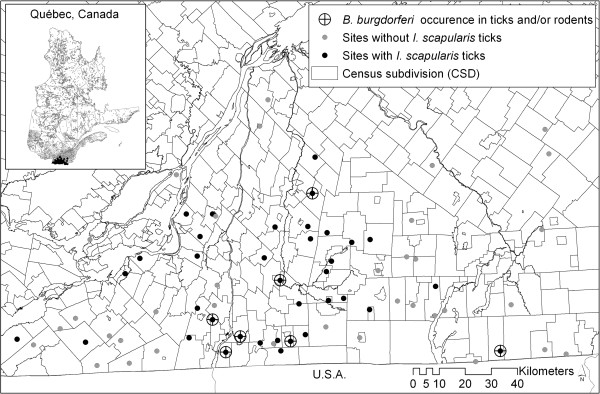
Methods: We investigated this hypothesis by studying invasion of B. burgdorferi and its tick vector Ixodes scapularis in 71 field sites in southeastern Canada. Indices of trapped rodent host diversity, and of biodiversity of the wider community, were investigated as variables explaining the numbers of I. scapularis collected and B. burgdorferi infection in these ticks. A wide range of alternative environmental explanatory variables were also considered.
Results: The observation of low I. scapularis abundance and low B. burgdorferi infection prevalence in sites where I. scapularis were detected was consistent with early-stage invasion of the vector. There were significant associations between the abundance of ticks and season, year of study and ambient temperature. Abundance of host-seeking larvae was significantly associated with deer density, and abundance of host-seeking larvae and nymphs were positively associated with litter layer depth. Larval host infestations were lower where the relative proportion of non-Peromyscus spp. was high. Infestations of hosts with nymphs were lower when host species richness was higher, but overall nymphal abundance increased with species richness because Peromyscus spp. mouse abundance and host species richness were positively correlated. Nymphal infestations of hosts were lower where tree species richness was higher. B. burgdorferi infection prevalence in ticks varied significantly with an index of rates of migratory bird-borne vector and pathogen invasion.
Conclusions: I. scapularis abundance and B. burgdorferi prevalence varied with explanatory variables in patterns consistent with the known biology of these species in general, and in the study region in particular. The evidence for a negative effect of host biodiversity on I. scapularis invasion was mixed. However, some evidence suggests that community biodiversity beyond just host diversity may have direct or indirect inhibitory effects on parasite invasion that warrant further study.
Figures
References
-
- Piesman J, Mather TN, Donahue JG, Levine J, Campbell JD, Karakashian SJ, Spielman A. Comparative prevalence of Babesia microti and Borrelia burgdorferi in four populations of Ixodes dammini in eastern Massachusetts. Acta Trop. 1986;43(3):263–270. - PubMed
-
- Spielman A, Clifford CM, Piesman J, Corwin MD. Human babesiosis on Nantucket Island, USA: description of the vector, Ixodes (Ixodes) dammini, n. sp. (Acarina: Ixodidae) J Med Entomol. 1979;15(3):218–234. - PubMed
-
- Ogden NH, Trudel L, Artsob H, Barker IK, Beauchamp G, Charron DF, Drebot MA, Galloway TD, O’Handley R, Thompson RA. et al.Ixodes scapularis ticks collected by passive surveillance in Canada: Analysis of geographic distribution and infection with Lyme Borreliosis agent Borrelia burgdorferi. J Med Entomol. 2006;43(3):600–609. doi: 10.1603/0022-2585(2006)43[600:ISTCBP]2.0.CO;2. - DOI - PubMed
Publication types
MeSH terms
LinkOut - more resources
Full Text Sources
Other Literature Sources
Medical
Miscellaneous
