Comment
doi: 10.1083/jcb.201305155.
Epub 2013 Jul 1.
Probing the depths of cellular senescence
Affiliations
- PMID: 23816622
- PMCID: PMC3704986
- DOI: 10.1083/jcb.201305155
Item in Clipboard
Comment
Probing the depths of cellular senescence
J Cell Biol.
.
Abstract
Cellular senescence is a state of irreversible cell cycle arrest that has been documented to both suppress cancer and promote aging. Although not well understood, extensive nuclear changes, including the remodeling of chromatin, take place as cells become senescent. In this issue, Ivanov et al. (2013. J. Cell Biol. http://dx.doi.org/jcb.201212110) report that chromatin fragments are released from the nuclei of senescent cells and are subsequently targeted for processing through the autophagy/lysosomal pathway.
Figures
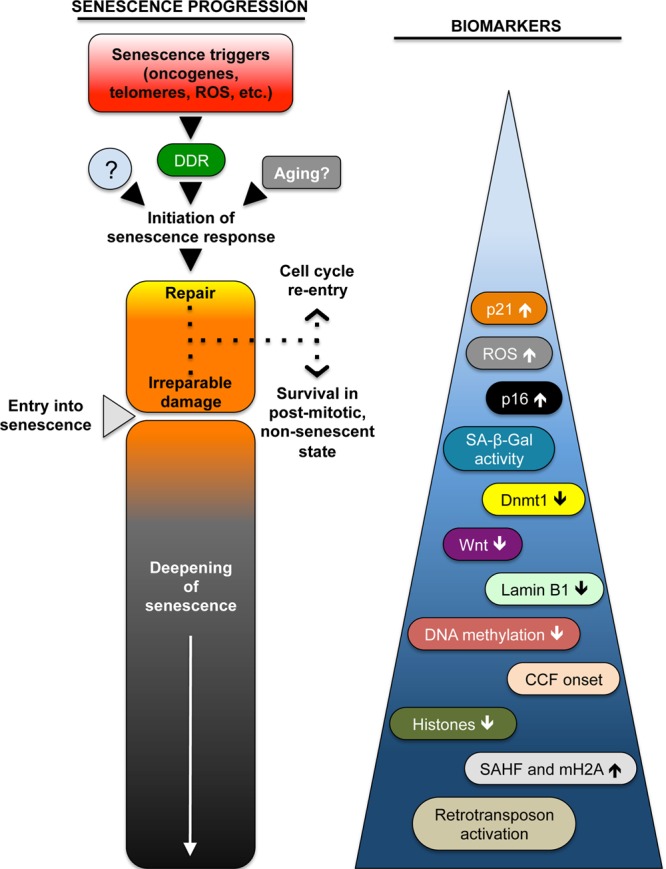
A schematic representation of the processes that lead to the establishment of cellular senescence. The progression of senescence has been separated into several components: (1) triggering events; (2) initiation of the senescence response; (3) entry into senescence; and (4) a further deepening of senescence phenotypes. Stages 2 and 3 can be separated by a period of attempted repair, which may result in recovery and survival in a healthy postmitotic state, or even resumption of cell proliferation. Entry into senescence is likely the result of the acquisition of irreparable damage, followed by an extended period during which additional degenerative changes can take place, evolve, and accumulate. On the right are illustrated some of the many molecular phenotypes, or biomarkers, that have been associated with cellular senescence. This listing is not meant to be comprehensive and similarly, the order is not meant to imply the chronological acquisition of these features. The construction of such a timeline we believe constitutes an important challenge for the field going forward. DDR, DNA damage response.
Comment on
-
Lysosome-mediated processing of chromatin in senescence.J Cell Biol. 2013 Jul 8;202(1):129-43. doi: 10.1083/jcb.201212110. Epub 2013 Jul 1. J Cell Biol. 2013. PMID: 23816621 Free PMC article.
References
-
- Coppé J.P., Patil C.K., Rodier F., Sun Y., Muñoz D.P., Goldstein J., Nelson P.S., Desprez P.Y., Campisi J. 2008. Senescence-associated secretory phenotypes reveal cell-nonautonomous functions of oncogenic RAS and the p53 tumor suppressor. PLoS Biol. 6:2853–2868 10.1371/journal.pbio.0060301 - DOI - PMC - PubMed
Publication types
MeSH terms
Substances
LinkOut - more resources
Full Text Sources
Other Literature Sources