Blood glucose as a predictor of mortality in children admitted to the hospital with febrile illness in Tanzania
- PMID: 23817332
- PMCID: PMC3741242
- DOI: 10.4269/ajtmh.13-0016
Blood glucose as a predictor of mortality in children admitted to the hospital with febrile illness in Tanzania
Abstract
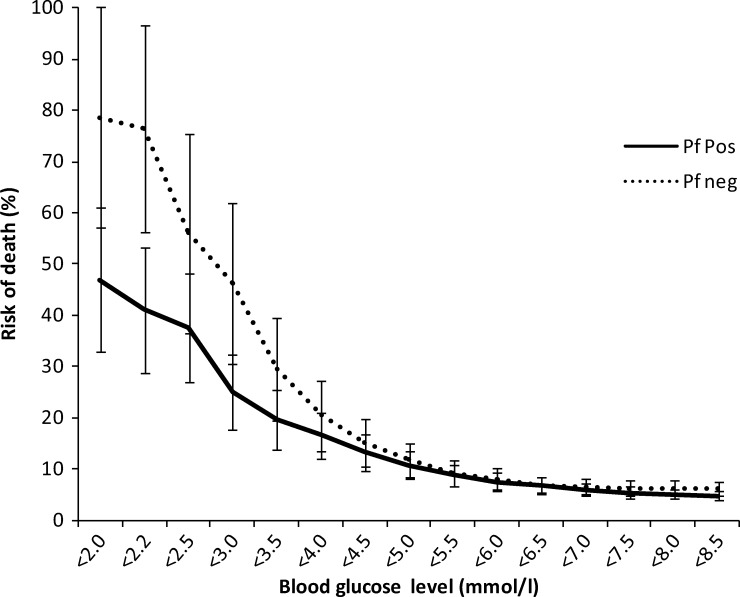
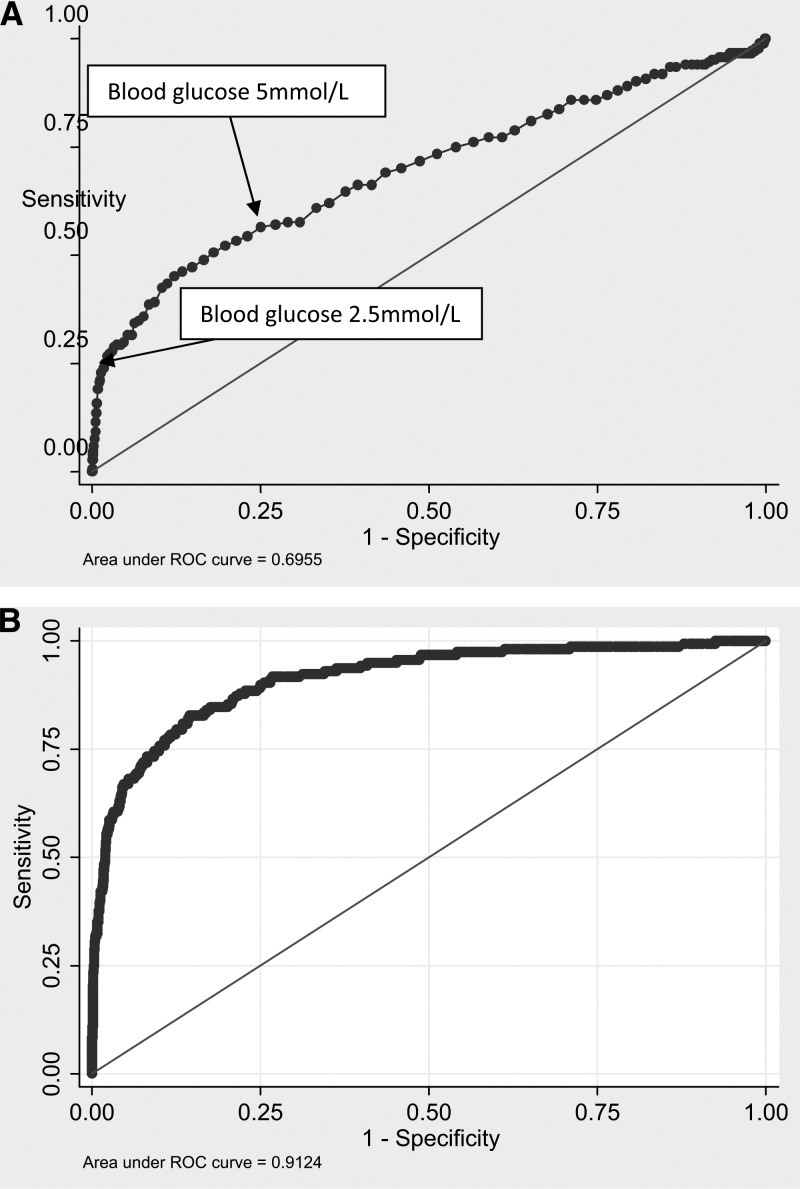
Data from a prospective study of 3,319 children ages 2 months to 5 years admitted with febrile illness to a Tanzanian district hospital were analyzed to determine the relationship of blood glucose and mortality. Hypoglycemia (blood sugar < 2.5 mmol/L and < 45 mg/dL) was found in 105 of 3,319 (3.2%) children at admission, and low-normal blood glucose (2.5-5 mmol/L and 45-90 mg/dL) was found in 773 of 3,319 (23.3%) children. Mortality was inversely related to admission blood sugar; compared with children with an admission blood glucose of > 5 mmol/L, the adjusted odds of dying were 3.3 (95% confidence interval = 2.1-5.2) and 9.8 (95% confidence interval = 5.1-19.0) among children with admission blood glucose 2.5-5 and < 2.5 mmol/L, respectively. Receiver operating characteristic (ROC) analysis suggested an optimal cutoff for admission blood sugar of < 5 mmol/L in predicting mortality (sensitivity = 57.7%, specificity = 75.2%). A cutoff for admission blood glucose of < 5 mmol/L represents a simple and clinically useful predictor of mortality in children admitted with severe febrile illness to hospital in resource-poor settings.
Figures
References
-
- Sperling MA. Hypoglycemia. In: Nelson WE, editor. Nelson Textbook of Paediatrics. Philadelphia, PA: WB Saunders Company; 1996.
-
- Marsh K, Forster D, Waruiru C, Mwangi I, Winstanley M, Marsh V, Newton C, Winstanley P, Warn P, Peshu N, Pasvol G, Snow R. Indicators of life-threatening malaria in African children. N Engl J Med. 1995;332:1399–1404. - PubMed
-
- White NJ, Miller KD, Marsh K, Berry CD, Turner RC, Williamson DH, Brown J. Hypoglycaemia in African children with severe malaria. Lancet. 1987;1:708–711. - PubMed
-
- Ssekitoleko R, Jacob ST, Banura P, Pinkerton R, Meya DB, Reynolds SJ, Kenya-Mugisha N, Mayanja-Kizza H, Muhindo R, Bhagani S, Scheld WM, Moore CC. Hypoglycemia at admission is associated with inhospital mortality in Ugandan patients with severe sepsis. Crit Care Med. 2011;39:2271–2276. - PMC - PubMed
Publication types
MeSH terms
Substances
Grants and funding
LinkOut - more resources
Full Text Sources
Other Literature Sources
Medical