


Smoking and diabetes: does the increased risk ever go away?
- PMID: 23817918
- PMCID: PMC3816526
- DOI: 10.1093/aje/kwt071
Smoking and diabetes: does the increased risk ever go away?
Abstract
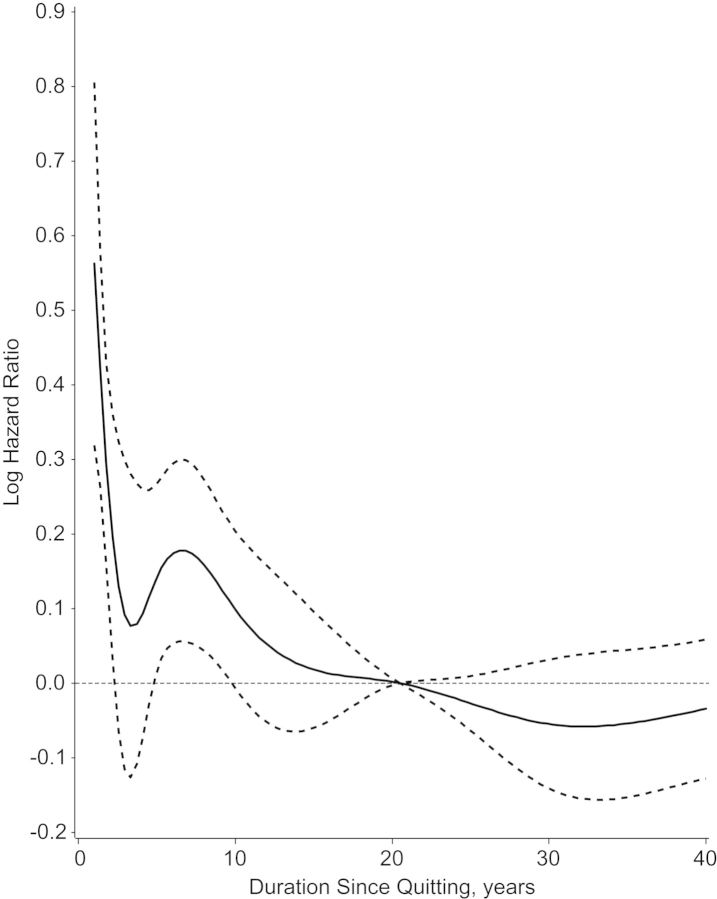
Recent studies reported that smoking cessation leads to higher short-term risk of type 2 diabetes than continuing to smoke. However, the duration of increased diabetes risk following smoking cessation needs further investigation. We followed 135,906 postmenopausal women aged 50-79 years enrolled in the Women's Health Initiative between September 1, 1993, and December 31, 1998, over an average of 11 years to examine the association between smoking cessation and risk of diabetes using Cox proportional hazard multivariable-adjusted regression models. Compared with that for never smokers, the risk for diabetes was significantly elevated in current smokers (hazard ratio = 1.28, 95% confidence interval: 1.20, 1.36) but was even higher in women who quit smoking during the first 3 years of follow-up (hazard ratio = 1.43, 95% confidence interval: 1.26, 1.63). Among former smokers, the risk of diabetes decreased significantly as the time since quitting increased and was equal to that of never smokers following a cessation period of 10 years. In new quitters with low cumulative exposure (<20 pack-years), diabetes risk was not elevated following smoking cessation. In conclusion, the risk of diabetes in former smokers returns to that in never smokers 10 years after quitting, and even more quickly in lighter smokers.
Keywords: risk factors; smoking; smoking cessation; type 2 diabetes.
Figures
References
-
- Willi C, Bodenmann P, Ghali WA, et al. Active smoking and the risk of type 2 diabetes: a systematic review and meta-analysis. JAMA. 2007;298(22):2654–2664. - PubMed
-
- Colditz GA, Willett WC, Rotnitzky A, et al. Weight-gain as a risk factor for clinical diabetes-mellitus in women. Ann Intern Med. 1995;122(7):481–486. - PubMed
-
- Williamson DF, Madans J, Anda RF, et al. Smoking cessation and severity of weight gain in a national cohort. N Engl J Med. 1991;324(11):739–745. - PubMed
-
- Hur NW, Kim HC, Nam CM, et al. Smoking cessation and risk of type 2 diabetes mellitus: Korea Medical Insurance Corporation Study. Eur J Cardiovasc Prev Rehabil. 2007;14(2):244–249. - PubMed
Publication types
MeSH terms
Grants and funding
LinkOut - more resources
Full Text Sources
Other Literature Sources
Medical
