Randomized Controlled Trial
. 2013 Oct;13(5):353-64.
doi: 10.1007/s40256-013-0035-2.

The effectiveness and safety of landiolol hydrochloride, an ultra-short-acting β1-blocker, in postoperative patients with supraventricular tachyarrhythmias: a multicenter, randomized, double-blind, placebo-controlled study

Affiliations
Randomized Controlled Trial

The effectiveness and safety of landiolol hydrochloride, an ultra-short-acting β1-blocker, in postoperative patients with supraventricular tachyarrhythmias: a multicenter, randomized, double-blind, placebo-controlled study

Nobuyuki Taenaka et al. Am J Cardiovasc Drugs. 2013 Oct.

Abstract

Background: Persistent postoperative supraventricular tachyarrhythmias (SVTs) increase cardiac burden and aggravate cardiac hemodynamics. Therefore, for patients in unstable conditions after surgery, prompt and sustained control of heart rate is essential. The importance of β-adrenoceptor antagonists (β-blockers) in controlling such postoperative atrial fibrillation or atrial flutter has been established, and the usefulness of ultra-short-acting β1-blockers with high β1 selectivity has been suggested based on their safety and efficacy under such circumstances.

Objectives: Our objectives were to evaluate the effectiveness and safety of landiolol hydrochloride, an ultra-short-acting β1-selective blocker, in the treatment of postoperative SVT in patients with a high risk of myocardial ischemia, or in patients after highly invasive surgery, in a multicenter, randomized, double-blind, placebo-controlled, group-comparative study.

Methods: A total of 165 patients were randomly allocated to three groups and received LM or MH doses of landiolol hydrochloride or placebo. LM group: dose L (1-min loading dose at a rate of 0.03 mg/kg/min, followed by a 10-min infusion at 0.01 mg/kg/min) followed by dose M (1-min loading at a rate of 0.06 mg/kg/min, followed by a 10-min infusion at 0.02 mg/kg/min); MH group: dose M followed by dose H (1-min loading dose at a rate of 0.125 mg/kg/min, followed by a 10-min infusion at 0.04 mg/kg/min); placebo (PP) group: dose P (1-min loading dose at a rate of 0 mg/kg/min, followed by a 10-min infusion at 0 mg/kg/min) followed by another round of dose P. If the targeted heart-rate reduction was not obtained at the end of the first 10-min infusion, the higher dose was started. The primary endpoint was the percentage of patients who met the heart-rate reduction criteria (≥20 % reduction and <100 beats/min). The safety endpoint was the incidence of adverse events in each of the three groups.

Results: The percentages of patients who met the heart-rate reduction criteria (≥20 % reduction and <100 beats/min) were 0.0, 60.4, and 42.0 % in the PP, LM, and MH groups, respectively. There were significant differences in the LM and MH groups relative to the PP group, but there was no significant difference between the LM and MH groups. No significant difference was observed in the incidence of adverse events among the three groups: 29.6 % in the PP group, 45.5 % in the LM group, and 43.1 % in the MH group.

Conclusion: Landiolol hydrochloride is effective and safe for patients with postoperative SVT.


Figures
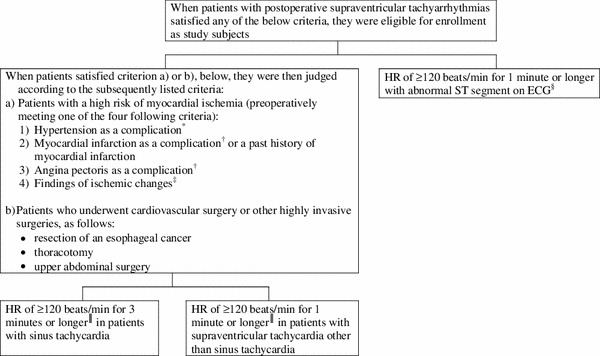
Fig. 1
Fig. 1
Criteria for enrollment of patients in the study. *Patients for whom the therapeutic drug could be confirmed, or patients with SBP of 140 mmHg or higher and DBP of 90 mmHg or higher for ≥2 days, with reference to WHO hypertension criteria. Patients for whom the therapeutic drug could be confirmed. Patients with changes in ST segment of 0.1 mV or more (including a decrease in ST segment by 0.05 mV or more in a Master 2-step test), an abnormal Q wave, negative T wave, U wave, or other abnormal findings related to ischemic changes on the ECG in a resting state or after exercise; or patients with LVH, abnormal wall movement, or a right ventricular/right atrial load on echocardiography in a test performed within 1 month of surgery. §Patients with an abnormal change (≥0.1 mV) in ST segment from the value on ECG at rest and with an ST segment of ≥+0.1 mV or ≤−0.1 mV. Variation in HR immediately before administration is less than 10 % of that recorded 1 or 3 min earlier. DBP diastolic blood pressure, ECG electrocardiogram, HR heart rate, LVH left ventricular hypertrophy, SBP systolic blood pressure
Fig. 2
Fig. 2
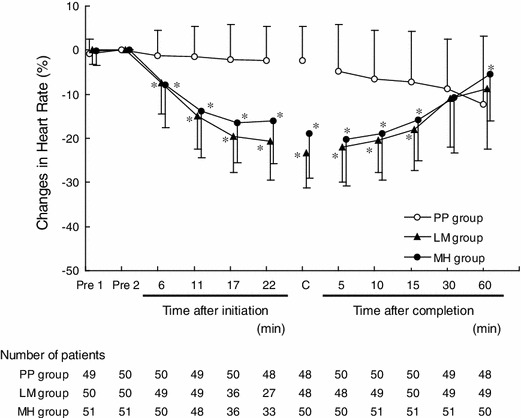
Time course of percentage change in heart rate (mean ± standard deviation). Pre 1 measurement of heart rate 3 min (sinus tachycardia), 1 min (other than sinus tachycardia), or 1 min (tachycardia with abnormal ST segment) before initiation of infusion, Pre 2 measurement of heart rate conducted immediately before initiation of infusion, C sum of the result immediately after completion of infusion plus the results at discontinuation of infusion. Refer to Table 1 for treatment group definitions. *Dunnett test; significance was defined as p < 0.05 (two-tailed)
Fig. 3
Fig. 3
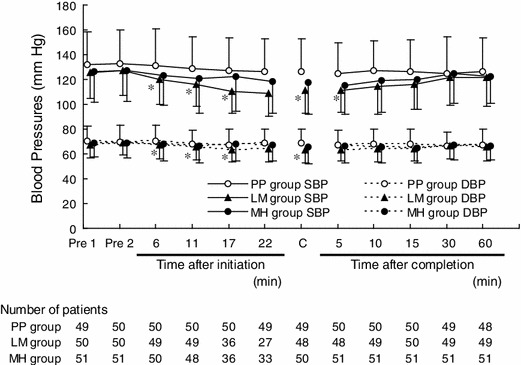
Time course of changes in blood pressure (mean ± standard deviation). Pre 1 measurement of blood pressure 3 min (sinus tachycardia), 1 min (other than sinus tachycardia), or 1 min (tachycardia with abnormal ST segment) before initiation of infusion, Pre 2 measurement of blood pressure conducted immediately before initiation of infusion, C sum of the result immediately after completion of infusion plus the results at discontinuation of infusion, SBP systolic blood pressure, DBP diastolic blood pressure. Refer to Table 1 for treatment group. *Dunnett test; significance was defined as p < 0.05 (two-tailed)

References

    1. Matloff JM, Wolfson S, Gorlin R, Harken DE. Control of postcardiac surgical tachycardias with propranolol. Circulation. 1968;37(4 Suppl):II-133–II-138. doi: 10.1161/01.CIR.37.4S2.II-133. - DOI - PubMed
    1. Balser JR, Martinez EA, Winters BD, Perdue PW, Clarke AW, Huang W, et al. β-Adrenergic blockade accelerates conversion of postoperative supraventricular tachyarrhythmias. Anesthesiology. 1998;89:1052–1059. doi: 10.1097/00000542-199811000-00004. - DOI - PubMed
    1. Gray RJ, Bateman TM, Czer LSC, Conklin CM, Matloff JM. Esmolol: a new ultrashort-acting beta-adrenergic blocking agent for rapid control of heart rate in postoperative supraventricular tachyarrhythmias. J Am Coll Cardiol. 1985;5:1451–1456. doi: 10.1016/S0735-1097(85)80362-4. - DOI - PubMed
    1. Mooss AN, Wurdeman RL, Mohiuddin SM, Reyes AP, Sugimoto JT, Scott W, et al. Esmolol versus diltiazem in the treatment of postoperative atrial fibrillation/atrial flutter after open heart surgery. Am Heart J. 2000;140:176–180. doi: 10.1067/mhj.2000.106917. - DOI - PubMed
    1. Daoud EG. Management of atrial fibrillation in the post-cardiac surgery setting. Cardiol Clin. 2004;22:159–166. doi: 10.1016/S0733-8651(03)00136-X. - DOI - PubMed

Publication types

MeSH terms