


Targeting global conservation funding to limit immediate biodiversity declines
- PMID: 23818619
- PMCID: PMC3718168
- DOI: 10.1073/pnas.1221370110
Targeting global conservation funding to limit immediate biodiversity declines
Abstract
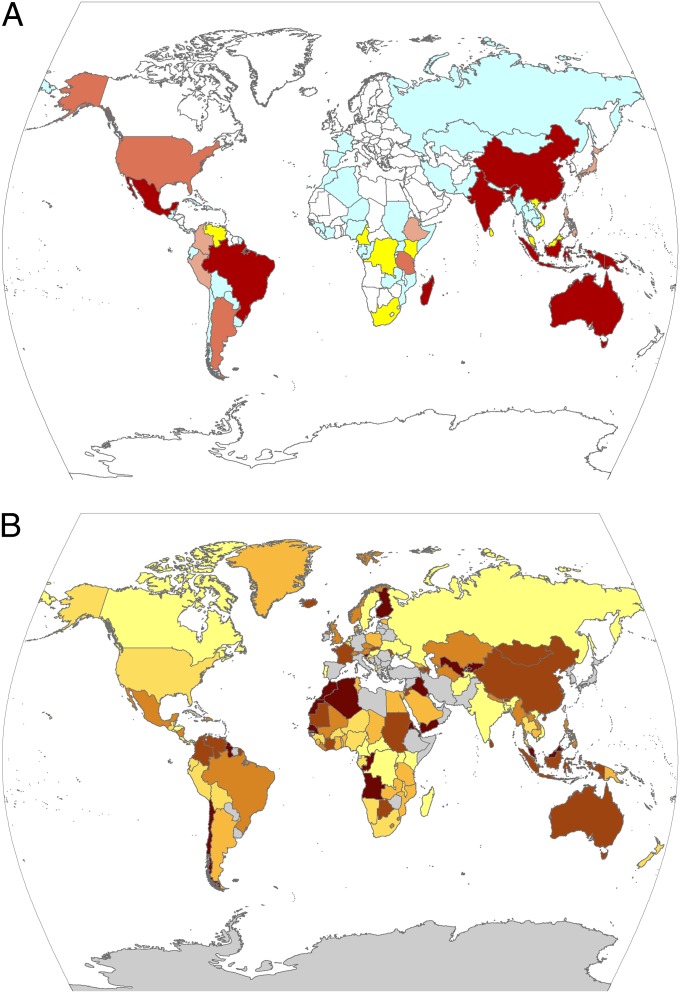
Inadequate funding levels are a major impediment to effective global biodiversity conservation and are likely associated with recent failures to meet United Nations biodiversity targets. Some countries are more severely underfunded than others and therefore represent urgent financial priorities. However, attempts to identify these highly underfunded countries have been hampered for decades by poor and incomplete data on actual spending, coupled with uncertainty and lack of consensus over the relative size of spending gaps. Here, we assemble a global database of annual conservation spending. We then develop a statistical model that explains 86% of variation in conservation expenditures, and use this to identify countries where funding is robustly below expected levels. The 40 most severely underfunded countries contain 32% of all threatened mammalian diversity and include neighbors in some of the world's most biodiversity-rich areas (Sundaland, Wallacea, and Near Oceania). However, very modest increases in international assistance would achieve a large improvement in the relative adequacy of global conservation finance. Our results could therefore be quickly applied to limit immediate biodiversity losses at relatively little cost.
Keywords: CBD; ecological/environmental policy; foreign aid; governance; sustainability.
Conflict of interest statement
The authors declare no conflict of interest.
Figures
References
-
- Butchart SHM, et al. Global biodiversity: Indicators of recent declines. Science. 2010;328(5982):1164–1168. - PubMed
-
- Convention on Biological Diversity. (2009) CBD Country Reports. Available at www.cbd.int/countries. Accessed September 1, 2012.
-
- McCarthy DP, et al. Financial costs of meeting global biodiversity conservation targets: Current spending and unmet needs. Science. 2012;338(6109):946–949. - PubMed
-
- McKinney ML. Effects of national conservation spending and amount of protected area on species threat rates. Conserv Biol. 2002;16(2):539–543.
Publication types
MeSH terms
LinkOut - more resources
Full Text Sources
Other Literature Sources
