


Early achievement and maintenance of stable asthma control using initially higher-dose inhaled corticosteroids as part of combination therapy: an open-label pilot study
- PMID: 23818758
- PMCID: PMC3692346
- DOI: 10.2147/DDDT.S44231
Early achievement and maintenance of stable asthma control using initially higher-dose inhaled corticosteroids as part of combination therapy: an open-label pilot study
Abstract
Background: Uncontrolled asthma is characterized by considerable variability. Well controlled asthma is associated with less unplanned use of health care resources and fewer acute exacerbations. In this study, we attempted to increase inhaled corticosteroid (ICS) doses initially in suboptimally controlled asthmatics, hypothesizing that early achievement of asthma control using this strategy would be associated positively with a higher level of stability.
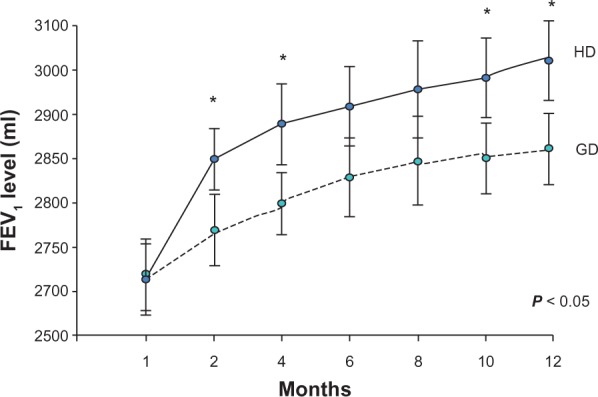
Methods: This was a randomized, open-label, prospective study including patients with uncontrolled asthma who were randomized to receive higher-dose (HD) ICS in combination with a long-acting beta-agonist (LABA) for one month and then shifted to doses suggested in the practice guidelines (GD) or to receive GD therapy alone. Lung function, ie, forced expiratory volume in one second (FEV(1)), peak expiratory flow, Asthma Control Test scores, and frequency of acute exacerbations, was followed up for one year.
Results: Seventy-six patients were treated with the HD strategy and 80 with the GD strategy. The increase in FEV(1) from baseline was greater in the HD group than in the GD group, especially during the first month of treatment (304 ± 49 mL versus 148 ± 39 mL, respectively, P = 0.01). Numbers of patients with completely or well controlled asthma were higher in the HD group than in the GD group (92.1% versus 81.1%, respectively, P = 0.03). Further, there was a significant difference between the groups with regard to frequency of acute exacerbations (9.2% in the HD group versus 21.3% in the GD group, P = 0.02); this effect was more pronounced for patients in the HD group with partially controlled or uncontrolled asthma.
Conclusion: Patients receiving HD therapy achieved asthma control more rapidly and maintained greater stability than those receiving GD therapy. This represents a novel strategy for gaining disease control in patients with uncontrolled asthma.
Keywords: asthma; higher doses; inhaled corticosteroids; treatment.
Figures


References
-
- Global Initiative for Asthma Global Strategy for Asthma Management and Prevention 2011Update. Available from: http://www.ginasthma.org/GINA-Report,-Global-Strategy-for-Asthma-Managem...Accessed May 19, 2013
-
- British Thoracic Society Scottish Inter-collegiate Guideline on Asthma Management Revised May 2011. Available from: http://www.brit-horacic.org.uk/Portals/0/Guidelines/AsthmaGuidelines/qrg...Accessed May 19, 2013
-
- Bousquet J, Clark TJ, Hurd S, et al. GINA guidelines on asthma and beyond. Allergy. 2007;62:102–112. - PubMed
-
- Rabe KF, Adachi M, Lai CK, et al. Worldwide severity and control of asthma in children and adults: the global asthma insights and reality surveys. J Allergy Clin Immunol. 2004;114:40–47. - PubMed
-
- Sekerel BE, Gemicioglu B, Soriano JB. Asthma insights and reality in Turkey (AIRET) study. Respir Med. 2006;100:1850–1854. - PubMed
Publication types
MeSH terms
Substances
LinkOut - more resources
Full Text Sources
Other Literature Sources
Medical
